Wake Forest calorie cuts slowed aging markers across 829 older adults in a pooled read of seven randomized diet trials — and weight loss explained only about half of that blood-index win, GeroScience reported on 12 September 2026.
The Wake Forest University School of Medicine team (Guida, Kritchevsky, Miller and colleagues) scored six aging-linked blood markers into one composite index. People randomized to caloric restriction (CR) improved that index versus no-CR controls. After the analysts adjusted for how much weight people lost, a statistically clear CR signal remained. That is the progress peg: a large, trial-grade aging-biomarker readout in humans, not another mouse lifespan claim.
Why it matters
Longevity headlines usually split into two buckets: animal lifespan extensions, or small human biomarker blips that never clear a phone-readable number. This paper sits in the rarer third lane — human randomized trials, pooled to 829 participants, with a pre-specified style of aging blood panel and a mediation answer strangers can understand: cutting calories moved the aging index, and only 48.5% of that move ran through the kilograms lost.
That matters because older adults are often told the only point of eating less is the scale. Wake Forest’s mediation math says the scale is a big piece — then stops short of “all of it.” Inflammation and metabolic markers still moved with CR assignment even after weight change was in the model. For anyone tracking geroscience trials (metformin TAME-style endpoints, GLP-1 aging add-ons, NAD boosters), a responsive composite blood index is the kind of short-cycle signal sponsors want when mortality endpoints take decades.
It also lands in a demand pocket The Good Signal already sees: longevity with a concrete count. 829 adults and 48.5% mediation are numbers a phone fold can carry without a methods appendix.
Key numbers
| Item | Figure | Source note |
|---|---|---|
| Participants pooled | 829 | Seven randomized CR trials |
| Assigned to CR / no-CR | 494 (59.6%) / 335 (40.4%) | Binary CR exposure in pooled models |
| Mean age | 67.5 years | Mostly older adults with overweight/obesity |
| Sex / race mix | 67.4% female; 82.0% white | Limits generalizability (authors note) |
| CR vs no-CR weight change | −7.9 kg vs −1.2 kg | Overall means |
| CR vs no-CR BMI change | −2.81 vs −0.41 kg/m² | Overall means |
| Between-group weight-loss difference | 6.7 kg (95% CI 5.9–7.5) | CR assignment effect on weight |
| Composite index effect (CR vs no-CR) | −2.2 quintile-sum points (95% CI −2.9 to −1.5) | Lower = improved aging-marker profile |
| Same effect after weight adjustment | −1.2 (95% CI −2.0 to −0.3) | Residual CR signal |
| Share of CR effect via weight loss | 48.5% (95% CI 22.6–82.2%) | Mediation / indirect effect |
| Follow-up blood draw used | ~6-month visit vs baseline | Change scores |
| Biomarkers in the index | 6 — CRP, IL-6, cystatin C, insulin, GDF-15, TNF-R1 | TAME-informed panel |
| Publication | 12 Sep 2026, GeroScience | DOI 10.1007/s11357-026-02529-9; CC BY |
How the 829-person signal was built
Wake Forest’s Integrated Aging Studies Databank and Repository (IASDR) holds data and biospecimens from more than 17 completed CR-style trials in older adults. For this paper the team pooled individual-level data from seven randomized trials that let them compare CR versus no-CR and track weight change against the same six-marker index.
Named trial families in the methods include CLIP, EMPOWER, HALLO-P, IDEA, I’M FIT / IM-FIT, INFINITE, and HOPE — diet and lifestyle programs that typically targeted roughly 7–15% weight loss over months, often with counseling and sometimes exercise arms. Inclusion ages clustered in the 55–86 range; baseline BMI study means sat roughly 30–36 kg/m². This is not a lean-young CALERIE clone; it is heavier, older adults already sitting in cardiometabolic risk.
The aging readout is a quintile sum score: for each person, change in each of the six markers is ranked into quintiles, then those ranks are added. That design, drawn from the TAME biomarkers workgroup logic and an earlier Wake Forest heart-failure CR trial, is meant to dampen noisy single-marker swings. CRP and IL-6 needed log transforms in the models; plate/batch effects were modeled as random effects after careful plate balancing.
Three nested models tell the story strangers care about:
- CR alone predicted a −2.2 point improvement on the composite index versus no-CR.
- Weight loss alone also tracked with better scores (about 0.22 index points per kilogram lost in the univariate framing the abstract reports).
- CR + weight together left CR at −1.2 and weight at 0.16 — each still associated with the index, neither swallowing the other.
Bootstrap mediation put the indirect (weight-mediated) share of the CR effect at 48.5%. Put plainly: if you only credit the scale, you miss roughly half the blood-index story these trials can see.
What this is not
- Not proof that calorie cutting adds years of human life. The endpoint is a composite blood index, not mortality, disability-free survival, or an epigenetic “years younger” clock validated as a surrogate.
- Not a new diet drug approval. No FDA action. The interventions were trial diet counseling / structured CR arms already run in Wake Forest’s network.
- Not a claim that exercise does nothing. Several source trials mixed exercise modalities; a sensitivity check in CLIP, EMPOWER, and IDEA that adjusted for exercise type did not overturn the main CR finding, but this paper is built to test CR and weight, not to rank gyms.
- Not a diverse national sample. Authors flag a single research network, 82% white participants, and the usual limits of pooling heterogeneous trials. Hard clinical endpoints still need separate validation.
- Not “starvation equals longevity.” CR here means energy below ad libitum without malnutrition, with trial targets in the high-single-digit to mid-teens percent weight-loss band — not extreme fasting challenges.
What to watch
- Whether independent cohorts reproduce the same six-marker index response to CR, GLP-1 drugs, or metformin-style geroprotectors.
- Links from this index to mortality, disability, and frailty — the authors explicitly call that out as next work.
- Head-to-heads against epigenetic clocks (GrimAge, DunedinPACE) so readers can see whether blood-protein composites and methylation clocks move together.
- Larger pragmatic trials that treat the index as an exploratory aging endpoint the way disease trials already bury FVC or CDR-SB.
Sources
Primary (fetched):
- Cassidy A. Guida, Fang-Chi Hsu, Rebecca Neiberg, Charles Semelka, Haiying Chen, Philip Kramer, Denise K. Houston, Barbara Nicklas, Stephen B. Kritchevsky, Michael E. Miller. “Impact of caloric restriction on biological aging: insights from a composite biomarker index in older adults.” GeroScience, published 12 September 2026. DOI: https://doi.org/10.1007/s11357-026-02529-9 (Open access, CC BY). PubMed PMID 42730911.
Context:
- Justice et al. TAME biomarkers framework (cited in-paper) for selecting CRP, IL-6, cystatin C, insulin, GDF-15, TNF-R1 into a composite index previously responsive to CR in older adults with HFpEF.
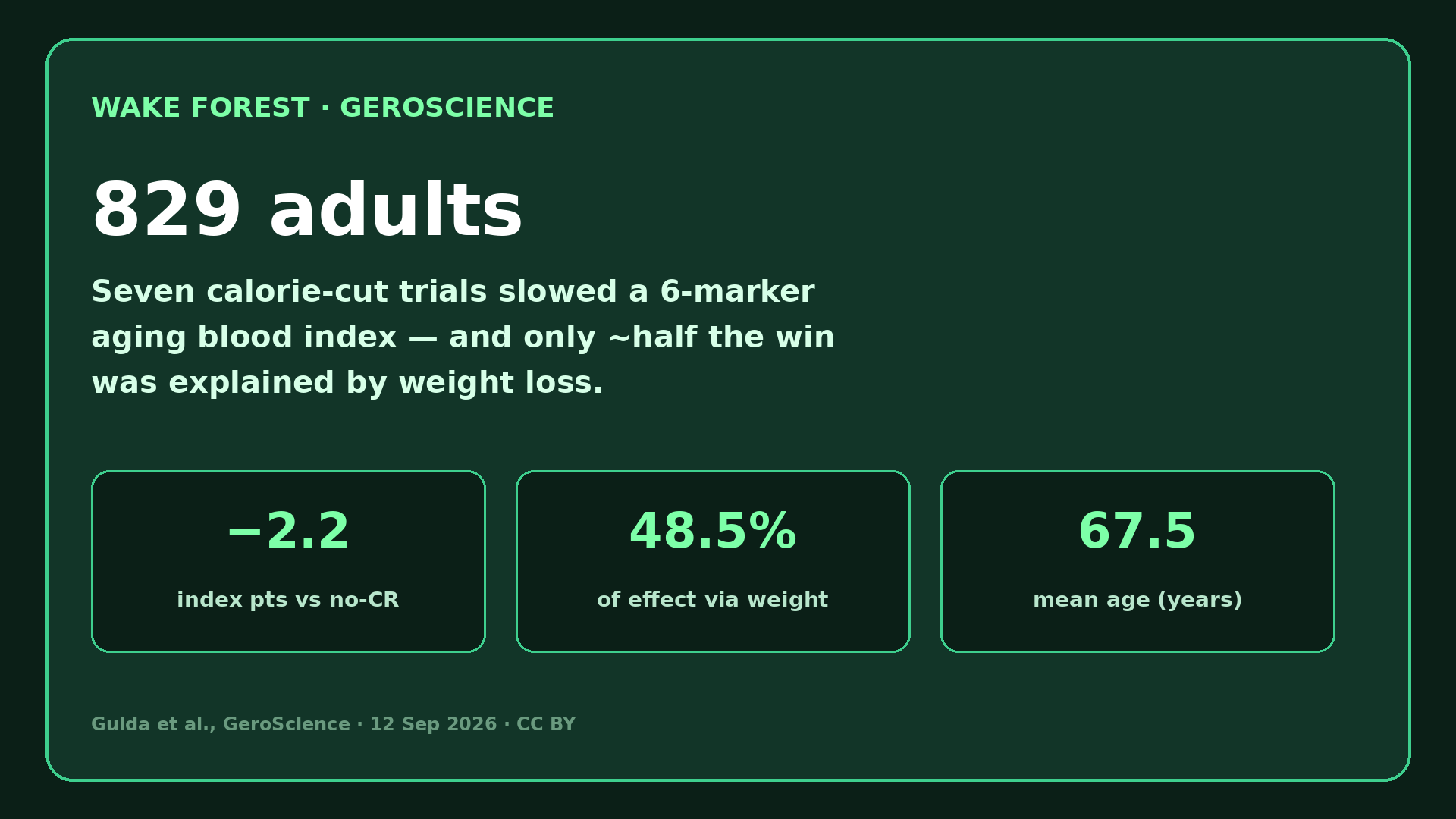
Cover: Original The Good Signal data card summarizing Guida et al. key figures (829; −2.2; 48.5%; 67.5). Not a journal figure.