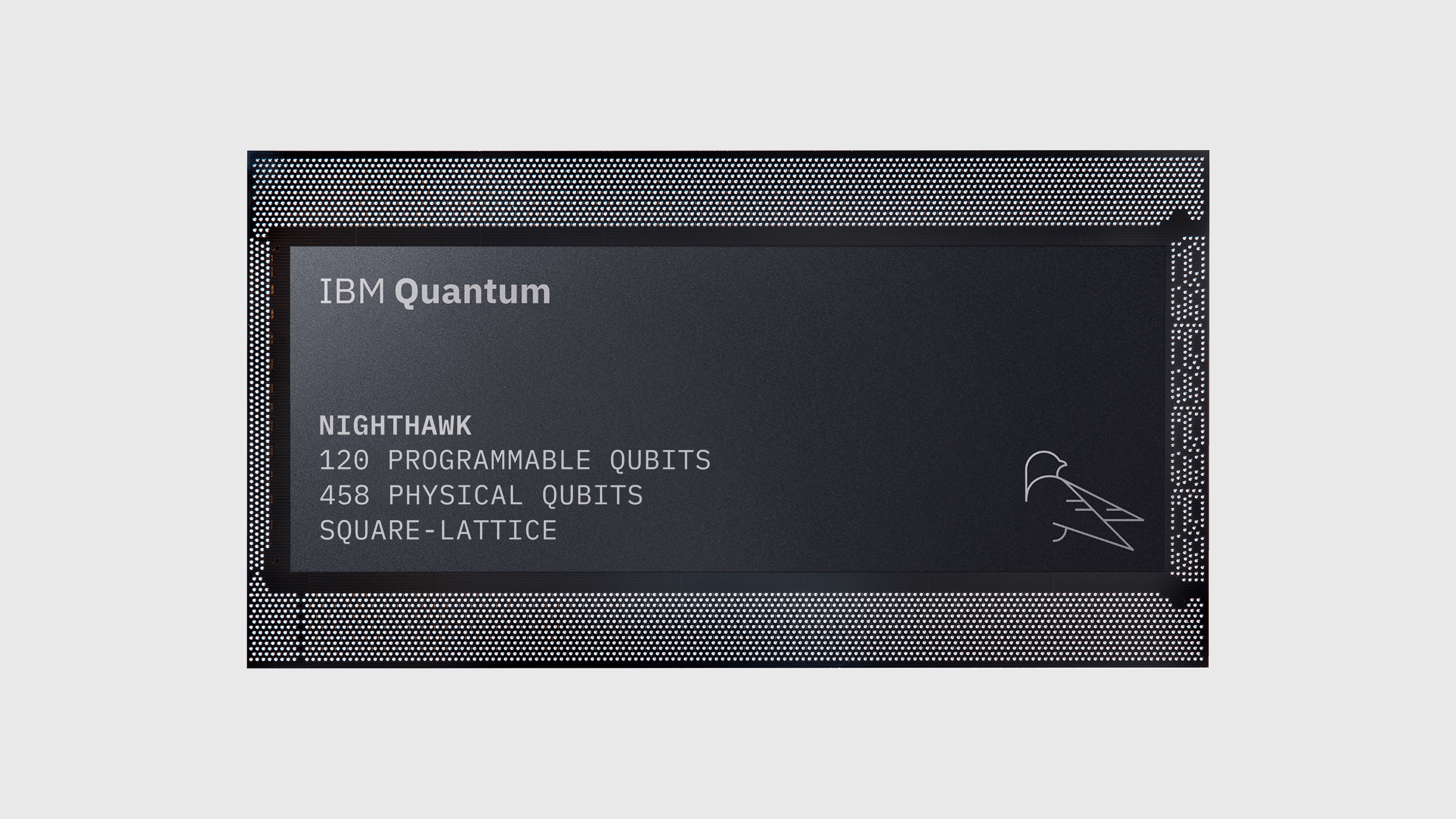
IBM’s Nighthawk r2 quantum processor is now live on the IBM Quantum Platform and runs more than 100,000 circuits a second — about 25× the throughput of today’s Heron fleet. The 120-qubit chip hits a 2026 IBM Quantum Roadmap target early: accurate results on circuits with 7,500+ gates. This is a speed-and-reset upgrade on superconducting hardware already in the cloud, not a finished fault-tolerant machine and not a claim that encryption is broken.
Why it matters
Quantum research is starved for shots. Almost every useful experiment — estimating an observable, sampling an advantage-candidate circuit, training an error-correction protocol — means running the same family of circuits thousands or millions of times and averaging the noise away. For years, a big slice of that calendar time was dead air: after each shot, the chip waited hundreds of microseconds for qubits to settle back to the ground state.
When that idle tax falls, the same cloud allocation buys more science. Material-simulation spectra that used to take longer to gather can land in about a minute. Error-correction labs get more mid-circuit resets per hour. Teams chasing quantum advantage get tighter error bars without begging for more qubits. Throughput is not “smarter qubits.” It is more usable computation per second on the machines researchers already book — and that is how near-term quantum work actually compounds.
Key numbers
| Quantity | Value (IBM Quantum blog, 31 Aug 2026) |
|---|---|
| Peg | Nighthawk r2 live on IBM Quantum Platform (ibm_phoenix) |
| Programmable qubits | 120 |
| Peak circuit throughput | >100,000 circuits per second |
| Heron fleet (compare) | ~4,000 circuits per second |
| Throughput gain vs Heron | up to 25× |
| Idle between shots | as low as 1 microsecond (was hundreds of µs) |
| Reset T1 when active | ~25 nanoseconds (median ~200 µs when off) |
| Initialization-error cut | around 25× |
| Roadmap circuit depth | accurate observables on 7,500+ gates |
| Physical elements on chip | 458 (120 qubits + 218 couplers + 120 resets) |
| Neutron-scattering demo | 12× speedup; spectra in ~60 seconds |
| Early advantage-candidate runs | up to ~10× faster with no accuracy loss (IBM) |
Those figures are from IBM’s own Nighthawk r2 engineering post (Haas, McKay, Davis). The phone-readable headline remains 100,000 circuits a second; the table is what pays that click.
How they killed the idle tax
Every circuit starts with qubits in a known state and ends with a measurement. Between shots, those qubits have to return to ground. On Heron and earlier chips, IBM mostly used conditional reset: measure, and if the qubit is in |1⟩, flip it with a π-pulse. Measurement is imperfect, and leaked states outside the computational subspace do not flip cleanly, so the system still sat idle for hundreds of microseconds to finish the job.
Nighthawk r2 swaps that for a dissipative reset gadget. Each programmable qubit connects through a high-dynamic-range tunable coupler to a cold environment. Turn the coupler on, and the qubit’s effective T1 — how long it holds energy — collapses from a median of about 200 microseconds to roughly 25 nanoseconds. The chip can reclaim a usable ground state on demand, cut inter-shot idle to as little as 1 microsecond, and leave neighbors alone while it does it.
That neighbor-safe behavior matters on Nighthawk’s square lattice, where most qubits touch four neighbors instead of two or three. Reset is available between circuits and mid-circuit, which is the plumbing quantum error correction and other dynamic-circuit protocols actually need: measure an auxiliary qubit, reset it, reuse it, without parking the whole chip.
The cost shows up as hardware you never program directly. Beside the 120 user qubits sit 218 couplers and 120 dedicated reset elements — 458 physical quantum elements in production. IBM calls it the most complex quantum processor it has shipped.
What early runs already show
Speed without fidelity is a stopwatch demo. IBM says Nighthawk r2 keeps Heron-class gate fidelity while cutting initialization error by about 25×, because actively cooled ground states are cleaner starting points.
On the 2026 roadmap checklist, the chip has already shown accurate observable estimation with Probabilistic Error Amplification on circuits containing more than 7,500 gates — a milestone IBM had aimed at year-end, now claimed early.
Researchers also reran the doped Clifford sampling experiments from the UChicago–IBM quantum-advantage line of work on Nighthawk r2. Those circuits are designed to outrun leading classical simulation methods while still letting you verify that the quantum machine did the job it claimed. IBM expects the denser connectivity (versus Heron) to widen that class of demos.
On applications, neutron-scattering simulations reported earlier this year ran about 12× faster on the new throughput, producing spectra that can be compared with lab data in roughly 60 seconds. Separately, IBM says early tests on advantage-candidate circuits already point to as much as 10× faster runtimes with no loss in accuracy.
What this is not
This is not a fault-tolerant product. Nighthawk r2 is a cloud-accessible superconducting processor built to push scale, quality, and — especially — speed on today’s noisy hardware. Logical qubits, full error-corrected algorithms, and IBM’s longer-range Starling / Blue Jay plans remain roadmap items, not this chip’s shipping claim.
It is also not “100,000 problems solved per second.” Circuit throughput counts how many prepared-and-measured executions the system can fire. Useful science still needs the right circuit family, enough shots for statistics, and classical post-processing. A 25× Heron speedup on shots is real; it is not a free pass past error rates.
Do not confuse this release with encryption-break headlines from other vendors’ resource estimates. IBM’s post is about reset hardware, roadmap depth, and cloud access — not Shor’s algorithm on Bitcoin curves.
Finally, the 7,500-gate milestone is accurate observable estimation under IBM’s PEA protocol, not a claim that every 7,500-gate algorithm now runs perfectly on the first try.
What to watch
Three checks will show whether Nighthawk r2 becomes daily infrastructure or a launch-week spike.
- Independent throughput. Outside users on
ibm_phoenixshould reproduce circuit-per-second gains under Open / Flex / Premium allocations, not only IBM’s internal max. - Quality under load. Watch two-qubit error and initialization fidelity when the chip is driven near the advertised 100 kHz regime — speed that softens fidelity is a false economy.
- Dynamic-circuit / QEC uptake. Mid-circuit reset only matters if error-correction and hybrid workflows actually book the machine for space-time checks and auxiliary reuse.
For a progress scoreboard that fits a phone screen, keep the pair IBM actually shipped: more than 100,000 circuits a second on a live 120-qubit cloud chip, and a 7,500-gate observable milestone cleared ahead of the 2026 plan. Everything else — fault tolerance, crypto, “quantum supremacy 2.0” slogans — has to wait for the experiments this throughput was built to run faster.
Sources
- IBM Quantum blog, 31 August 2026: IBM Quantum Nighthawk r2—more circuits, faster (Haas, McKay, Davis; primary numbers)
- Quantum Computing Report, 2 September 2026: IBM Releases Nighthawk r2 QPU… (deployment as
ibm_phoenix; secondary roundup) - IBM Quantum Platform: systems list (cloud access)