Caltech and the University of Washington’s InQubator for Quantum Simulation (IQuS) report in Nature Physics (11 September 2026) evidence that a digital quantum processor can simulate a collision that creates a new, heavier particle — the hallmark of inelastic scattering, where kinetic energy turns into matter.
The experiment ran on 104 qubits of IBM’s ibm_marrakesh machine and used up to 5,589 two-qubit gates to follow the system past the crash. The team identifies the heavier product from the skewness of the measured energy density after two wavepackets collide in one-dimensional Ising field theory.
This is a controlled lattice model on a quantum chip, not a claim that IBM has rebuilt the Large Hadron Collider in a fridge. The progress signal is that post-collision dynamics — long a pain point for quantum field-theory simulation — are now visible enough to show an inelastic channel.
Why it matters
High-energy collisions are how nature converts energy into particles. Classical computers struggle with the real-time quantum dynamics of strongly interacting fields once the Hilbert space explodes. Quantum processors are a natural fit in principle; in practice, preparing the right incoming particles and surviving enough gates to see what comes out has been the bottleneck.
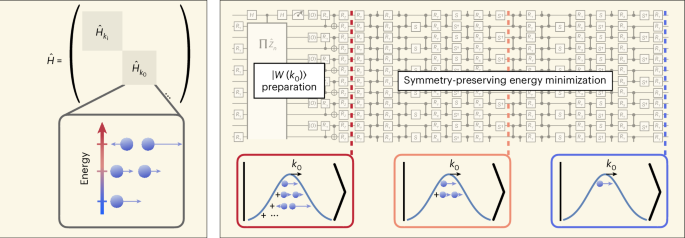
Farrell, Zemlevskiy, Illa and Preskill attack both ends. They introduce a wavepacket-preparation algorithm that extends W-state protocols with mid-circuit measurement and feedforward so circuit depth does not grow with the spatial size of the packet — a claimed superexponential improvement over older methods. Then they collide two lightest particles above the inelastic threshold and watch for a heavy partner.
If that workflow keeps working on larger lattices and richer theories, near-term quantum machines become tools for nuclear and high-energy theorists, not only for random-circuit benchmarks. The paper itself frames scattering simulations as a leading candidate for useful quantum advantage.
Key numbers
| Quantity | Value (Nature Physics 11 Sep 2026 / arXiv:2505.03111) |
|---|---|
| Peg | 11 September 2026 Nature Physics |
| Device | IBM ibm_marrakesh, 104 qubits |
| Two-qubit gates (main run) | up to 5,589 |
| Time evolution | up to 45 second-order Trotter steps |
| Theory | 1D Ising field theory |
| Signal | energy-density skewness → heavy |2⟩ particle |
| Light / heavy masses (lattice units) | m₁ ≈ 1.59, heavier |2⟩ partner above threshold |
| Collision time (simulation) | wavepackets collide near t ≈ 8.25; outbound structure by t ≈ 16.5–24.75 |
| Algorithm claim | wavepacket prep depth independent of packet size / spatial dimension |
| Related (IQuS note) | error-mitigated circuits cited up to 6,412 two-qubit gates |
| Institutions | Caltech IQIM; UW IQuS; AWS Center for Quantum Computing (Preskill affiliation) |
How they did it
The incoming state is two localized wavepackets, each carrying the lightest particle of the theory. Older prep methods made circuit depth grow badly with packet width. The new method builds on efficient W-state creation: distribute a single excitation across many qubits with mid-circuit measurement and conditional follow-ups so depth stays flat as the support grows.
They demonstrate the prep idea not only for 1D Ising but also for scalar field theory, the Schwinger model, and two-dimensional Ising field theory — a portfolio that matters because the same bottleneck shows up across lattice QFTs.
On hardware, the team lays out L = 104 qubits on ibm_marrakesh, evolves with second-order Trotterization (they discuss step sizes such as δt = 0.55 and finer grids for figures), and measures the vacuum-subtracted energy density along the chain. Below the inelastic threshold, outbound bumps stay roughly symmetric. Above threshold, the 11 → 12 channel — two light particles in, one light and one heavy out — skews the energy density. That skewness is the published evidence.
Noise still wins eventually: cumulative error made simulations past t ≈ 24.75 impossible on this device. Matrix-product-state (MPS) classical comparisons track the quantum energy density while the run remains trustworthy. Energy-conservation-based mitigation is part of how they extract a clean signal from deep circuits.
What this is not
- Not an LHC measurement. No protons, no detectors in a tunnel — a 1D lattice field theory on superconducting qubits.
- Not fault-tolerant quantum computing. Physical qubits, Trotterized evolution, and heavy error mitigation; the paper is explicit about noise limits.
- Not a claim that every collision channel is resolved. Elastic and inelastic amplitudes sit in superposition; the observable is asymmetry/skewness of energy density, not a full particle-physics event display.
- Not Google-vs-IBM supremacy theater. The device is IBM’s; the science question is QFT dynamics.
What to watch
- Richer theories on similar depth — Schwinger or 2D Ising scattering with the same constant-depth prep.
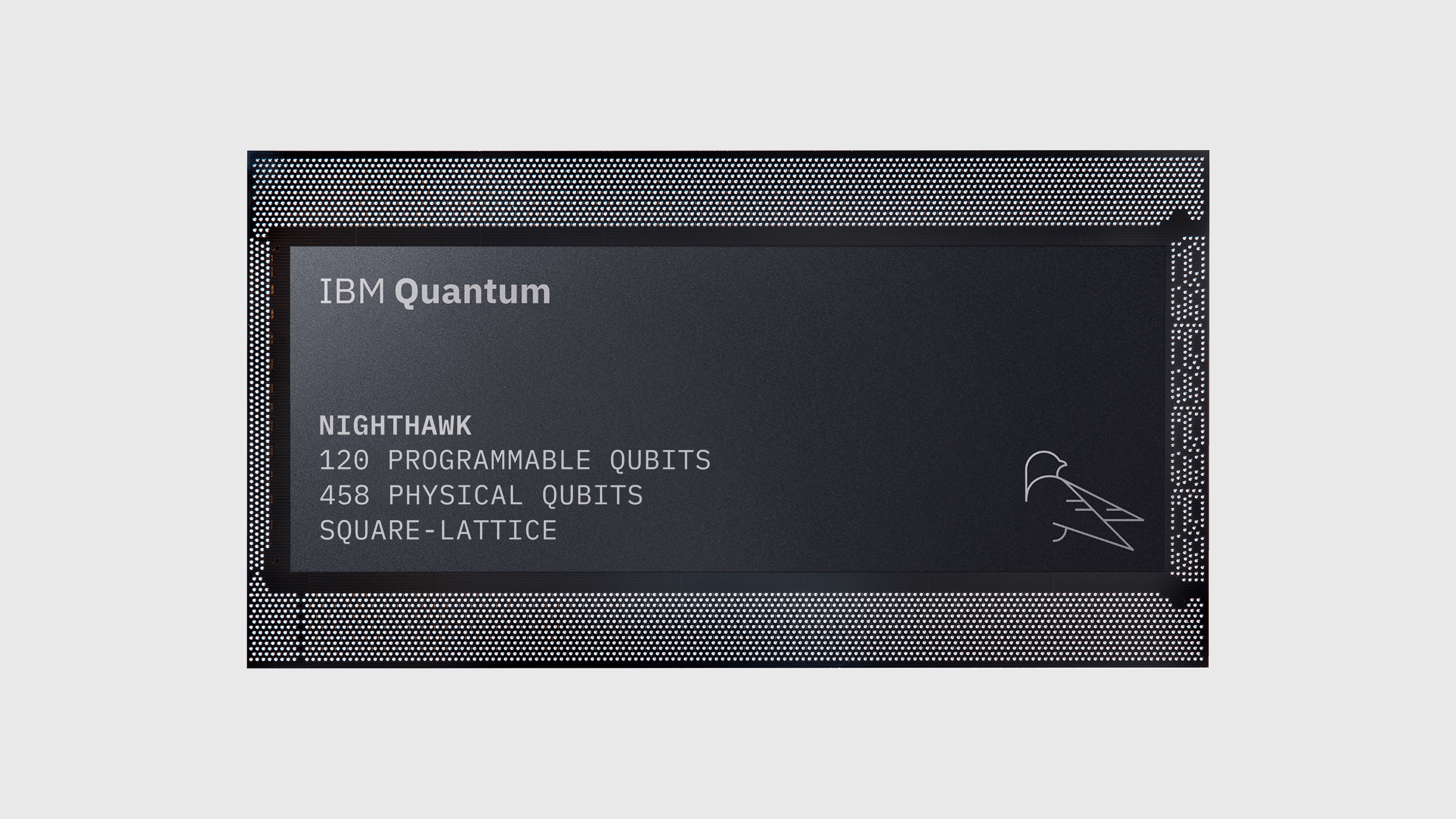
- Larger lattices / lower noise — whether Heron/Nighthawk-class throughput or better coherence pushes past t ≈ 25 in lattice units.
- Quantitative cross sections — moving from “evidence of inelasticity” to extracted production rates that theorists can compare.
- Independent reproductions on other superconducting or trapped-ion platforms.
The progress signal is a 104-qubit, multi-thousand-gate digital simulation that shows a crash producing a heavier particle in a textbook QFT process. The hedge stays in the lede: model theory on a noisy chip, not a collider discovery — and still one of the clearest near-term uses of quantum hardware for fundamental physics.
Why inelastic scattering is the hard test
Elastic scattering is the boring (but useful) case: the same particles leave that entered, just redirected. Inelastic scattering is where the Hilbert space gets interesting — new particle content appears. In the Ising field theory used here, the lowest inelastic channel is schematically 11 → 12: two light particles in, one light and one heavy out. Because the hardware evolves a quantum superposition, elastic and inelastic outcomes coexist; the experimental signature is not a single track in a bubble chamber but a skew in how energy is distributed along the qubit chain after the crash.
That is why the authors spend so much space on skewness γ derived from the third moment of the energy density in outbound “bumps.” Below threshold, the bumps stay comparatively symmetric. Above threshold, and in agreement with MPS calculations at early post-collision times, the quantum data go right-skewed (γ > 0) as the heavy partner forms. It is an indirect detector — and, on noisy hardware, often the only detector you can afford.
Preskill’s group and IQuS have been arguing for years that QFT dynamics are among the most credible near-term scientific uses of quantum processors. This paper is a concrete data point: 104 qubits, thousands of two-qubit gates, a physics observable that classical tensor networks can still cross-check, and a prep algorithm meant to scale when the lattice grows.
Sources
- Farrell, R. C., Zemlevskiy, N. A., Illa, M. & Preskill, J., “Digital quantum simulations of scattering in quantum field theories using W states,” Nature Physics, published 11 September 2026. https://www.nature.com/articles/s41567-026-03436-8
- Same work on arXiv: https://arxiv.org/abs/2505.03111 (arXiv:2505.03111)
- IQuS publication note: https://iqus.uw.edu/publication/quantum-simulations-of-particle-collisions-in-quantum-field-theories-using-w-states/