What happened
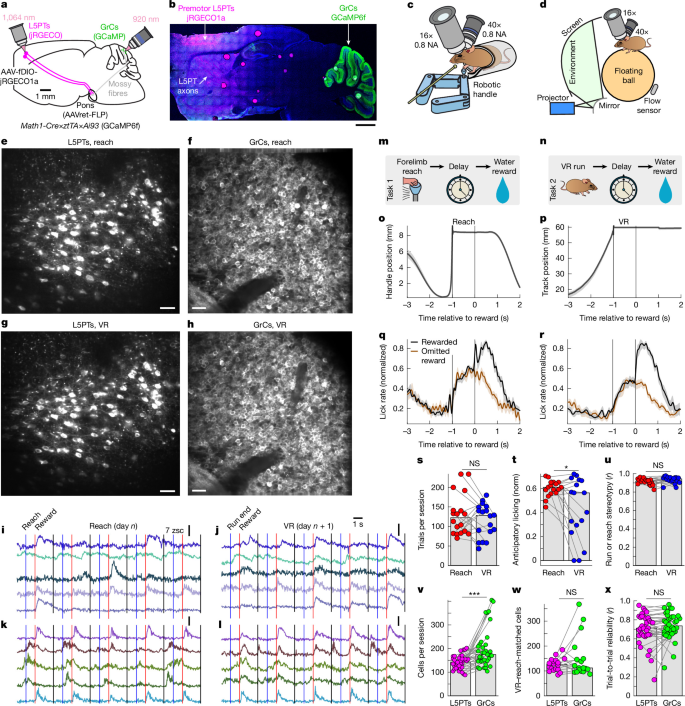
On 26 August 2026, Nature published work from Martha G. Garcia-Garcia, Mark J. Wagner and colleagues at the NIH National Institute of Neurological Disorders and Stroke (with co-authors at the University of Oxford) showing how mouse brains run two related motor skills without mixing them up.
The team simultaneously imaged two nodes of the cortico-cerebellar pathway — premotor layer-5 pyramidal-tract neurons (L5PT) and cerebellar granule cells (GrCs) — while mice learned two tasks that share a timing structure: a reach and a virtual-reality run. Across 18 matched cross-task session pairs from 9 mice, cortical patterns generalized from one skill to the other. Granule-cell patterns did not scramble at random. They rotated apart as coherent low-dimensional trajectories, separating the contexts while keeping each skill’s internal geometry.
The numbers
From the paper’s main and extended analyses (same 18 cross-task pairs unless noted):
| Measure | Premotor L5PT | Cerebellar granule cells |
|---|---|---|
| Cross-task single-cell correlation | r ≈ 0.58 | r ≈ 0.23 |
| Cross-task trajectory rotation (median) | ~19° | ~54° |
| Example session rotations | ~17–19° | ~73° and ~124° in two mice |
| Excess GrC decorrelation vs predictive licking | — | Spearman ρ ≈ 0.60 |
Optogenetic silencing of granule cells during the delay period (4 mice) abolished anticipatory licking in both tasks (laser off vs on: several comparisons p < 10⁻⁶). Effective dimensionality was lower in GrCs than L5PT on single-trial data — the opposite of a classic high-rank expansion story.
What the paper is arguing
Textbook cerebellar theory often casts granule cells as an expansion layer that throws cortical patterns into a high-dimensional space so similar inputs can be told apart. Here, GrCs stayed low-rank within each task. Separation came from a geometric trick: an affine reorientation that swings one trajectory away from the other while preserving the cortical motif inside each. Expert mice showed the strongest cross-task divergence. The division of labor the authors propose: cortex supplies reusable dynamic primitives; cerebellum reconfigures them for context-specific output.
Why it matters
Anyone who has learned two similar piano pieces, two sports swings, or two login habits knows the failure mode: practice on one bleeds into the other. This study puts a measurable rotation angle on how a mammalian cerebellum can keep those maps apart without discarding the shared structure that makes transfer useful. It is a basic-science result with a named lab, a VoR date, and numbers a stranger can hold — not a clinical device.
What this is not
- Not a human trial. Mice only.
- Not a brain-computer interface or a therapy.
- Not proof that granule cells never expand dimensionality in other tasks — only that in this dual-skill design they separated contexts by rotation, not by high-rank expansion.
- Funding note: NIH intramural NINDS (ZIA NS009434 to Wagner); Garcia-Garcia held an NINDS Competitive Fellowship. U.S. government work.
What to watch next
- Whether the same rotation motif appears in other dual-skill pairs and in primates.
- Closed-loop tests that force or block trajectory reorientation and measure learning interference.
- Links from Dryad (10.5061/dryad.9p8cz8x0p) and Zenodo code (10.5281/zenodo.21341571) as other labs try to replicate the geometry.
Sources
- Garcia-Garcia, M.G., Wójcik, M.J., Thota, S. et al. Granule cells reorient cortical trajectories to separate contexts. Nature (2026). https://doi.org/10.1038/s41586-026-10946-1 (Published / VoR 26 Aug 2026)