What happened
A Tokyo coding theorist just published a quantum error-correcting code that aims at classical LDPC performance — with a hardware-friendly rate.
On 9 September 2026, the journal Quantum published Kenta Kasai’s paper “Breaking the Orthogonality Barrier in Quantum LDPC Codes” (DOI 10.22331/q-2026-09-09-2205). An Institute of Science Tokyo release the same day highlighted a concrete code written [[9216, 4612, d]] with d ≤ 48: it protects 4,612 logical qubits using 9,216 physical qubits — roughly one logical qubit for every two physical qubits.
With belief-propagation decoding plus light post-processing, simulations reached a frame error rate of 10⁻⁸ at 4% depolarizing noise — about one failure in 100 million trials. That is a numerical experiment on a designed code, not a demo on a named quantum processor.
The hedge that belongs in the lede, not the headline: a classical density-evolution benchmark near p ≈ 0.057 is a comparison point for the waterfall shape — not a measured threshold of Kasai’s quantum code on hardware.
Why it matters
Fault-tolerant quantum computing dies on overhead. Surface-code style layouts often demand many physical qubits per logical qubit. If a family of quantum LDPC codes can keep a high encoding rate and a large distance and a decoding waterfall, the qubit bill for useful algorithms shrinks.
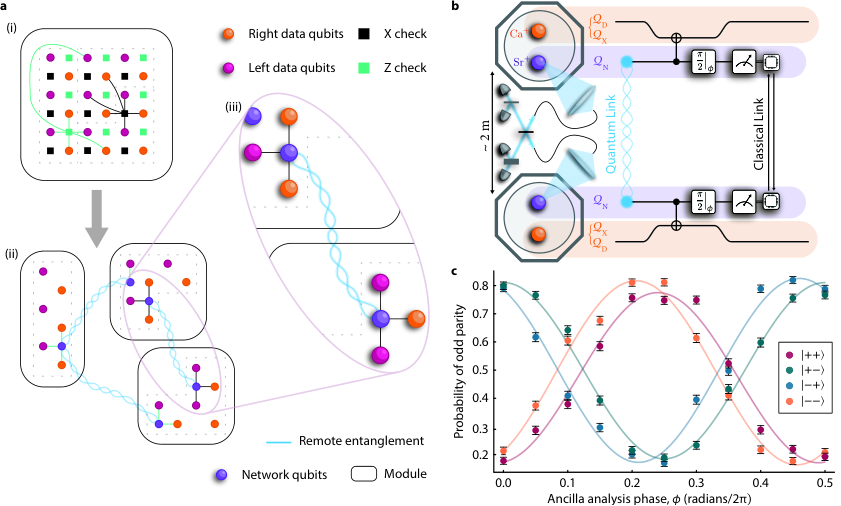
Classical LDPC design already knows how to chase distance and thresholds by setting check degrees, keeping randomness, and killing short loops. Quantum codes add an orthogonality constraint between X- and Z-type checks. Enforce that constraint everywhere and you often reintroduce short cycles and weak structures. Kasai’s move is to apply orthogonality only to the active rows used for correction, while latent parent rows keep classical design freedom via affine permutation matrices.
Independent groups already treated the preprint as infrastructure: Harvard, MIT, and QuEra adapted the ideas for reconfigurable neutral-atom machines under the name “Kasai codes,” and later constructions (Cornucopia, GALA) cite the same design line. Today’s journal version locks the claim in the peer-reviewed record.
The numbers
| Quantity | Value |
|---|---|
| Code parameters | [[9216, 4612, d]], d ≤ 48 |
| Logical qubits | 4,612 |
| Physical qubits | 9,216 |
| Approx. rate | ~1 logical / 2 physical |
| Regularity / girth | (3,12)-regular, girth 8 |
| Simulated FER | 10⁻⁸ at 4% depolarizing noise (with post-processing) |
| Classical BP comparison point | p ≈ 0.05702 (not the quantum hardware threshold) |
| Journal / date | Quantum, 9 Sep 2026 |
Kasai reports that weight-48 logical operators can be built explicitly, and that X- and Z-type distances tied to the latent structure are both exactly 48. Searches and low-error simulations found no lower-weight logical errors; a fully proven global lower bound on d remains open, which is why the paper and press materials say “strong evidence” of distance near 48 rather than a finished theorem.
How the design works
Selective orthogonality is the punchline. Quantum mechanics still constrains the checks that actually run during error correction, but the complementary latent structure can keep the randomness and degree choices that make classical LDPC codes decode cleanly. Eliminating 4-cycles and 6-cycles also reduces trapping sets that stall belief-propagation.
“The quantum constraint is essential, but it does not have to govern every part of the design,” Kasai said in the Science Tokyo / EurekAlert release. The significance, he argued, is not only one high-rate example — it is that threshold, distance, short loops, and hard-to-decode patterns can sit in one classical-style design loop again.
What this is not
- Not a working fault-tolerant computer. No trapped-ion, superconducting, or atom-array chip is claimed here.
- Not a measured device threshold. The 4% noise figure is a simulation under a depolarizing model with a chosen decoder.
- Not “the” classical threshold transferred unchanged. The p ≈ 0.057 line is a classical ensemble benchmark for waterfall comparison.
- Not the end of hardware engineering. Neutral-atom rearrangements, wiring, and gate noise still decide whether Kasai-like codes win on a given machine.
What to watch
Watch for hardware papers that implement Kasai-style or Cornucopia/GALA layouts with real atom motion or superconducting connectivity, and for open questions on a rigorous minimum-distance proof. Invited talks already on Kasai’s calendar (YITP, RIKEN, CWI, and others) are a signal that coding theorists and hardware teams are treating the construction as a shared substrate. The practical test is simple: can a laboratory encode hundreds of logical qubits at this rate without the decoder waterfall collapsing under circuit-level noise?
Sources
- EurekAlert / Institute of Science Tokyo, “Bringing classical LDPC code design theory to quantum computers,” 9 September 2026: eurekalert.org/news-releases/1142982
- Kenta Kasai, “Breaking the Orthogonality Barrier in Quantum LDPC Codes,” Quantum (9 September 2026). DOI: 10.22331/q-2026-09-09-2205