On 10 September 2026, NIST researchers reported that an array of transition-edge sensors — quantum thermometers held a fraction of a degree above absolute zero — measured the confounding X-ray emissions of plutonium, uranium and neptunium with unprecedented accuracy. The team cut the uncertainty on those X-ray energy readings by roughly one-third to one-eighth versus earlier measurements, clearing a path to cleaner gamma-ray accounting at nuclear plants and weapons facilities.
Why it matters
Nuclear monitors do not count atoms one by one. They read the unique gamma-ray fingerprints of radioactive elements. The catch is that plutonium, uranium and neptunium also spit out X-rays in the same energy window as those gammas. That overlap masks the signal that inspectors and plant operators need to know how much material sits in a flask or a fuel batch — and whether the isotope mix looks like reactor fuel or something closer to weapons grade.
NIST's new measurements turn that background into a subtractable number. With the X-ray lines pinned down more tightly, gamma-ray detectors can filter the noise and characterize nuclear material more precisely and, NIST says, more quickly. Faster assays matter on the plant floor: fission fuel goes through multistep processing, and composition has to be rechecked between steps. Shorter hold-ups can raise efficiency and cut cost. For international safeguards, physicist Jonathan Dean (NIST and University of Colorado Boulder) put the stake plainly: the work supports "more precise accounting of material in nuclear facilities."
Key numbers
| Quantity | Value (NIST news / PRL, 10 Sep 2026) |
|---|---|
| Peg | Published online 10 September 2026 |
| Elements measured | Plutonium, uranium, neptunium |
| Sensor type | Transition-edge sensors (TES) — superconducting quantum thermometers |
| Uncertainty cut | Roughly 1/3 to 1/8 vs prior X-ray energy measurements |
| Overlap problem | X-rays sit in the same energy band as diagnostic gamma rays |
| Natural U-235 share | 0.7% of natural uranium |
| Fuel enrichment | A few percent U-235 |
| Weapons-grade enrichment (cited) | About 90% U-235 |
| Lab partners | NIST, CU Boulder, Los Alamos, Houghton University, Kastler Brossel / Sorbonne |
| DOE sites with TES installed | Three Department of Energy laboratories (with Los Alamos) |
Those figures come from NIST's 10 September news release and the accompanying Physical Review Letters paper — not from invented press math. The phone-readable headline is cleaner nuclear accounting; the table is what pays that click.
How the quantum sensors work
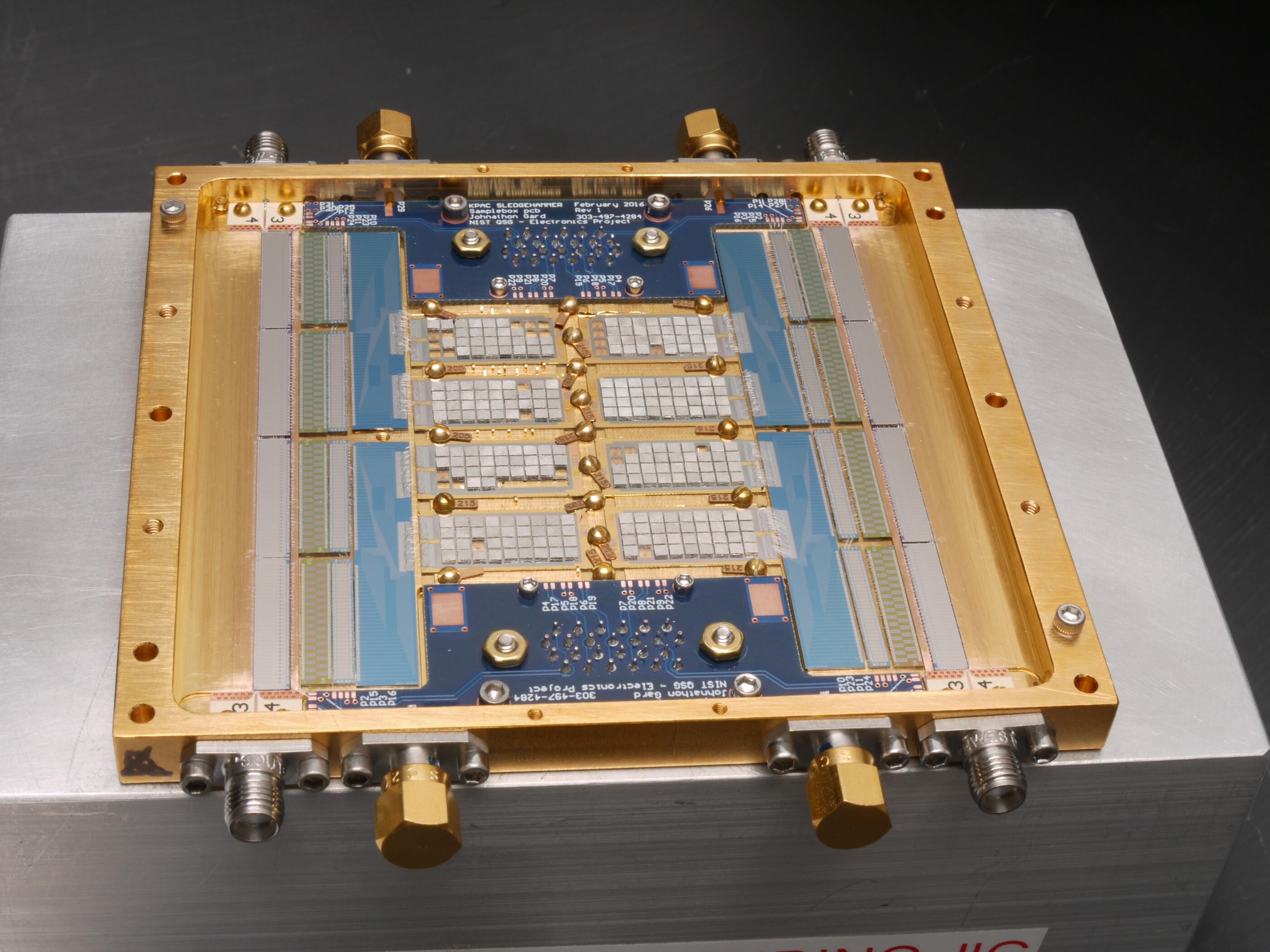
A transition-edge sensor is a superconducting film parked right at the knife-edge between zero resistance and ordinary metal. When a single X-ray photon hits, it dumps a tiny pulse of heat. That heat is enough to shove the film across the transition, and the resistance jump scales with the photon's energy. One photon makes a small resistance change; a few photons make a larger one. Stack hundreds of those miniature thermometers into an array — NIST's illustration shows roughly 250 gamma-ray TES devices — and you get a high-resolution energy spectrometer for soft X-rays that sit on top of the gamma lines inspectors already trust.
Dean's team used that array to measure the Kα X-ray emission linewidths of uranium, neptunium and plutonium in the energy range where the X-rays collide with gamma signals. The paper, led by A. Wessels and colleagues, is Measured and theoretical Kα x-ray emission linewidths of U, Np, and Pu, Physical Review Letters, DOI 10.1103/tcbz-kqk1. Theory and measurement land together: once the X-ray lines are known to within a third to an eighth of the old uncertainty, you can subtract them instead of guessing through them.
Isotope ratios are the practical payoff. Atoms of one element can carry different neutron counts. The ratio between those isotopes tells you whether a batch is headed for a reactor or something else. NIST walks through the classic uranium example: nature's uranium is only 0.7% U-235; fuel needs a few percent; weapons-grade material is cited near 90%. Better X-ray subtraction does not invent that chemistry — it makes the gamma assay that underwrites those ratios less noisy.
Where the sensors already sit
The refrigeration is not pocket-sized. TESs need cooling to a fraction of a degree above absolute zero, so the gear is too bulky for a handheld wand. Anywhere with enough power for the fridge can host an array, Dean notes, and samples can also be shipped to a lab when an on-site TES is not available. "Our instruments are compatible with both approaches," he said.
With Los Alamos National Laboratory, NIST has already installed TES detectors at three Department of Energy laboratories for nuclear-material monitoring. Separate research deployments reach SLAC, Argonne's Advanced Photon Source, Brookhaven's National Synchrotron Light Source, and international sites including CERN. Two U.S. companies now manufacture a NIST-designed compact refrigerator for the sensors — a sign the platform is leaving the one-off prototype stage, even if miniaturization remains unfinished.
What this is not
This is not a claim that nuclear stockpiles can now be inventoried from a phone. It is not a handheld scanner, and it is not a substitute for gamma-ray measurements themselves. The advance is metrology: tighter X-ray line data so existing (and future) gamma assays can subtract a known background. The sensors still need cryogenics. Field use at plants will depend on logistics, sample access, and whether operators trust the new tables enough to rewrite procedures.
It is also not a weapons story dressed as science news. NIST's framing is dual-use monitoring and plant efficiency — the same physics that helps a safeguards inspector also shortens hold-up time between fuel-processing steps. We keep that hedge in the lede and here: better accounting tools, not a declaration that proliferation risk vanished on 10 September.
What to watch
Three near-term checks will show whether TES nuclear metrology becomes daily infrastructure or a specialist paper.
- Adoption at the three DOE sites. Watch whether the installed arrays move from research deployments into routine material-balance assays.
- Independent replication. Outside labs should reproduce the one-third-to-one-eighth uncertainty cut on U, Np and Pu Kα lines with their own spectrometers.
- Cryocooler shrink. NIST is already pushing simpler, cheaper chillers; two companies ship a compact design. Cost and footprint will decide how many plants can host an array instead of mailing samples.
For a progress scoreboard that fits a phone screen, keep the pair NIST actually shipped: X-ray lines for three actinides measured with TES quantum sensors, and uncertainty cut by about one-third to one-eighth. Everything else — faster plant throughput, tighter international inventories — has to follow from using those numbers.
Sources
- NIST news, 10 September 2026: NIST-Developed Quantum Sensors Improve Nuclear Monitoring
- A. Wessels et al., Physical Review Letters, published online 10 September 2026: Measured and theoretical Kα x-ray emission linewidths of U, Np, and Pu. DOI 10.1103/tcbz-kqk1