The finding
A U.S. randomized trial just put a dollar figure on a public-health hope: monthly cash to mothers with low income slowed an epigenetic measure of biological aging in their toddlers.
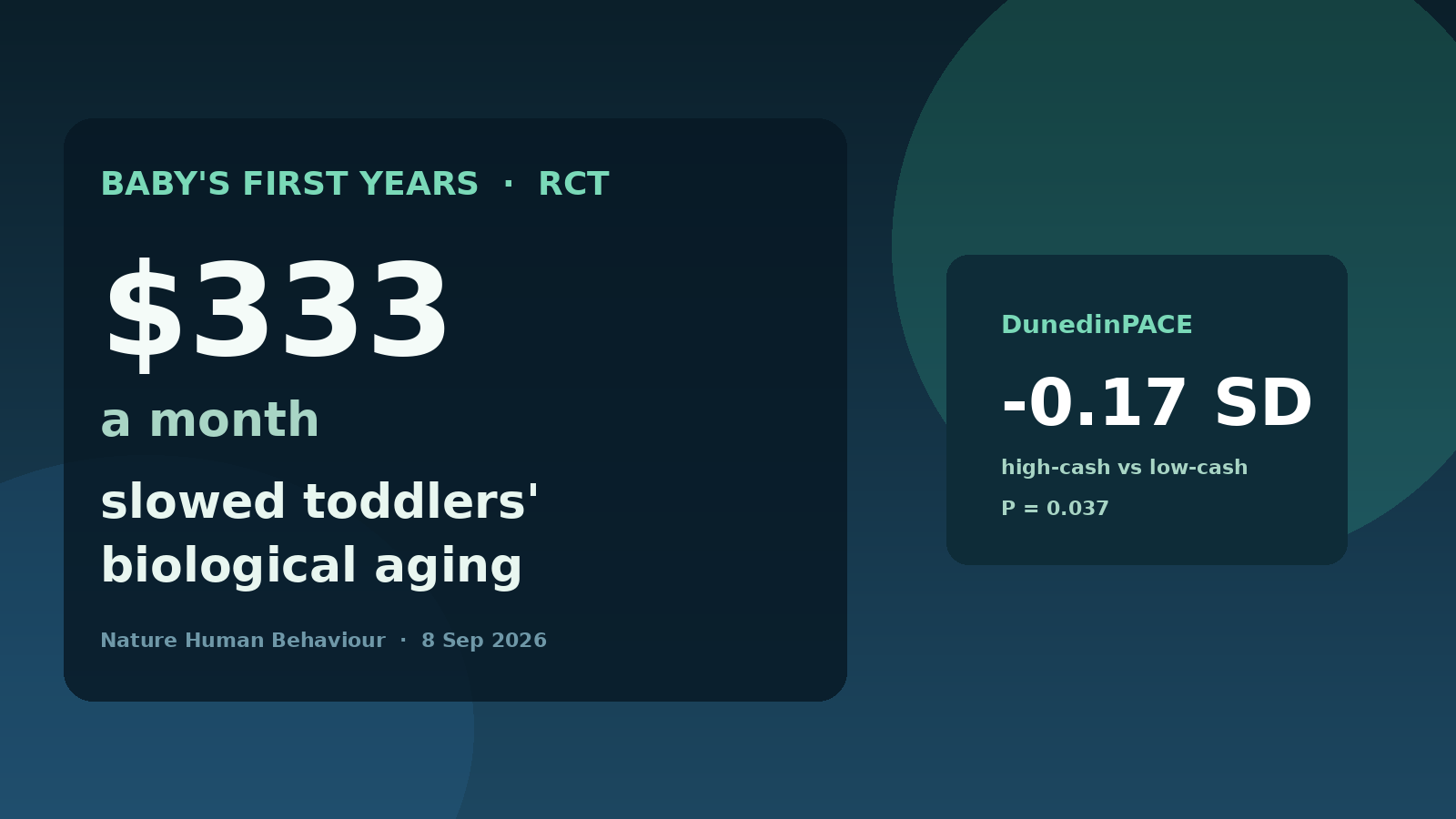
In results published 8 September 2026 in Nature Human Behaviour, the Baby's First Years team reported that children whose mothers received $333 a month for the first four years of life showed −0.17 standard deviations slower DunedinPACE — a DNA-methylation score that tracks the pace of aging — than children in families assigned $20 a month (95% CI −0.32 to −0.01, P = 0.037). Lead author Laurel Raffington of the Max Planck Institute for Human Development and colleagues analyzed saliva samples from 735 four-year-olds in the trial (clinical identifier NCT03593356).
This is not a life table and not a claim that the kids will live longer. DunedinPACE is a molecular pace-of-aging marker validated mainly in adults; the authors themselves say whether the epigenetic shift persists, and how it maps onto later health, is still unknown. Mothers' own DunedinPACE scores did not differ by cash group.
Why it matters
Poverty is already linked to earlier disease and shorter lifespan. Until now, most of the epigenetic evidence was correlational — kids in harder economic conditions tended to look "older" on aging clocks, but income moves with countless other factors.
Baby's First Years was built to isolate cash. Mothers were randomized shortly after birth to a high or low monthly debit-card gift with no strings. The high-cash arm is roughly $4,000 a year, about an 18% boost in family income for households that had to be below the federal poverty line at enrollment. If money itself can nudge a biology-of-aging marker by age four, that reframes childhood poverty as a modifiable public-health exposure — not only a social condition.
"Previous research has shown correlational evidence… but correlations alone can't tell us whether intervening can slow that process," Raffington said in a Max Planck–linked briefing carried by Medical Xpress. "So it is notable to see a causal impact of the cash transfers."
The numbers
| Arm | Monthly gift | Enrolled dyads (target mix) | Child saliva at age 4 in aging analysis |
|---|---|---|---|
| High-cash | $333 | 400 of 1,000 | Part of N = 735 children with DNAm |
| Low-cash | $20 | 600 of 1,000 | Part of N = 735 children with DNAm |
| Child outcome (high vs low) | Effect size (d) | P |
|---|---|---|
| DunedinPACE | −0.17 | 0.037 |
| Epigenetic-g (preferred separate calc.) | −0.15 | 0.077 (not significant) |
| GrimAge Acceleration | 0.05 | 0.529 (ns) |
| PhenoAge Acceleration | 0.10 | 0.392 (ns) |
The cash contrast the models estimate is $313 a month (high minus low). DunedinPACE group differences held up in sensitivity checks that weighted for missing DNA samples (P = 0.023 and 0.032). GrimAge and PhenoAge — other "accelerated aging" clocks the team checked — did not move. A preregistered cognition-linked methylation score, Epigenetic-g, was inconclusive.
How the trial worked
Baby's First Years enrolled 1,000 mother–child pairs between 9 May 2018 and 19 June 2019 at birth hospitals in greater New Orleans, greater Omaha, the Twin Cities, and New York City. After childbirth, mothers were randomly assigned to the high- or low-cash debit card. Age-4 university visits (July 2022–August 2023) collected 2 ml saliva from mothers and children; samples shipped to the Max Planck Institute of Psychiatry for DNA-methylation profiling.
DunedinPACE was developed in the Dunedin Study birth cohort from decades of organ-system biomarkers. In adults it prospectively predicts chronic disease and mortality; a calorie-restriction trial in adults shifted blood DunedinPACE by about d = −0.29. Applying that class of clock to toddlers is newer science — the paper notes that interpretation of epigenetic clocks in children is not fully settled — which is why the authors frame today's result as a detectable early signal, not a finished longevity claim.
Companion BFY papers have already shown the high-cash gift raised spending on toys and books and some measures of infant brain activity, while many hypothesized effects on maternal and child health behaviours stayed null. The epigenetic result sits in that mixed landscape: biology moved on one preregistered aging index even where everyday health reports often did not.
Enrollment required legal age for consent, English or Spanish, residence in the recruitment state, and a stated low chance of moving away soon after birth. Randomization sequences were site-specific (roughly 40% high-cash / 60% low-cash). Baseline surveys covered maternal education, race and ethnicity, marital status, health behaviours in pregnancy, household income and net worth, and infant birth weight and gestational age — the same covariates the intent-to-treat models adjust for when estimating the DunedinPACE gap.
What this is not
- Not a longer-life guarantee. No child in the sample has aged into the disease window DunedinPACE predicts in adults.
- Not a mother effect. The same clocks in mothers showed no cash-group difference (all |d| < 0.10).
- Not every aging clock. GrimAge and PhenoAge Acceleration were flat; Epigenetic-g did not clearly improve.
- Not yet durable. The team lacks pre-intervention methylation baselines and does not yet know if the age-4 gap lasts to age 6 and beyond.
What to watch
BFY continues through age 6. Combining age-4 and age-6 waves, and linking DunedinPACE to later BMI, cognition, and disease risk, will show whether a −0.17 SD nudge at preschool age is a blip or the start of a healthier trajectory. Policy readers will also watch whether other cash or income experiments replicate the saliva DunedinPACE signal — and whether prenatal timing matters as much as the postnatal window tested here.
For now, the news is concrete enough to state without hype: in a preregistered U.S. RCT, $333 a month for four years left toddlers with a slower molecular pace-of-aging score than $20 a month, by about one-sixth of a standard deviation.
Sources
- Laurel Raffington et al., "Effects of a randomized controlled trial of unconditional cash transfers on epigenetic measures of ageing and cognition in children and mothers," Nature Human Behaviour (published 8 September 2026). DOI: 10.1038/s41562-026-02568-4
- Open-access PDF: nature.com/articles/s41562-026-02568-4.pdf
- ClinicalTrials.gov: NCT03593356
- Medical Xpress summary (8 September 2026): Cash transfers to mothers with low income may slow biological aging in children