Scientists at the Salk Institute just published a brain microprotein atlas built from more than 600 postmortem frontal-cortex samples — with and without Alzheimer’s disease — and reported 1,067 tiny proteins that were missing from reviewed UniProt/Swiss-Prot catalogs. One standout is a 63-amino-acid product from the MKKS locus (MKKS63) that is the gene’s main detectable translation product, falls in Alzheimer’s tissue, and, when removed in cells, wrecks microglial mitochondrial respiration. This is a map and a mechanism lead, not a drug and not a diagnostic.
Why it matters
Most Alzheimer’s multi-omics still reads the genome through a dictionary that quietly skips short open reading frames. Those smORFs can encode microproteins — polypeptides typically under 150 amino acids — that never make it into the curated Swiss-Prot list even when ribosomes and mass spectrometers say they are real. If you only score the long, famous proteins, you can miss half the conversation in aging microglia and neurons.
A public atlas with spectral grades changes the desk work. Drug and biomarker hunters get peptide evidence they can re-search. Genetics teams can ask whether an Alzheimer’s-associated variant hits a smORF rather than (or in addition to) the annotated main ORF. And for one locus, MKKS, the team already shows that the short product — not just the classic McKusick–Kaufman syndrome protein — is the one that moves with disease and touches microglial bioenergetics.
Key numbers
| Quantity | Value (Nature Aging, 14 Sep 2026) |
|---|---|
| Peg | Open-access microprotein atlas of human frontal cortex |
| Samples | >600 postmortem frontal-cortex tissues (AD and non-AD) |
| New MPs (high-confidence MS) | 1,067 absent from reviewed UniProtKB/Swiss-Prot |
| Length definition | microproteins ≤150 amino acids |
| Lead locus | MKKS → 63-aa MP (MKKS63), predominant at the locus |
| Disease signal | MKKS63 downregulated in AD; KO impairs microglial OXPHOS |
| Institutions | Salk Institute (lead); Scripps; Rush Alzheimer’s Disease Center |
| Supporting data | Zenodo archive + Hugging Face atlas app (paper) |
Those figures come from Miller, Saghatelian and colleagues in Nature Aging (DOI 10.1038/s43587-026-01207-x). The phone-readable headline stays 1,067 hidden proteins; the table is what pays the click.
What they actually built
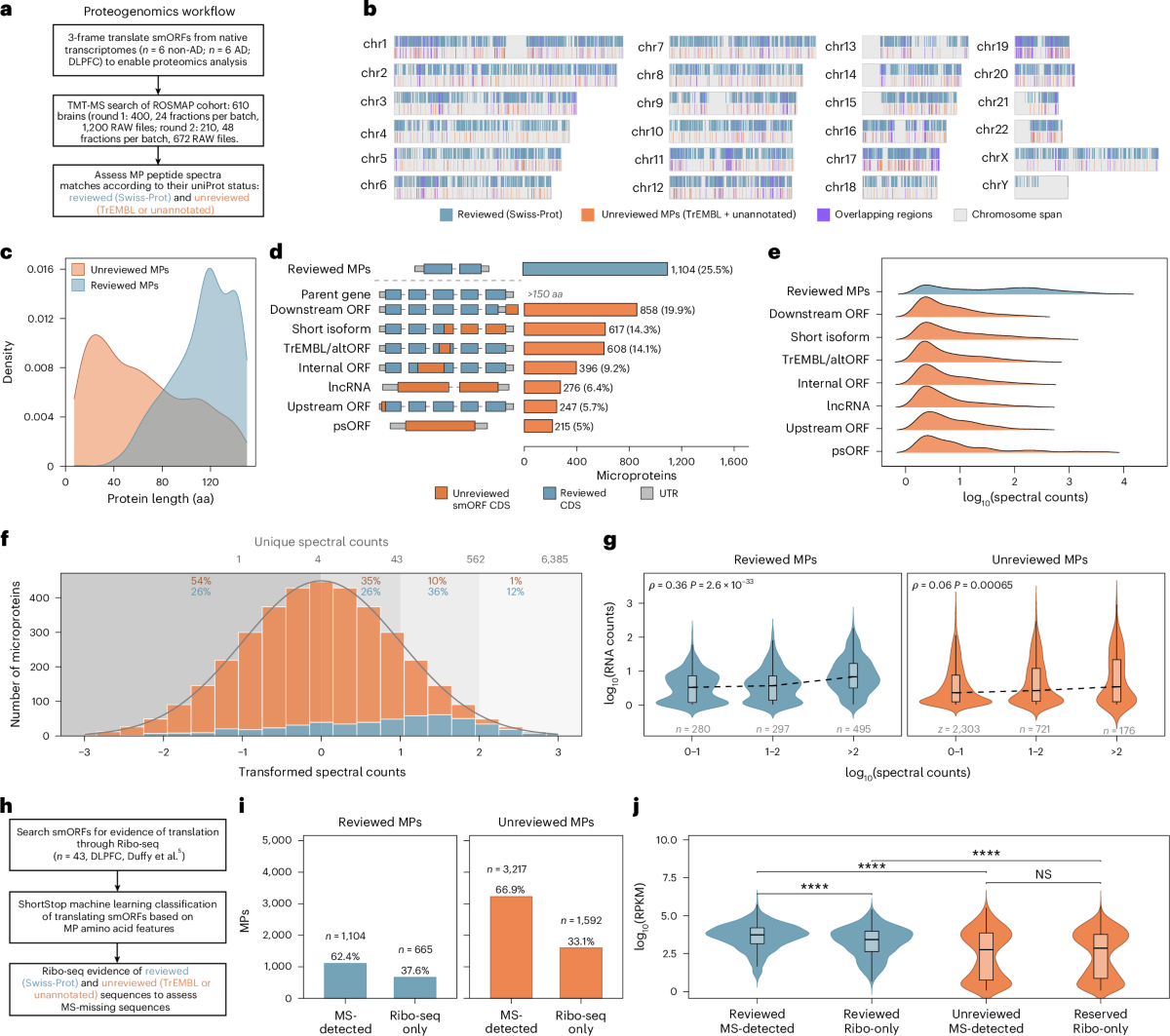
The atlas is not a single assay. The team stacked native transcriptomics, deep tandem mass spectrometry, and deep-learning-predicted reference spectra so each candidate microprotein can be graded against a predicted fragment pattern rather than waved through on a single peptide guess. That matters because short proteins yield few tryptic peptides — historically the reason mass spectrometry ignored them.
They also used ribosome profiling (Ribo-seq) from non-AD dorsolateral prefrontal cortex with a machine-learning filter (ShortStop) to recover translating smORFs that sit below MS detection. In other words: RNA evidence of translation plus MS evidence of peptides, not vibes. Unreviewed microproteins in their set were typically less abundant and showed weaker protein–mRNA concordance than reviewed Swiss-Prot microproteins — another reason a dedicated atlas beats hoping a standard proteomics pipeline will notice them.
David A. Bennett’s Rush Alzheimer’s Disease Center cohort work sits in the authorship for a reason: the expression contrasts are grounded in large, well-characterized postmortem series, not a handful of convenience brains.
The MKKS63 lead
MKKS is famous for a longer protein tied to McKusick–Kaufman / Bardet–Biedl biology. In this atlas, the predominant detectable translation product at the locus is a 63-amino-acid microprotein the authors designate MKKS63. It is downregulated in Alzheimer’s frontal cortex, and knocking it out impairs microglial mitochondrial oxidative phosphorylation — the energy pathway microglia need for costly jobs like clearing debris.
That is the progress-journalism stake: Alzheimer’s research has spent years on amyloid, tau, and lipid genes; here is an unannotated short ORF at a known disease locus that moves with pathology and hits microglial bioenergetics. It is still a lead. It is not “the Alzheimer’s protein,” and the paper does not claim a therapy.
The authors also note a broader pattern: some microproteins diverge in expression from the annotated main ORF at the same locus — a decoupling that can be replicated across cohorts and linked to RNA-binding-protein motifs near splice junctions. For genetics, that means an Alzheimer’s QTL near a gene name might be acting through the short product you never annotated.
What this is not
This is not a blood test, a PET tracer, or a pill. Mapping 1,067 previously unreviewed microproteins does not mean 1,067 drug targets. Spectral support grades confidence; it does not prove every sequence is a stable, functional protein in every cell type.
It is also not a claim that Swiss-Prot was “wrong.” Reviewed databases optimize for curated function. The atlas expands the searchable brain proteome for aging and neurodegeneration research — TransCODE-style territory — so the next CRISPR or proteomics pass has somewhere to look.
Do not read MKKS63 as a cure story. Loss-of-function in microglia that hurts respiration is a mechanistic clue. Clinical translation would need human genetics, replication, and a therapeutic hypothesis the paper does not ship.
What to watch
- Independent reanalysis. Outside groups should re-search the Zenodo spectral plots and ROSMAP-linked tables and say which of the 1,067 survive their own false-discovery thresholds.
- Cell-type resolution. Frontal-cortex bulk and proteogenomic stacks are a start; single-cell or sorted-microglia follow-ups will show whether MKKS63’s AD drop is microglia-selective.
- Genetics. Rare and common Alzheimer’s variants overlapping MKKS smORF exons — independent of the long ORF — would raise the priority of MKKS63 from atlas entry to causal candidate.
For a scoreboard that fits a phone screen: more than 600 brains, 1,067 previously unreviewed microproteins with high-confidence spectra, and one 63-amino-acid MKKS product that falls in Alzheimer’s and hits microglial mitochondria. That is a bigger map of the aging brain — not a finished therapy.
Sources
- Miller, B. et al. Nature Aging (14 Sep 2026): A microprotein atlas of the human frontal cortex in Alzheimer’s disease — DOI 10.1038/s43587-026-01207-x (primary; open access PDF)
- Zenodo supporting data: 10.5281/zenodo.20045162