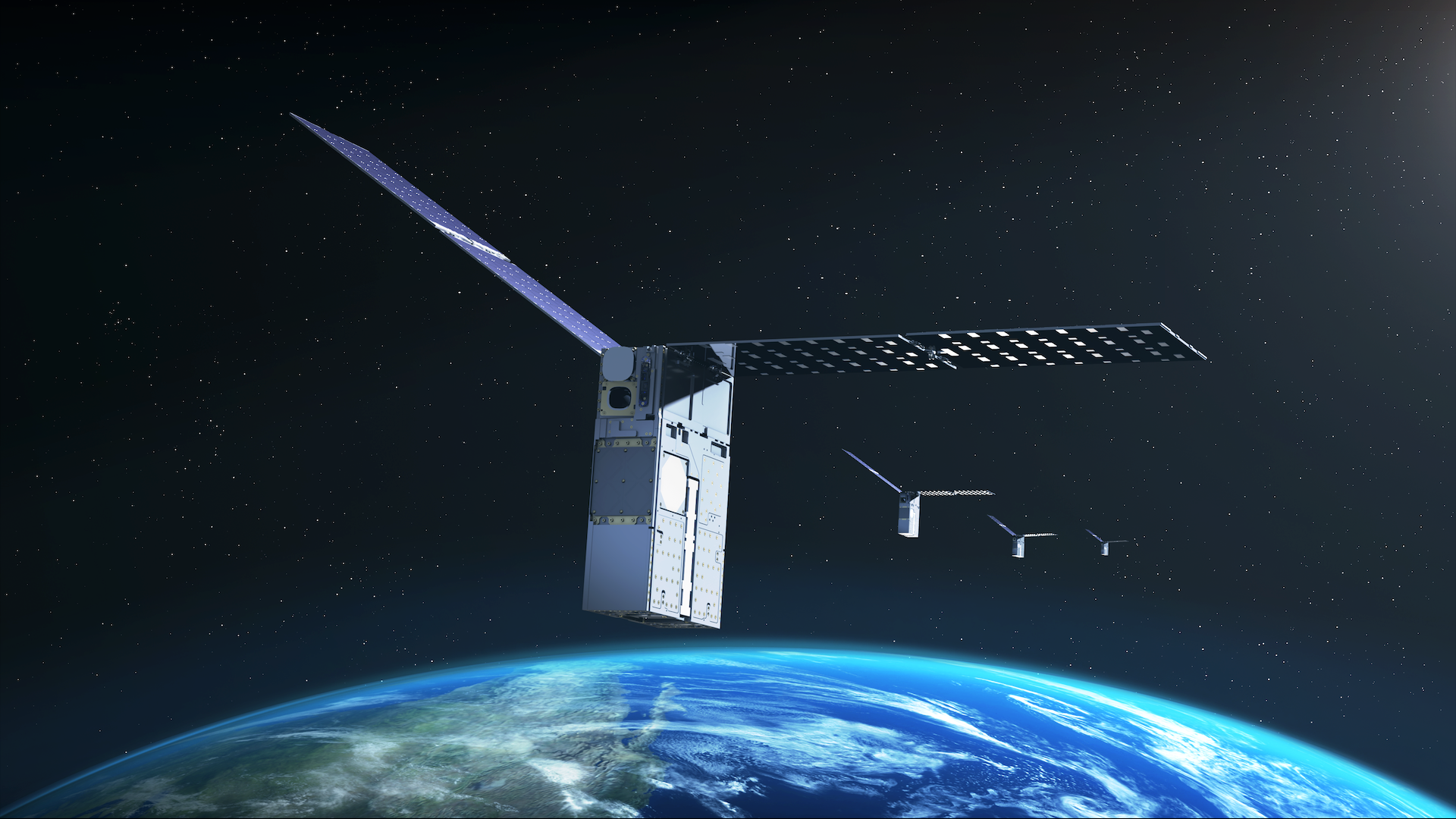
GPS is a terrestrial convenience. It thins out at the Moon and is useless for a swarm that has to know where it is without waiting on a ground network. On 17 August 2026, NASA Ames reported a flight result from Starling, a four-spacecraft CubeSat swarm launched in 2023, that treats other satellites and debris as the landmarks.
What happened
The extended-mission experiment is FALCON — Fast Autonomous Lost-in-space Catalog-based Optical Navigation. It is a joint flight experiment by NASA and EraDrive, a Stanford spin-out, running Era-Core flight software on cameras Starling already carried. Roger Hunter, program manager for NASA’s Small Spacecraft and Distributed Systems program at Ames, called it another first for the mission: optical cameras navigating by relative position to other objects in space.
Starling’s star-tracker cameras are standard instruments. They identify bright objects to tell a spacecraft its orientation. FALCON used those same cameras to photograph other spacecraft and orbital debris, then matched the sightings to a catalog of known objects maintained and made publicly available by the U.S. Department of War. That matching let FALCON estimate Starling’s own orbit without GPS.
In a separate run, the team loaded the full catalog of approximately 20,000 objects and their predicted orbits onto the spacecraft. Over three days, FALCON improved the known orbits of more than 200 objects with no intervention from operators on the ground. NASA says the onboard predictions were better than the ones supplied by ground stations.
| FALCON test | What was onboard | Result (NASA Ames, 17 Aug 2026) |
|---|---|---|
| Self-orbit determination | Star-trackers + public catalog of known objects | Own orbit without GPS |
| Catalog update | Full ~20,000-object catalog | >200 orbits improved in 3 days, no ground intervention |
| Comparison | Ground-station predictions | Onboard predictions better, NASA says |
| Next (later 2026) | Four-spacecraft data share | Swarm-level refine, scheduled |
Arezu Sarvestani’s Ames post is the primary. Starling is led from Ames; funding sits in NASA’s Small Spacecraft and Distributed Systems program, Research and Technology Mission Directorate. EraDrive began as a University SmallSat Technology Partnerships project and is now commercialising Era-Core. That path — university partnership, startup, flight test on a NASA swarm — is the agency’s own framing, not a product review.
The live recap already had the 20,000 / 200 / three-day figures. It was still a stub: no table, no program office, no scheduled swarm extension. This rewrite keeps every NASA number and adds the operational next step Ames already printed.
Why it matters
Coordinated GPS-free networks are a requirement NASA has written down for lunar surface operations, for multi-point science that needs each spacecraft’s location, and for collision avoidance that does not wait on a ground network. FALCON is a technology demonstration on cheap CubeSats. It is not a replacement for GPS where GPS still works.
Two capabilities ran on the same cameras and must stay distinct in the copy. One is “where am I?” — lost-in-space orbit determination from catalogued neighbours. The other is “where are they?” — tightening the catalog itself. NASA is careful to call the self-orbit determination a first for spacecraft using optical cameras this way. The catalog-update run is the space-traffic half: more than 200 objects in three days, onboard, unattended.
The Department of War catalog is a public input, not a classified subplot. The experiment matches cameras to a published list. Do not write it as a military targeting story. Do not write it as a GPS funeral. GPS remains the right tool in low Earth orbit when the signal is there. FALCON is for when it is not — cislunar, far side, or a swarm that cannot poll the ground at the needed cadence.
What to watch next
- Swarm share, later in 2026. Ames says Starling will extend FALCON so the four spacecraft share tracking data and refine positions collectively. That is the test that matters for a lunar constellation. Until it flies, the verified claim is self-orbit determination plus 200 catalog updates in three days.
- Collision-avoidance use. Hunter listed on-orbit space-traffic monitoring and collision avoidance as implications. Those are implications. They are not a CONOPS that has run.
- EraDrive as a commercial path. NASA is explicit that Starling is a platform for real-world testing of flight software. Cover a commercial sale when there is a contract, not a press-kit paragraph.
Sources
- NASA Ames, “NASA’s Starling Mission Opens New Frontiers in Space Navigation,” 17 August 2026 — https://www.nasa.gov/blogs/smallsatellites/2026/08/17/nasas-starling-mission-opens-new-frontiers-in-space-navigation/