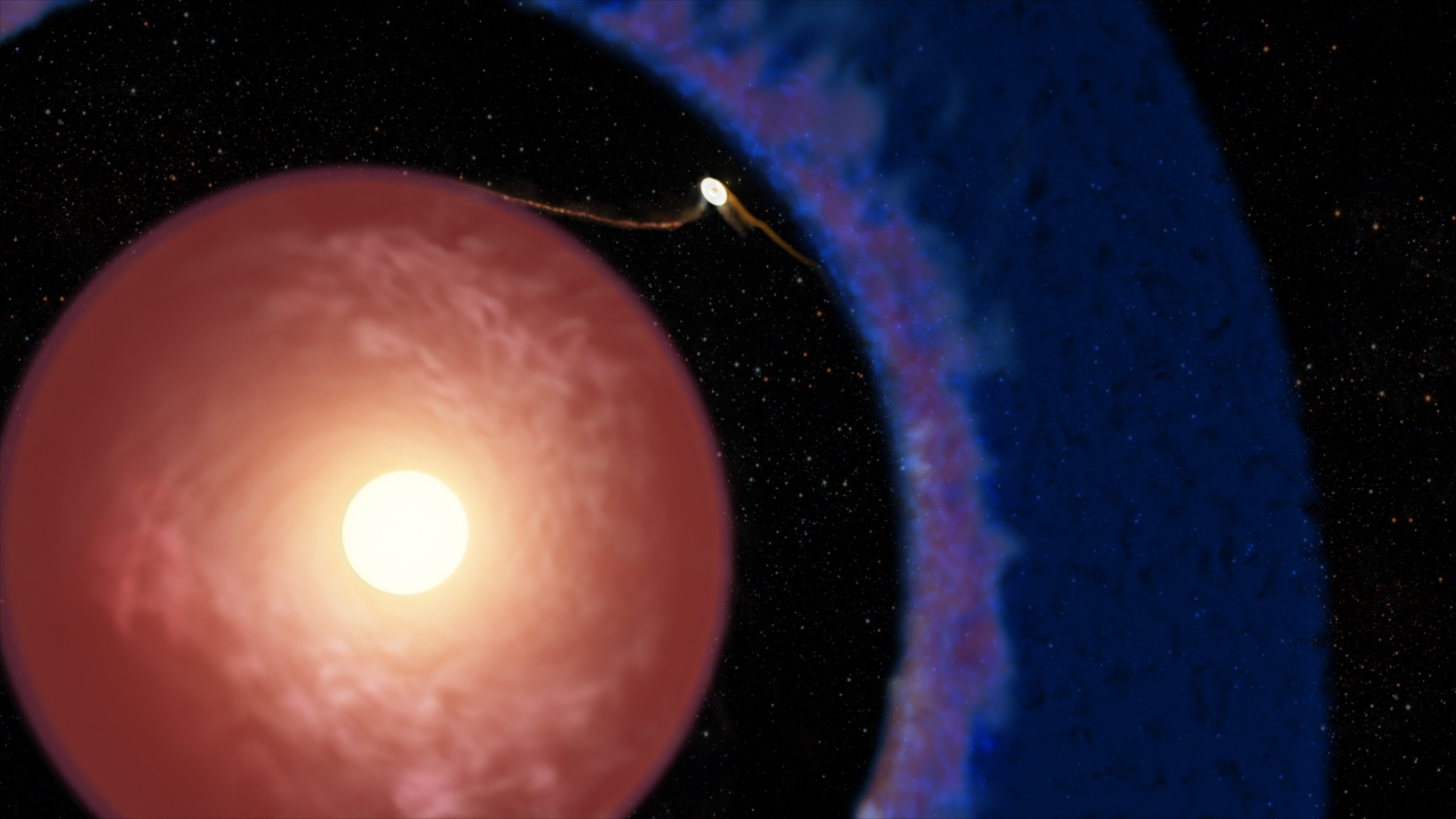
Elias 2-24 b is now the youngest confirmed exoplanet on the books — still growing inside its dusty birth disk about 450 light-years away — after a team led from Chile confirmed it with NASA-funded Keck archive data in The Astrophysical Journal Letters on 16 September 2026.
The hedge first: “youngest” means ≲1 million years by the paper’s adopted age for the Elias 2-24 system, not a stopwatch on the planet itself. Mass estimates from evolutionary models sit roughly in the Jupiter-mass range (about 1.9–4.0 Jupiter masses in the abstract’s 1-Myr isochrone comparison), and those model masses are upper limits because they ignore accretion light. The news is not a new telescope launch. It is a confirmation that a glowing speck in a disk gap is a real, still-forming world — and that giant planets can appear earlier and farther out than many textbooks assumed.
Why it matters
Most of the ~6,000 confirmed exoplanets are billions of years old and sit close to their stars, because transit surveys catch those easy geometries. Baby planets are usually buried in dust. That leaves a blind spot: the years when cores grow, atmospheres inflate, and gaps open.
Elias 2-24 b sits in that blind spot. It occupies a narrow gap in a protoplanetary disk, at about 55 au from its star — roughly ten times farther out than Jupiter sits from the Sun. Prior record holders for “youngest known planet” were a four-way pack around PDS 70 and WISPIT 2, all more than 5 million years old, according to NASA’s write-up quoting co-author Lucas Cieza. A world under a million years old forces models that already struggled with those older “babies” to explain an even faster clock.
For readers who do not care about isochrones: this is a time machine for our own solar system. We cannot rewind Jupiter’s childhood. We can watch a Jupiter-mass object still vacuuming gas from a disk.
Key numbers
| Quantity | Value (ApJL 16 Sep 2026 / NASA–Keck press) |
|---|---|
| Peg | 16 September 2026 ApJL confirmation |
| Name | Elias 2-24 b |
| Adopted system age | ≲1 Myr (youngest exoplanet to date) |
| Prior youngest pack | >5 Myr (PDS 70 ×2, WISPIT 2 ×2) |
| Separation | 394 ± 31 mas → 54.9 ± 4.3 au |
| Position angle | 298°.8 ± 3°.2 |
| Photometric mass range (1 Myr isochrones, no accretion) | 1.9–4.0 MJup (upper-limit caution in paper) |
| Host distance | 139.3 ± 1.2 pc (~450 ly in NASA prose) |
| Host spectral type / stellar mass (paper context) | K6; ~0.78 M⊙ (Cieza et al. disk geometry) |
| Survey | 7 disk-host stars with Keck/NIRC2 vortex (2018 May–June) |
| Gap scale (discussion) | centered ~0″.4 (~55 au), width ~30 au |
| Lead | Andrea Bernardi (Universidad Diego Portales) |
What happened
About a decade ago, ALMA showed a gap in Elias 2-24’s dusty disk. ESO’s Very Large Telescope later spotted a faint point of light in that gap. Theory pushed back: forming a Jupiter-size planet at Jupiter’s distance was expected to take about 5 million years, and farther out should take longer. A glowing dot at ~55 au in a ≲1 Myr system looked too early to be real.
Andrea Bernardi and colleagues — including Alice Zurlo, Lucas Cieza, and Jet Propulsion Laboratory / Caltech coronagraph experts — mined the Keck Observatory Archive, a NASA-funded partnership with Caltech/IPAC’s NASA Exoplanet Science Institute. They recovered the same point of light in 2018 and 2020 Keck/NIRC2 vortex-coronagraph frames, tracked its motion, and showed it behaves like a co-moving planet rather than a background star or reduction artifact.
The Letter reports a custom VIP-based reduction with angular and reference differential imaging plus PCA. Across the seven-target survey, 5σ contrasts reached roughly 1–11 Jupiter masses beyond about 0″.25, depending on the system. Elias 2-24 b landed inside the gap at the numbers in the table above.
NASA’s Ashley Balzer story stresses the multi-telescope handshake: ALMA mapped the gap, VLT saw the candidate, Keck archive epochs sealed common proper motion. Bernardi’s line in the NASA piece is the method moral: “this confirmation was possible only by using multiple telescopes together.”
How big — and why the mass is hedged
The abstract’s 1.9–4.0 MJup range comes from comparing photometry to 1 Myr isochrones without accretion. Section 5 of the paper is blunt: at these ages, accretion luminosity can dominate the planet’s glow, so evolutionary masses and temperatures are overestimates if you treat all light as cooling heat. Table 3 explores ATMO, AMES, and BEX models; dusty / nonequilibrium “hot-start” cases tend toward lower masses than cold-start extremes. Hydrodynamical gap-carving work cited in the discussion had already favored the low end, around ~1 MJup.
For a progress story, the honest phone number is: Jupiter-class, still accreting, sitting in the gap it likely carved — with mass still model-dependent until spectroscopy and multi-wavelength follow-up land.
What this is not
- Not a Roman Space Telescope discovery. Roman launched 30 August 2026 and is cited as the future tool that should make similar detections easier; this result is Keck archive + ALMA + VLT heritage.
- Not a measured birthday in days. Ages for ≲1 Myr T Tauri systems are hard; the authors adopt ≲1 Myr after reviewing DSHARP ages as young as ~0.2–0.4 Myr and other youth indicators.
- Not proof that every ALMA gap hides a planet. It is strong evidence for this gap–planet link and support for core accretion during a rapid gas-accretion phase.
What to watch
- Spectroscopy of Elias 2-24 b — temperature, surface gravity, and accretion tracers that can break the mass degeneracy.
- Roman coronagraph surveys for younger, closer-in Jupiter analogs currently lost in stellar glare.
- Replication on other DSHARP / ODISEA gaps with similar multi-epoch high-contrast archives.
- Whether formation models can grow a ~Jupiter-mass body at ~55 au inside 1 Myr without exotic shortcuts.
Sources
- Bernardi, A. et al. (2026). Searching for Embedded Protoplanets with the Keck/NIRC2 Vortex Coronagraph: Confirmation of a Core-accretion Planet in the Narrow Gap of the Elias 2-24 Disk. The Astrophysical Journal Letters 1009:L3. DOI: 10.3847/2041-8213/ae9bb6. Published 16 Sep 2026.
- NASA Science (Ashley Balzer), 16 Sep 2026 — Newfound ‘Baby’ Planet Smashes Record for Youngest Known World.
- W. M. Keck Observatory news, 16 Sep 2026 — Youngest Exoplanet Yet Discovered Found Hiding in Keck Observatory Data.
Author: The Good Signal. Cover: W. M. Keck Observatory / Adam Makarenko artist concept via NASA Science (public press image).