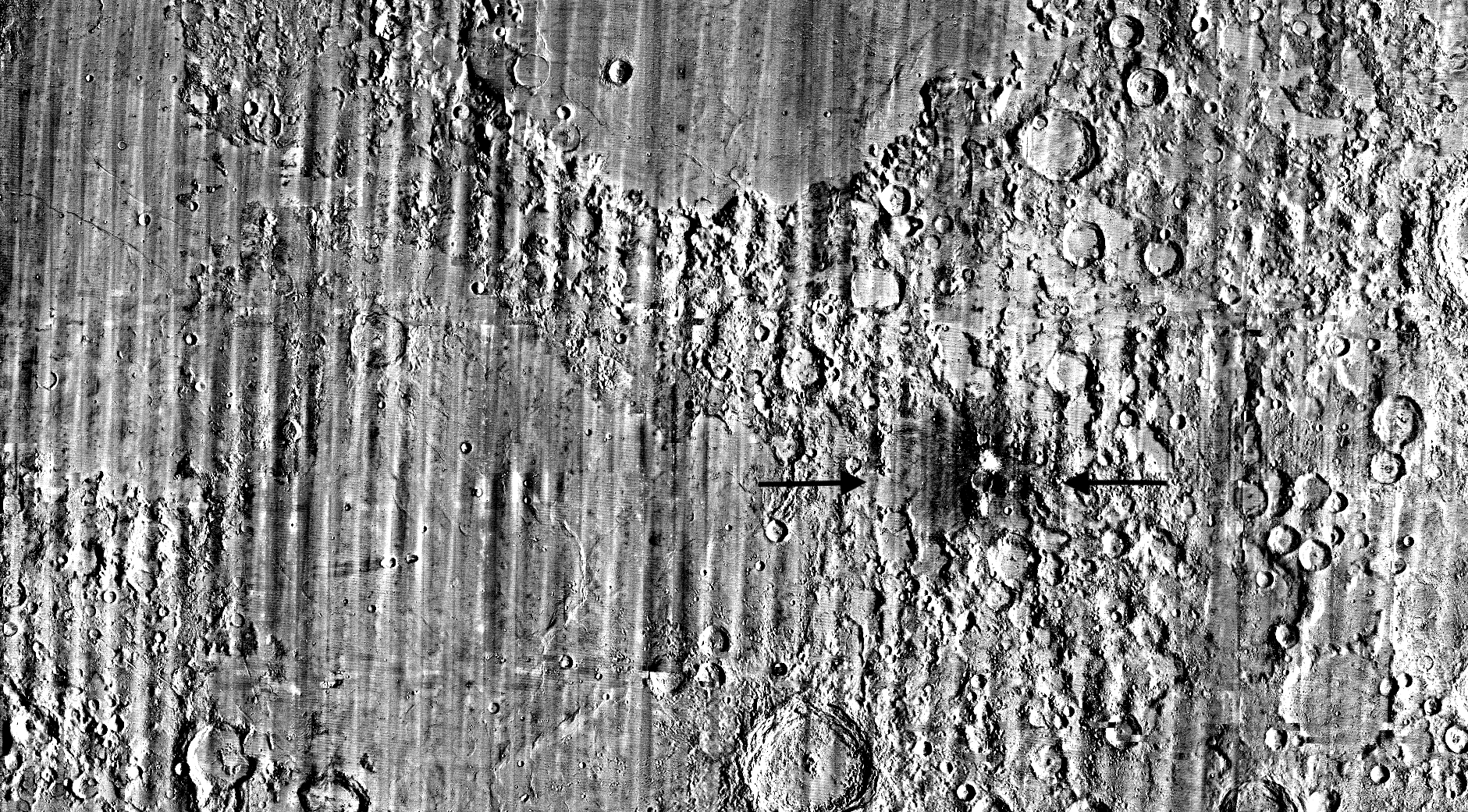
NASA said on 16 September 2026 that its Lunar Reconnaissance Orbiter (LRO) has spotted a fresh Moon crater 728 feet wide — about 222 meters across — carved in spring 2024 by a rock the size of a three- to six-story building. Scientists writing in Science Advances call it a once-in-132-year event and the largest contemporary impact crater yet found in the solar system.
The hole is named McGetchin, after lunar scientist Tom McGetchin. It sits on the Moon’s eastern near side. At 141 feet deep it could swallow three yellow school buses stacked end to end. This is not a newly formed “mystery scar” waiting for a name: before-and-after LRO images pin the impact window to 11 April–22 May 2024, and the papers quantify how far the blast reworked the surface.
Why it matters
NASA is planning a sustained human presence on the Moon. Every fresh crater is a free experiment in how hard the surface gets hit, how far debris travels, and how the top layer of dust — the regolith — changes under a single punch. McGetchin is rare enough that models treat it as roughly a once-per-century class event, yet LRO was already in orbit and taking pictures, so the before and after frames exist.
That matters for landing sites, rover wheels, and habitat design. An impact that fluffs nearby soil also changes how heat moves through the ground at night. If cold spots routinely extend kilometers beyond the rim, engineers need those radii in their maps — not just the crater diameter on a press release.
The progress signal is simple: the Moon is still being hit hard, often enough to rewrite local geology, and an agency spacecraft already flying has the archive to catch the biggest recent punch.
Key numbers
| Quantity | Value (NASA Science 16 Sep 2026; Robinson et al. / Powell et al., Science Advances) |
|---|---|
| Crater name | McGetchin |
| Width | 728 feet (~222 m) |
| Depth | 141 feet |
| Impactor scale (NASA) | rock the size of a 3– to 6-story building |
| Formation window | 11 Apr – 22 May 2024 |
| Recurrence (paper) | once in 132 years (model estimate) |
| Discovery | 24 Oct 2025, Robert Wagner (LROC change detection) |
| Peg / papers | pair of Science Advances papers, mid-Sep 2026 |
| Cold spot (Diviner) | |
| Distal change (Robinson abstract) | surface changes extending >1,000 crater radii |
| Mission context | LRO flying >17 years; team has flagged ≥1,000 new craters and ~100,000 surface changes |
| Small-crater rate (NASA) | ~140 new ~30-foot craters per year |
How NASA caught it
Robert Wagner, an image-processing specialist working with the Lunar Reconnaissance Orbiter Camera (LROC) team at Intuitive Machines, was running a routine data-quality check on 24 October 2025. He stacked global Wide-Angle Camera maps so unchanged terrain went gray and differences lit up. McGetchin jumped out as a bright debris splash hundreds of pixels across — “by far the most obvious impact debris pattern I’ve ever seen,” he told NASA.
The Wide-Angle Camera sees the whole Moon at roughly football-field pixels. After the hit was flagged, the Narrow-Angle Camera revisited the site at about 3 feet per pixel, locking in size, shape, and the local geology the impact excavated. Mark S. Robinson and colleagues then published the crater paper in Science Advances (A new 222-m diameter lunar crater, DOI 10.1126/sciadv.aeh7812), with Wagner among the co-authors.
A second team, led by Tyler M. Powell with David A. Paige among the co-authors, used LRO’s Diviner thermal instrument. Nighttime temperatures show an ~7-kilometer-wide cold spot 8 to 9 kelvin cooler than surroundings — NASA’s public write-up rounds that to about 4 miles and 16°F. Their paper (New lunar crater reveals extensive distal regolith modification, DOI 10.1126/sciadv.aeh9568) argues the impact fluffed the upper centimeters to decimeters of regolith, so the ground holds less heat after sunset.
That is the scene, not the seminar: a bright spot on a map, a hole bigger than the Colosseum’s footprint, and a cold halo large enough to matter for anyone who might park a lander nearby.
What this is not
- Not an Earth-threatening asteroid warning. The rock hit the Moon in 2024; telescopes did not catch the strike in real time, and the news is the crater archive, not a near-miss of Earth.
- Not proof that “once in 132 years” is exact. That figure is a model estimate in the Robinson paper’s framing of rarity; NASA’s story also says “about once in a century or even longer.”
- Not the first new crater LRO has seen. The mission has already tagged at least 1,000 new impacts and ~100,000 smaller surface changes. McGetchin is the record-holder for size among contemporary finds, not the only hit.
- Not a finished Artemis site survey. The distal-modification radii inform future maps; they do not by themselves pick a base location.
What to watch
- Follow-up NAC topography — whether published elevation products refine depth, rim collapse, and melt/breccia maps beyond the first NASA figures.
- Cold-spot fading — Diviner re-looks that test how fast the fluffed regolith settles and the nighttime temperature anomaly shrinks.
- Impactor characterization — a future paper NASA flagged for size and force estimates of the 3- to 6-story-class fragment.
- Operational maps for Artemis and commercial landers — whether 7-km-class cold-spot and >1,000-radii disturbance zones enter hazard layers as standard buffers.
The progress signal holds either way: LRO turned a once-in-a-century-class lunar punch into measured geology — 728 feet across, 141 feet deep, pinned to spring 2024 — while two Science Advances teams quantified how far the blast still rewrites the Moon’s skin.
Sources
- Lonnie Shekhtman, “NASA’s Moon Orbiter Spots New, ‘Once-in-Century’ Moon Crater,” NASA Science, 16 September 2026. https://science.nasa.gov/solar-system/moon/nasas-moon-orbiter-spots-new-once-in-century-moon-crater/
- Robinson, M. S., Boyd, A. K., Mahanti, P., Manheim, M. R., Speyerer, E. J., Stopar, J. D., Wagner, R. V., “A new 222-m diameter lunar crater,” Science Advances (2026). DOI 10.1126/sciadv.aeh7812
- Powell, T. M., Greenhagen, B. T., Horvath, T., Williams, J.-P., Jhoti, E., Speyerer, E. J., Elder, C. M., Paige, D. A., “New lunar crater reveals extensive distal regolith modification,” Science Advances (2026). DOI 10.1126/sciadv.aeh9568