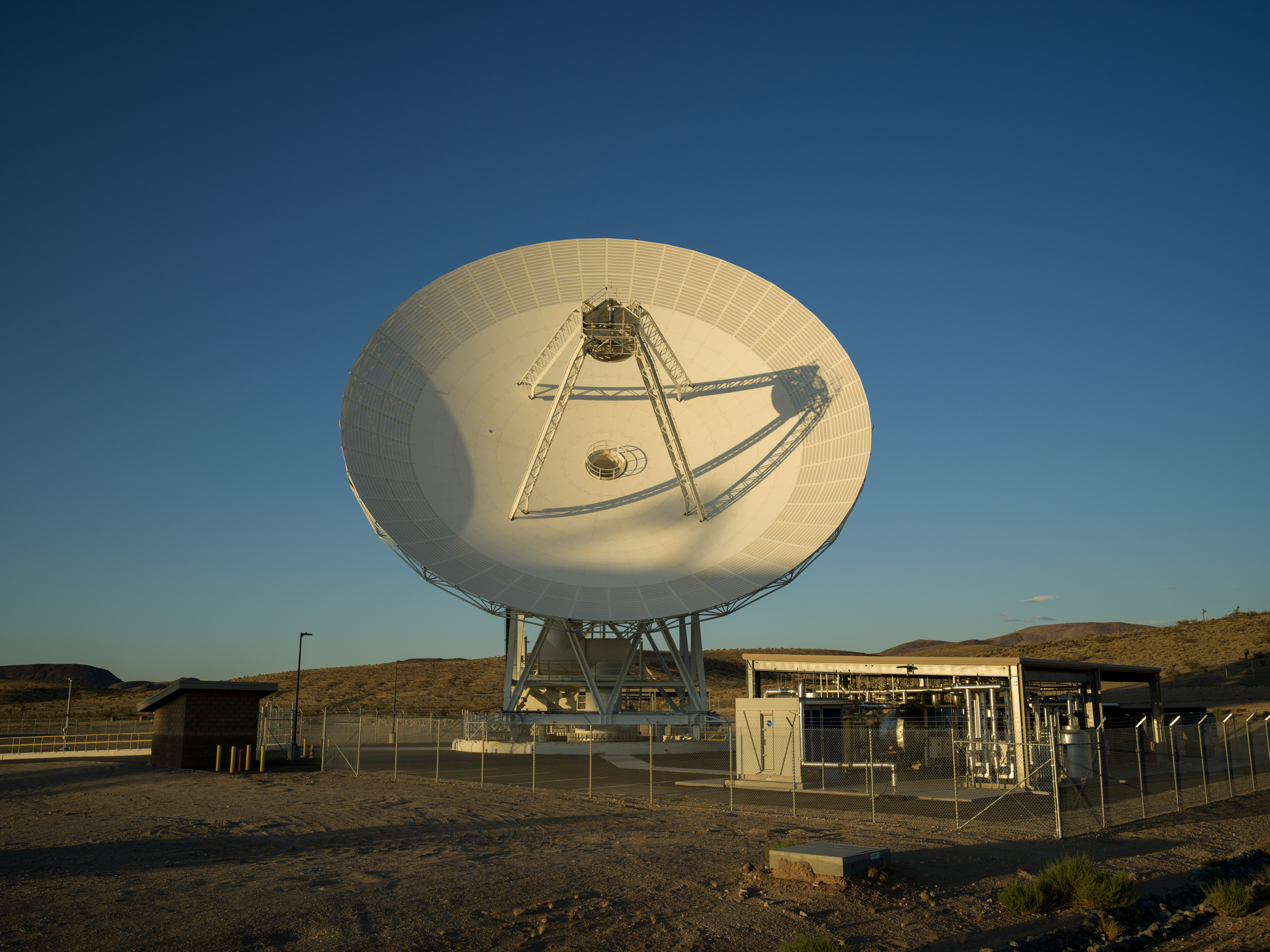
NASA’s Jet Propulsion Laboratory cut the ribbon on 25 August 2026 at the Goldstone Deep Space Communications Complex near Barstow, California, on Deep Space Station 23 — a new 34-metre-wide (114-foot-wide) radio-frequency antenna. The dish had already begun operations on 3 August. Its first track was NASA’s Chandra X-ray Observatory. Since then it has been talking to Mars Reconnaissance Orbiter, Psyche, Juno, Voyager 1, and other robotic spacecraft in deep space.
This is not a new telescope. It is not first light from Roman. It is not NASA talking to Mars for the first time. DSS-23 is the fifth of six dishes in the Deep Space Network’s Aperture Enhancement Project, which started in 2009. It does not replace the 70-metre dishes yet. Arraying the 34-metre antennas is the planned backup. Optical and laser communications on this dish are a future layer. They are not in this week’s release.
Why it matters
NASA’s Deep Space Network is the radio backbone for the agency’s farthest spacecraft: giant dishes at three global facilities that keep a lock on missions as Earth turns. JPL, which manages the network for NASA, says those complexes already support more than 40 spacecraft exploring the solar system and interstellar space. More than 100 NASA and non-NASA missions rely on the Deep Space Network and the Near Space Network together — the International Space Station, future Artemis flights, Earth-monitoring satellites, lunar missions, and probes beyond the heliosphere.
A 34-metre dish coming online is not a discovery. It is capacity. Every extra hour of tracking, and every array that has to stand in for a 70-metre antenna that is getting expensive to keep running, is a booking on those three sites. DSS-23 is the California increment of a project NASA has been building since 2009: six new multifrequency beam-waveguide 34-metre antennas. Five are now in the network. The sixth, Deep Space Station 33, is due at Canberra in 2029. NASA says that antenna will bring the total number of 34-metre dishes across the network to 13.
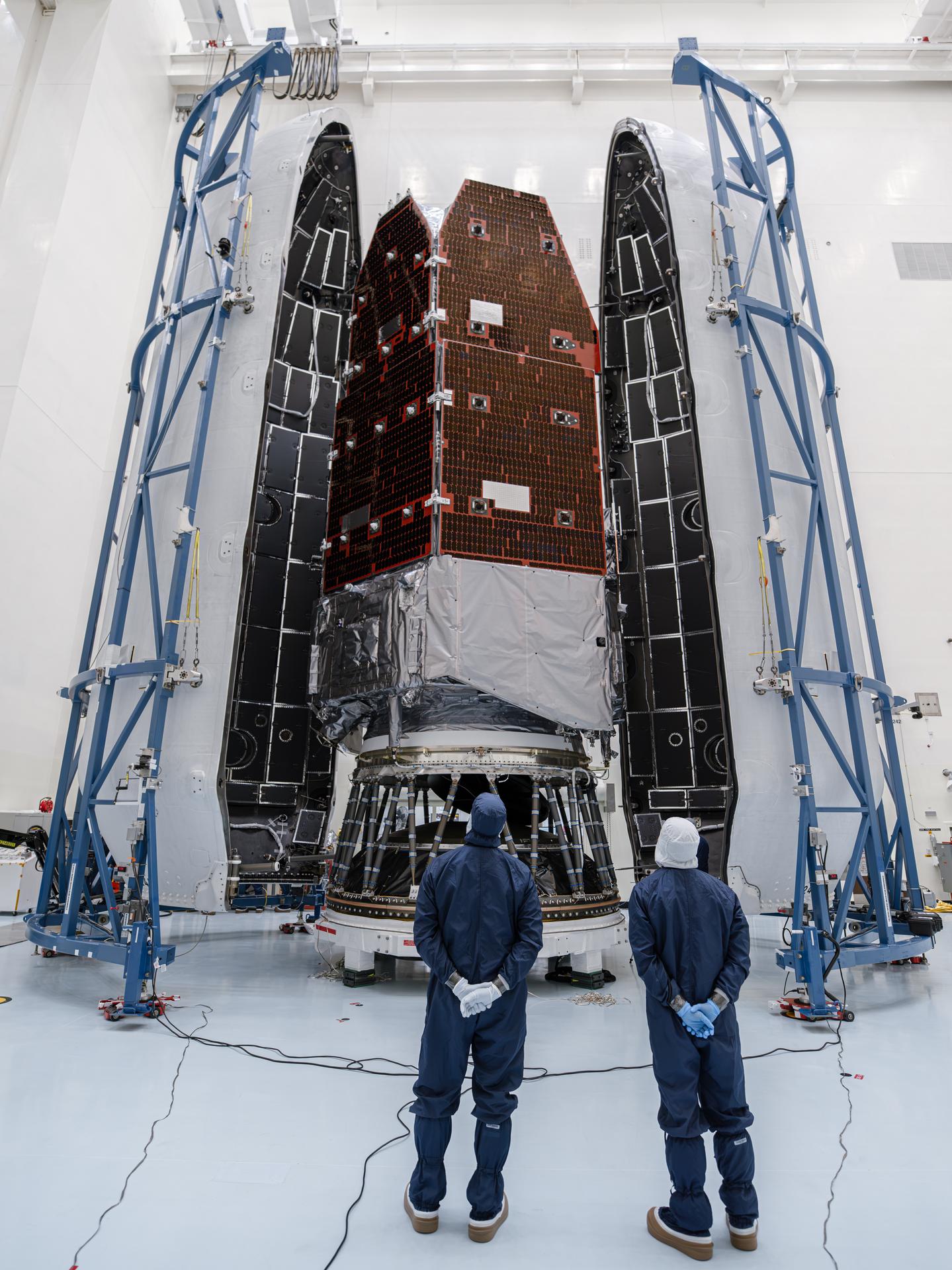
The same network will talk to NASA’s next space telescope after Sunday’s launch. DSS-23 has not already talked to Roman. Roman is still on the ground, encapsulated and cleared for a targeted 30 August liftoff. Do not write this dish onto that observatory.
James Kenyon, associate administrator of the Research and Technology Mission Directorate at NASA Headquarters, put the policy sentence on the California dish: “By expanding the Deep Space Network, we are strengthening the communications foundation NASA needs for the bold missions ahead — from exploring more of the Moon than ever before to peering deeper into the solar system.”
Voyager 1 is the proof-of-work NASA chose to name: a brand-new Goldstone dish is already in the circuit of a spacecraft in interstellar space.
The print
NASA’s 25 August story and JPL news release 2026-057, dated Aug. 25, 2026, are the source for the table. Every figure below is on those two pages.
| Item | Figure |
|---|---|
| Dish width | 34 metres (114 feet) |
| Reflector framework | 133 tons, bolted December 2024 |
| Construction start | February 2020 |
| Test campaign | May through July 2026 |
| Operations start | 3 August 2026; first track Chandra |
| Named tracks since | Mars Reconnaissance Orbiter, Psyche, Juno, Voyager 1 |
| Ribbon cutting | 25 August 2026, Goldstone |
| Aperture Enhancement Project | started 2009; six 34-metre dishes planned |
| AEP dishes now in the network | fifth of six |
| Sixth AEP dish | Deep Space Station 33, Canberra, 2029 |
| 34-metre antennas after DSS-33 | 13 network-wide |
| Antennas at Goldstone now | fifth at the site, joining three 34-metre antennas and one 70-metre (230-foot) antenna |
| Spacecraft the DSN supports | more than 40 |
| Missions on DSN + Near Space Network | more than 100 NASA and non-NASA |
NASA’s phrasing after the first track is that DSS-23 “has been communicating with dozens of missions such as” those four named spacecraft “and other robotic spacecraft in deep space.” The release does not give a count beyond “dozens.” Do not invent one.
How they did it
Construction of DSS-23 began in February 2020. In December 2024 the 133-ton metal reflector framework was placed and bolted atop the antenna’s pedestal. Engineers then installed the panels that reflect radio-frequency signals sent to and received from spacecraft, and calibrated the dish so it can work with the rest of the network.
Goldstone now has five antennas: the three 34-metre dishes that were already there, the 70-metre (230-foot) dish, and DSS-23. DSS-23 is also the fifth Aperture Enhancement Project antenna to join the global network, which has complexes at Goldstone, Madrid, and Canberra, Australia.
The design is a multifrequency beam-waveguide antenna. Instead of hanging heavy, sensitive electronics on the moving dish, it directs signals down to a stable, climate-controlled underground room. NASA says that layout is easier to maintain and upgrade, and lets one dish work across different radio frequencies.
“The biggest challenge wasn’t actually constructing the antenna. It was transforming a complex collection of mechanical, electrical, software, radio frequency, and infrastructure systems into a single, mission-ready asset,” said Germaine Aziz, manager of the Deep Space Network Aperture Enhancement Project at JPL. “Every subsystem must be integrated, calibrated, and verified to operate with extraordinary precision and reliability before it can support NASA’s deep space missions.”
A test campaign ran from May through July. Operations started on 3 August with Chandra. The ceremonial ribbon cutting — NASA leadership, JPL and Deep Space Network staff, and dignitaries at the completed dish — was 25 August.
Dave Gallagher, director of JPL, called it a step toward a modernized network: “The addition of this next-generation antenna brings us closer to a completely modernized network that embraces advanced technology to ensure NASA’s leadership in deep space communications.” After over 60 years of continuous operations, he said, “these upgrades prime the network for a new era of exploration.”
JPL, managed by Caltech for NASA, runs the Deep Space Network with oversight from NASA’s Space Communications and Navigation (SCaN) Program.
What this is not
It is not a telescope. DSS-23 is a radio-frequency communications and navigation antenna. It does not take a “first light” image. It is not first light from Roman, and this dish has not already talked to Roman.
It is not the first time NASA can talk to Mars. Mars Reconnaissance Orbiter has been on the Deep Space Network for years. DSS-23 joining that traffic is extra aperture, not a first contact.
It is not a replacement for the 70-metre dishes. NASA is explicit: the 34-metre antennas can be arrayed — combined and operated together — to provide an equivalent communications backup for each facility’s single 70-metre antenna. Those 70-metre dishes, after more than 50 years of near-continuous operation, “are getting increasingly costly to maintain and repair.” Arraying is the planned backup. The 70-metre antennas are still there.
It is not an optical or laser communications station in this release. Laser comms on this dish is future work. The 25 August NASA and JPL stories do not claim it is flying on DSS-23 now.
What to watch
- Canberra in 2029. Deep Space Station 33 is the last of the six Aperture Enhancement Project dishes. NASA says that antenna will bring the 34-metre count to 13.
- Arraying versus the 70-metre dishes. The backup architecture is several 34-metre dishes acting as one, not a new 70-metre. Watch whether arraying is actually used as those older antennas age.
- Roman after Sunday. The Deep Space Network will talk to NASA’s next space telescope after the targeted 30 August launch. Do not write DSS-23 onto that first pass unless NASA names the station.
- The rest of the queue. A new dish does not automatically mean every mission among the more than 100 on the DSN and Near Space Network gets more hours. It means the booking sheet got one more California aperture.
- Laser later. If NASA later puts optical communications on a 34-metre AEP dish, that will be a different release. This one is radio frequency.
Sources
- NASA, “New Next-Gen Dish Adds Muscle to NASA’s Deep Space Network,” 25 August 2026 — https://www.nasa.gov/technology/space-comms/deep-space-network/new-next-gen-dish-adds-muscle-to-nasas-deep-space-network/
- NASA Jet Propulsion Laboratory, same headline, 25 August 2026, release 2026-057 — https://www.jpl.nasa.gov/news/new-next-gen-dish-adds-muscle-to-nasas-deep-space-network/