NASA Goddard and Johnson Space Center have put numbers on a worry Artemis already had: some of the microbes that ride along with people can, in a model, last more than a day in south-polar shadows. The paper is Prabal Saxena, Stefano Bertone, Heather V. Graham, Natalie M. Curran, Aaron B. Regberg, Andrew Needham, Betsy Pugel and Noah E. Petro, “Potential survivable niches for microbial life on the lunar south pole,” Science Advances 12, eaec0811 (2026), DOI 10.1126/sciadv.aec0811. Version of record 19 August 2026. The PDF was fetched for this article.
The headline number in the results is not a culture plate. It is a map. At three Artemis III candidate landing regions — Nobile Rim, Connecting Ridge and De Gerlache Rim — Aspergillus niger has a roughly 3% share of the mapped, non-permanently-shadowed surface where the model says it could survive for at least 7 Earth days. In lunar winter the same fungus has 15 to 30% of that mapped area for a 1-day threshold. The authors say they did not put organisms on the Moon. They compared published lethal UV doses and growth-temperature caps with LRO topography and heat.
What happened
Crewed lunar exploration until now has been equatorial. Apollo’s six landing sites sit where the Sun climbs high and UV and heat are biocidal on exposed surfaces. Artemis III is aimed at the south pole, where the Sun skims the horizon, crater floors can stay dark, and water ice is the scientific prize. Saxena’s team asked a narrower question than habitability: given UV and high temperature as the two dominant biocidal factors, where could common spacecraft microbes remain viable — dormant, not growing — for at least one Earth day. That window is longer than the longest gap between consecutive Apollo extravehicular activities.
They picked five organisms that already show up in crewed habitats or NASA clean rooms: Bacillus subtilis, Deinococcus radiodurans, Staphylococcus aureus, Aspergillus niger and Fusarium spp. Table 1 in the paper lists the numbers they actually used (bolded in the table as the analysis values):
| Microbe | Max growth T, dry (K) | UV lethal dose, 6-log (J/m²) |
|---|---|---|
| Bacillus subtilis | 328 | 84 (veg, air/low RH); 410 (endospore, surface) |
| Deinococcus radiodurans | 331 | 2,280 (veg, surface) |
| Staphylococcus aureus | 324 | 300 (veg, surface) |
| Aspergillus niger | 315 | 27,000 (veg, surface); 30,560 (spore, surface) |
| Fusarium spp. | 314 | 6,720 (veg, surface); 3,360 (spore, surface) |
Those doses are Earth-lab 6-log inactivation fluences, not lunar measurements. Maximum growth temperatures were used as a conservative high-temperature cap; polar summer maxima in the model sit below them over almost the whole region. Vacuum, galactic cosmic rays, Earthshine and extreme cold were treated as second-order on the one-to-seven-day timescales, with the arguments in Materials and Methods.
Regional maps poleward of 85° combine Diviner maximum summer temperatures at 240 m/pixel with average illumination from LOLA topography at 60 m. High-resolution runs for the three Artemis III sites ray-trace the Sun onto updated LOLA maps at 5 m/pixel. Direct illumination only, except inside De Gerlache’s permanently shadowed region (88.5°S, 87.1°W), where they add scattered UV. In sunlit terrain, scattered flux is about 1% of the direct solar flux.
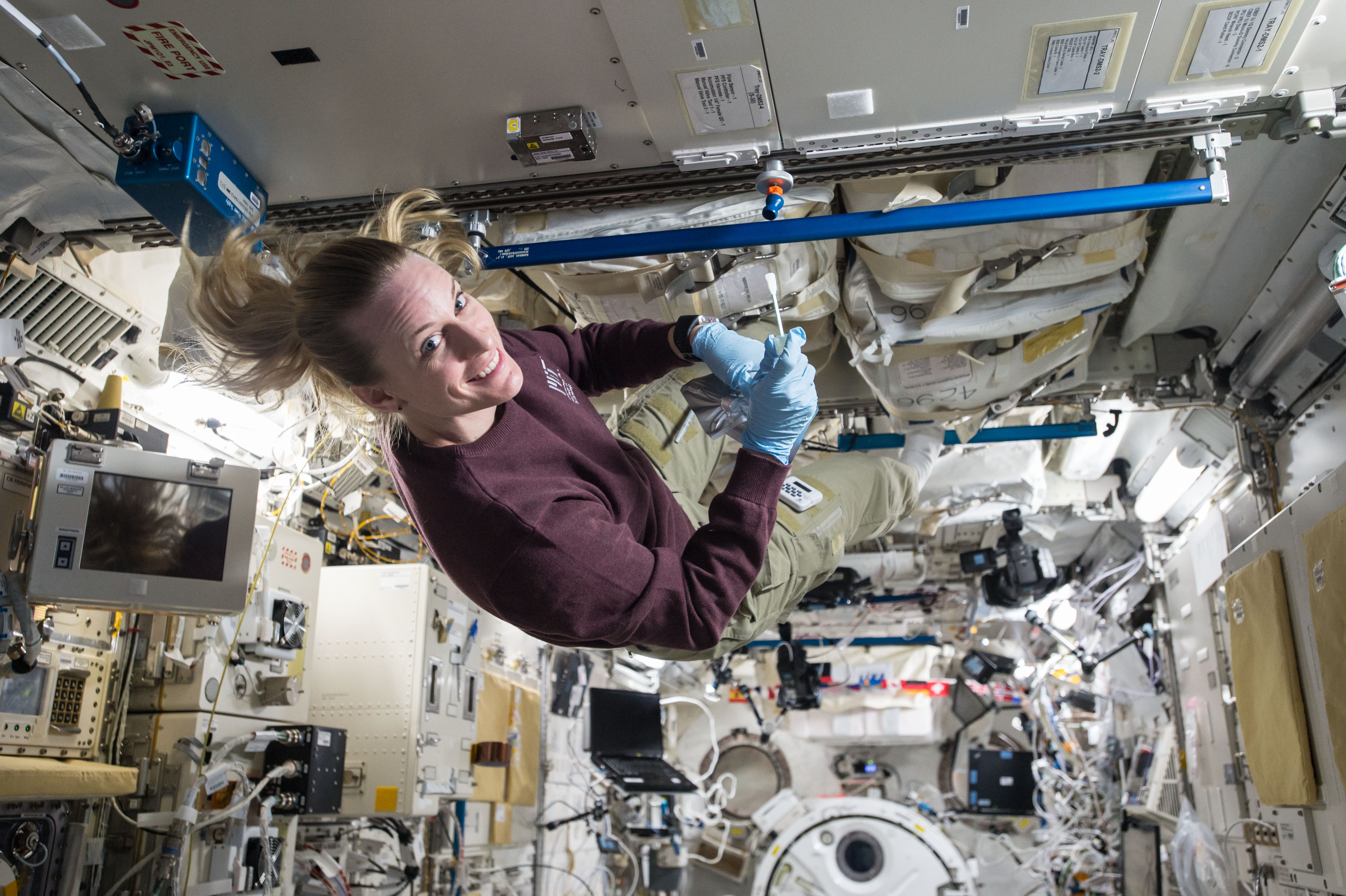
NASA’s companion story, also 19 August, is the public-facing version of the same paper. It states that humans carry, on average, 1 million bacteria on each patch of skin the size of a pencil eraser, and that survival in this study means remaining alive for at least one Earth day, not growing. Both claims are on the NASA page; the million-bacteria line is not a result from Saxena’s model.
Chart-ready numbers
Fractional survivable area is the paper’s comparable output. All figures below are from the 19 August PDF.
| Result | Number | Notes |
|---|---|---|
| 1-day UV fluence, polar extremes | ~1 MJ/m² (highly lit) to 0 (PSRs) | Fig. 1, direct illumination |
| Aspergillus, 1-day, non-PSR, summer | 2–9% of mapped area | three Artemis III regions |
| Aspergillus, 1-day, non-PSR, winter | 15–30% of mapped area | same |
| Aspergillus, ≥7 days, all three regions | ~3% of mapped non-PSR area | “at least 7 days” |
| Fusarium vs Aspergillus area | 4–7× smaller | 1-day threshold |
| Deinococcus vs Aspergillus | 5–9× smaller | 1-day |
| Staphylococcus and Bacillus vs Aspergillus | 11–30× smaller | 1-day |
| Small-crater d/D (Chang’e 3/4/5) | ~0.07 (1–10+ m); ~0.055 (≲1 m) | implies extra micro-PSRs poleward of 87° |
| Scattered UV in sunlit terrain | ~1% of direct | Methods |
| Diviner grid | 240 m | temperature |
| High-res illumination | 5 m/pixel | Artemis III sites |
Winter is the easy season in the model; summer is the hard one. Nobile Rim 2 holds the largest survivable fraction for the three hardiest microbes in summer; Connecting Ridge does in winter. De Gerlache Rim is the smallest in summer. Permanently shadowed regions are more permissive still: with scattered light included, all five microbes can last longer than a week in parts of De Gerlache’s PSR. The authors quote prior work calling lunar PSRs “one of the least biocidal environments in the solar system.” That is a relative statement about UV and heat, not a claim that anything is alive there.
Why it matters
Artemis is going where the ice is. Ice is in the cold traps. Cold traps are also where organic contamination, once delivered, is hardest to cook off. The paper’s policy line is blunt: there are currently no bioburden requirements for spacecraft bound for the lunar surface, and Category II PSR practice may need a harder look. That is a contamination-control argument, not a public-health scare. Needham, a co-author, is an Artemis contamination-control scientist for lunar samples. The NASA story quotes him on Mars: if you want to know whether a signal is indigenous, you need the baseline from before boots and vents.
The optimistic reading, which the authors also write down, is that a survivable niche is a sampling target, not only a place to avoid. If a cell can persist in a cryptobiotic state in a boot-print-scale shadow, then repeated, well-documented sampling of those shadows is how you turn an imperfect landing into a controlled experiment. The same topography that hides ice hides hitchhikers. Mapping both is infrastructure for polar science.
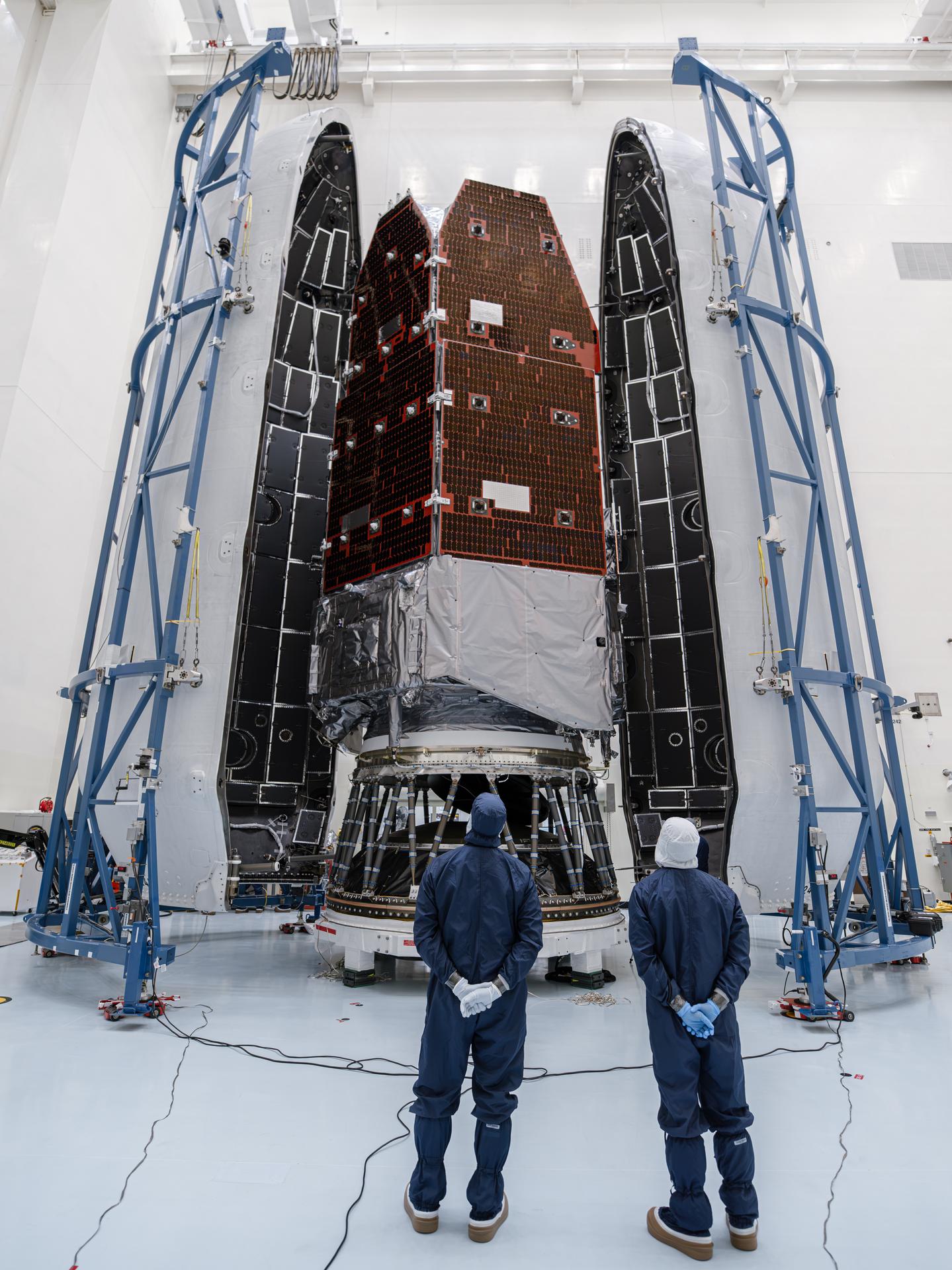
The same NASA week, the Nancy Grace Roman Space Telescope is encapsulated at Kennedy for a targeted 30 August Falcon Heavy launch — polar contamination maps on one desk, a wide-field observatory on another.
Limits
This is a model chained to other people’s inactivation experiments. Lethal doses in Table 1 come from air or surface irradiations at stated humidity and life-cycle stage. A spore on lunar regolith, under vacuum, at 5-meter topographic resolution, is not the same target. The authors say so. They also say growth is not expected: there is no stable, dense atmosphere and no liquid bioavailable water at the surface. Survival is a dormant or persister state. A 7-day Aspergillus contour is not a colony.
Regional 60-meter illumination underestimates shadowing in poorly lit ground and overestimates it in highly lit ground relative to the 5-meter ray-trace. PSRs are masked to zero direct flux on the regional maps. Sub-meter craters and boot prints are extra niches from Chang’e d/D ratios, not a second simulation.
NASA’s 1-million-bacteria-per-eraser line is a human-microbiome average on the agency page. It is not a predicted polar bioburden. Do not treat it as a lunar census.
What to watch next
Three tests would move this from a map to a measurement. First: a payload that actually exposes a known spore strip in a south-polar PSR and brings it home, or assays it in situ, on a timescale of days to a week. Until that flies, 3% and 7 days are model output. Second: whether Artemis contamination-control requirements for Category II PSRs change in writing, with a bioburden number attached. A paper is not a planetary-protection rule. Third: whether Nobile Rim, Connecting Ridge and De Gerlache keep their status as Artemis III candidates once ice science and contamination science are scored on the same overlays.
Until then the sourced claim is specific: Science Advances, 19 August 2026, five Earth microbes, LRO Diviner and LOLA, Aspergillus at about 3% of mapped Artemis III terrain for at least seven days, survival not growth, no lunar culture.