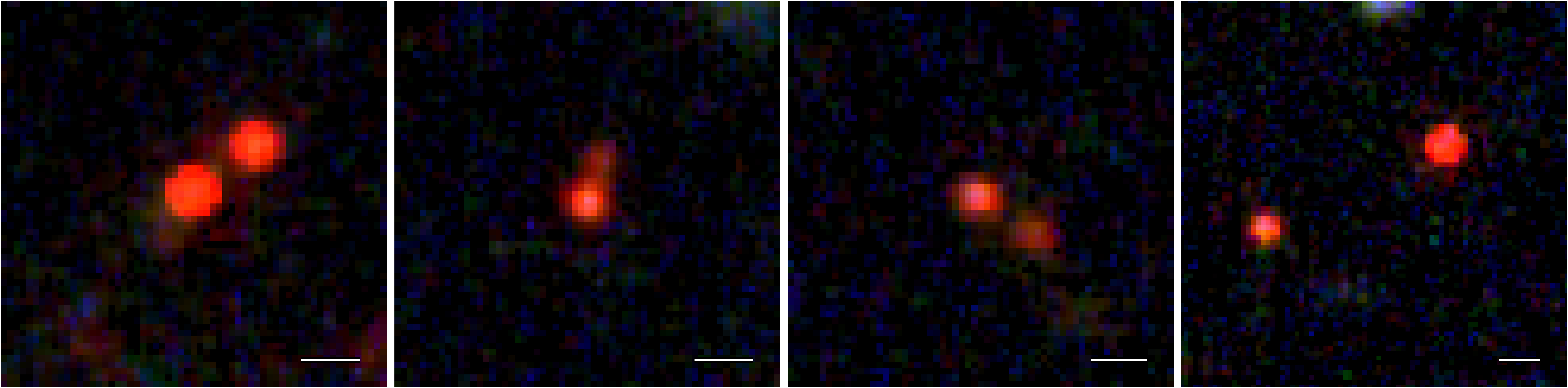
On 31 August 2026, a University of Tokyo / Kavli IPMU team led by graduate student Takumi Tanaka, with John Silverman and dozens of COSMOS collaborators, reported four dual Little Red Dot (LRD) systems in JWST’s COSMOS-Web field — compact, extremely red objects thought to host rapidly growing black holes when the universe was only about a billion years old. The paper, Hidden in Pixels. I., went live in Publications of the Astronomical Society of Japan (DOI 10.1093/pasj/psag092); the Kavli IPMU release pegs the lookback at ~12.5–12.8 billion years.
Two of the four pairs have COSMOS-3D slitless spectroscopy: matching single lines (assumed Hα) put them at z = 5.822 and z = 5.464, with projected separations 1.64 kpc and 7.36 kpc. Across the sample, the LRD angular auto-correlation shows roughly a 20–30× excess on sub-arcsecond (kilo-parsec) scales versus an extrapolation of the power-law clustering of JWST-found AGNs measured on 10″–100″ scales. These are precursor dual LRDs / merger candidates — not confirmed black-hole mergers already completed, and not all four pairs are spectroscopically locked.
Why it matters
Every big galaxy today has a supermassive black hole. Nobody fully knows how those holes got huge so fast in the first billion years. JWST’s Little Red Dots are one of the leading clues: tiny, red, often showing broad Balmer lines, abundant enough that their number density sits well above a simple extrapolation from luminous quasars.
Mergers are a standard growth channel on paper — gas inflows, dual active nuclei, later gravitational waves — but until this work, nobody had a clean sample of two LRDs sitting on top of each other. Conventional LRD searches used aperture color plus compactness cuts that can glue a close pair into one “dot” or throw the system out. Tanaka’s group flipped the method: color every pixel, relax compactness, and hunt for red cores that are actually twins.
For a stranger, the stake is visual and simple. Four pairs of infant-universe black-hole engines, some already confirmed at the same redshift, sitting thousands of light-years apart — a collision course you can point at on a JWST cutout. If the pairs really merge later, future space gravitational-wave observatories such as LISA could hear the echoes.
Key numbers
| Metric | Value | Notes |
|---|---|---|
| Dual LRD candidate pairs | 4 | COSMOS-Web; pixel-by-pixel color selection |
| Lookback age (IPMU release) | ~12.5–12.8 billion years | Early-universe window |
| Spectroscopic redshifts (2 pairs) | z = 5.822, z = 5.464 | Matching single lines; assumed Hα |
| Projected separations (those 2) | 1.64 kpc, 7.36 kpc | Physical, not comoving |
| Angular separations (all 4) | 0.2″–1.2″ | Few thousand to tens of thousands of ly |
| Clustering excess on kpc scales | ~20–30× | vs extrapolated JWST AGN ACF (10″–100″) |
| Parent cleaned LRD sample | N = 829 | Pixel method; ~2× Akins et al. aperture sample |
| Chance of 4 pairs ≤1.2″ at random | ~7×10⁻⁵ (~3.8σ) | Monte Carlo in COSMOS-Web-like field |
| Journal / date | PASJ, 31 Aug 2026 | DOI 10.1093/pasj/psag092 |
| Lead | Takumi S. Tanaka (UTokyo / Kavli IPMU) | Silverman et al. |
Pair separations run from a few thousand to a few tens of thousands of light-years — far smaller than the Milky Way’s ~100,000-light-year disk. That is close, in galaxy terms.
How they found them
COSMOS-Web covers 0.54 deg² with NIRCam (and a MIRI subset). Instead of one color per aperture, the team built S/N and (m_F277W − m_F444W) maps, kept contiguous patches of ≥10 pixels with per-pixel S/N > 1 and color > 1.5, then cleaned artifacts with DINOv2 + UMAP + DBSCAN and visual inspection. Four systems survived where both neighbors independently meet LRD color criteria inside a 3″ cutout.
Image modeling with galight favored compact PSF-like components. Brown-dwarf templates fit worse than LRD SED models. Two systems — CW-B2-4383 and CW-A4-16093 — fall inside COSMOS-3D F444W grism coverage. Each shows a line at the same observed wavelength in both components. Alternative line IDs (C IV, Mg II, Hβ, Paschen) clash with photometry or missing [O III]; Hα at z = 5.822 and 5.464 fits. Brighter components show broad-line evidence (FWHM ~1800–2100 km s⁻¹ in double-Gaussian fits); fainter components are noisier — a broad line may simply be undetected.
Velocity offsets between the spectroscopically confirmed members are tiny (Δv ≈ 13 and 47 km s⁻¹), well below estimated escape speeds from ~10¹¹–10¹¹·⁵ M_⊙ halos at these separations. Fly-bys are unlikely; the pairs sit deep inside a shared halo’s virial radius.
Black-hole mass estimates still disagree by method: single-epoch broad Hα gives roughly 10⁷ M_⊙; BH-envelope blackbody fits assuming near-Eddington radiation give closer to 10⁵·³–10⁶·³ M_⊙. Either way, the paper argues early mergers in the 10⁵–10⁷ M_⊙ range are on the table.
What this is not
- Not confirmed mergers. The authors call the sample “likely to represent precursors of mergers between LRDs.”
- Not four spectroscopically confirmed pairs. Two have matching-line support; two remain photometric (system z_photo ~6.4).
- Not proof every LRD is a black hole in the same way. The field still debates envelopes, stellar contributions, and selection. The paper’s working frame is rapidly accreting early SMBHs.
- Not Roman Space Telescope news. Different mission, different story already on this site.
What to watch
- Deeper NIRSpec IFU on all four systems — especially the two photometric pairs and the off-centered extended fluff around CW-B5-15958.
- The same pixel method on more JWST treasury fields. CEERS, JADES, and PRIMER-UDS turned up no duals yet; their combined area is still several times smaller than COSMOS-Web, so the null is not a contradiction.
- A proper dual fraction with completeness corrections (raw four / 829 ≈ 0.5% is only a starting sketch).
- Whether kilo-parsec LRD clustering stays special once large WFSS programs build matched galaxy and AGN control samples — and whether LISA-era forecasts can use dual-LRD rates as a prior on early SMBH merger rates.
Four red twins in the infant universe, two already locked at the same redshift, clustering far above chance: that is the progress signal. The mergers themselves are still in the future — of the cosmos, and of the observing queue.
Sources
- Kavli IPMU press release, 31 Aug 2026. https://www.ipmu.jp/en/20260831-LRD
- University of Tokyo School of Science press, 31 Aug 2026. https://www.s.u-tokyo.ac.jp/en/press/11226/
- Tanaka, T. S. et al. Hidden in Pixels. I. Discovery of dual “little red dots” indicates excess clustering on kilo-parsec scales. PASJ (31 Aug 2026). DOI 10.1093/pasj/psag092; arXiv abstract/numbers: https://arxiv.org/abs/2412.14246