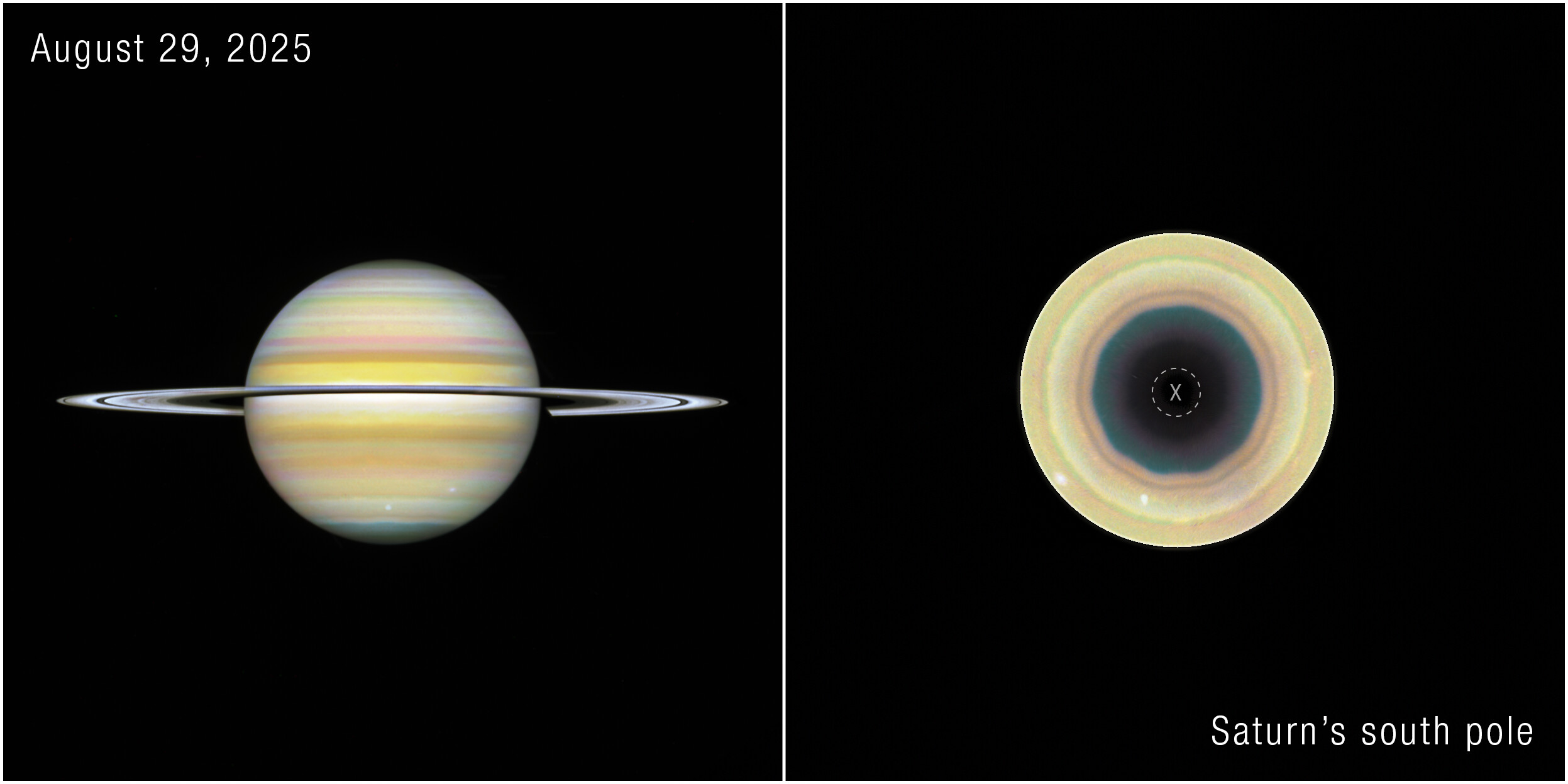
NASA’s Hubble Space Telescope has confirmed a giant, evolving 10-sided atmospheric wave wrapping Saturn’s south pole — the first large, regular-sided jet pattern ever reported in the planet’s southern hemisphere.
The NASA and ESA/Hubble releases landed on 2 September 2026, with the peer-reviewed results in Science Advances. This is a newly strengthening polar jet pattern, not a new moon, not a weather forecast for Earth, and not proof the famous northern hexagon has a permanent twin.
Why it matters
Saturn’s north pole has hosted a six-sided jet — the hexagon — for more than 40 years of continuous watching. Scientists have hunted a southern counterpart in Hubble data since 1990. Cassini’s full southern surveys from 2004 to 2017 never found a long-lived southern polygon. A southern decagon (ten sides) means polygonal polar jets are not a one-off northern quirk. It also gives researchers a rare live view of a giant pattern forming, instead of only studying one that has already settled in for decades.
The numbers
| Fact | Figure | Source |
|---|---|---|
| Sides of the new southern wave | 10 (decagon) | NASA Science / ESA Hubble, 2 Sep 2026 |
| Northern hexagon tracked continuously | >40 years | Amy Simon, NASA Goddard (OPAL) |
| Hubble confirms the feature back to | 2023 | NASA / ESA releases |
| Polar latitude of the clear decagon | ~63°S | UC Berkeley SSL summary of OPAL images |
| Upper-troposphere winds shaping the visible wave | ~400 km/h | UC Berkeley SSL / study team |
| Nearby anticyclone latitude | ~55°S (darkened in 2025) | UC Berkeley SSL |
Hubble’s multi-filter views show the wave is not a flat cloud sketch. It sits inside a powerful jet and extends through multiple atmospheric layers, so its outline shifts slightly with wavelength as different altitudes come into view.
How they found it
Lead author Agustín Sánchez-Lavega (University of the Basque Country) and amateur observers Trevor Barry and Jean-Paul Oger first flagged a subtle undulating southern band in ground-based images fed into the Planetary Virtual Observatory Laboratory in 2024. Stronger ground views in 2025 pushed the team toward Hubble.
Hubble’s Outer Planet Atmospheres Legacy (OPAL) program — led by Amy Simon at NASA Goddard, with co-author Michael Wong at UC Berkeley — had already been photographing the outer planets yearly for more than a decade. Polar projections of 2024 and 2025 Hubble frames made the ten-sided outline unmistakable near 63°S. Looking back, the team could see weaker vertices in 2023 images: an evolving feature, not an overnight flip.
Cassini once saw a brief polygonal look near the southern jet around 60.5°S in 2004, but that disturbance lasted only days and never returned. The new decagon is different: multi-year, strengthening, and vertically extended.
What this is not
- Not a confirmed permanent twin of the northern hexagon. Simon notes the southern feature still appears to be changing and may or may not settle.
- Not a Cassini rediscovery. Cassini never logged a long-lived southern polygon.
- Not a surface “storm cloud” only. Multi-wavelength Hubble data show structure across altitudes.
- Not explained down to the aerosol chemistry. The blue tint’s particle mix is still unknown, and deeper vertical structure needs more modeling.
Wong and colleagues flag a darkening anticyclonic vortex near 55°S in 2025, just before the decagon became obvious — a plausible trigger, still unproven without better 3-D simulations.
What to watch
The team wants continued Hubble monitoring plus James Webb Space Telescope time and shallow-water / 3-D models to learn whether the decagon locks in like the northern hexagon or keeps evolving. Saturn’s south pole only returned to a useful Earth viewing angle in 2023 after years of seasonal tilt, so the observational clock is finally running again.
Wong and the OPAL team also note a compact anticyclonic vortex near 55°S that darkened sharply in 2025, just as the decagon became obvious. That timing is a clue, not a closed case: “Perhaps the vortex caused the initial perturbation, and then the balance of forces caused the persistent decagon,” Wong said. “We really need more detailed simulations of its 3-D structure to know for sure.”
Sánchez-Lavega’s shallow-water models show a decagon can emerge in a turbulent fluid. Those runs are existence proofs. They do not yet deliver a finished Saturn forecast, and the aerosol chemistry behind the wave’s blue tint remains unknown.
The northern hexagon, briefly
Voyager-era images in 1980 revealed the northern hexagon; Cassini later showed it can shift color from blue toward gold while keeping its six-sided outline. Lab tanks of spinning liquid can mimic polygonal jets, but Saturn’s real drivers — deep winds, seasonal chemistry, vertical wave trapping — are still debated. The southern decagon adds a second, younger data point instead of another theory paper alone.
Saturn’s seasons matter here. Axial tilt hid the south pole from useful Earth viewing after mid-2012; it only came back into play in 2023. That gap is why a southern pattern could grow for years without anyone on Earth catching a clean polar map.
OPAL’s Saturn cadence started in 2018, after Cassini’s planned plunge ended the orbiter era. The program’s whole pitch was patience: yearly maps, not one spectacular snapshot. If the decagon holds, Saturn joins a short list of worlds where giant polygonal jets are a repeatable atmospheric mode. If it fades, scientists still win — they will have watched a planetary-scale wave rise and fall in near-real time.
Sources
- NASA Science — NASA’s Hubble Tracks New Decagon Encircling Saturn’s South Pole (2 Sep 2026)
- ESA/Hubble — heic2612 (2 Sep 2026)
- UC Berkeley Space Sciences Lab — Decagon wave emerges near Saturn’s south pole (Alan Toth; OPAL team summary)
- Peer-reviewed paper: A. Sánchez-Lavega et al., “A decagon wave around Saturn’s south pole,” Science Advances (2026). DOI 10.1126/sciadv.aee4251