The World Health Organization and the Africa Centres for Disease Control and Prevention on 27 August 2026 welcomed the end of Uganda’s Ebola outbreak. The clock WHO actually ran is 42 consecutive days with no new confirmed case since the last patient — an imported case — was discharged on 16 July 2026. Uganda recorded 20 confirmed Bundibugyo cases, 18 recoveries and two deaths. More than 800 contacts were identified and monitored.
That is not the Democratic Republic of the Congo outbreak. WHO says that one continues. It is not eradication. It is not a Bundibugyo vaccine win — there is still no approved vaccine for this species. Twenty cases is a contained import cluster, not a continental all-clear. WHO continues to advise against travel and trade restrictions: no flight suspensions, no border closures, no denying entry to travellers from affected countries.
“Uganda has demonstrated that with decisive action, Ebola outbreaks can be brought under control quickly,” said Dr Tedros Adhanom Ghebreyesus, WHO Director-General. The rest of his line is the policy under the headline: with preparedness, surveillance in clinics and communities, and careful management of points of entry, “countries can keep people and goods moving while ensuring people stay safe, or receive care if they are sick.”
Why it matters
Uganda just showed that an Ebola spillover from a neighbour can be stopped before it becomes a national epidemic — and that the internationally agreed way to say so is a 42-day countdown, twice the upper limit of Ebola’s incubation period, not a briefing the day the last ward emptied.
The country declared the outbreak on 15 May 2026. Fifteen of the 20 confirmed cases were imported from the DRC; five were locally acquired among contacts and health workers linked to those imports. Uganda announced interruption of local transmission on 28 July. WHO and Africa CDC waited out the additional 42 days after the 16 July discharge, then said the outbreak in Uganda had ended.
Al Jazeera, reporting on 26 August, named the impatience. Diana Atwine, permanent secretary at Uganda’s Health Ministry, told NTV that officials had already assessed the chain of transmission and “knew that we were free from Ebola.” WHO, she said, “had to wait because that’s the process. That’s the guideline.” She asked countries that had imposed travel restrictions to lift them.
This is a public-health print, in the same family as Burkina Faso’s malaria vaccine cut cases by a third: a named African count, a named date, a named institution. Neither is a claim that the continent is finished with the pathogen.
The Uganda print
WHO’s 27 August news release, issued jointly with Africa CDC, is the source for the table. Africa CDC carried the same figures the same day.
| Measure | WHO / Africa CDC, 27 August 2026 |
|---|---|
| Confirmed Bundibugyo cases | 20 |
| Imported from the DRC | 15 |
| Locally acquired (contacts and health workers linked to imports) | 5 |
| Recovered | 18 |
| Died | 2 |
| Contacts identified and monitored | more than 800 |
| Consecutive days with no new confirmed case | 42 |
| Last patient discharged | 16 July 2026 (imported case) |
| Outbreak declared | 15 May 2026 |
| Uganda announced interruption of local transmission | 28 July 2026 |
Al Jazeera adds two operational details the 27 August release does not name: the last confirmed case was recorded on 21 June, and the last patient was discharged from Mulago National Referral Isolation Centre. WHO Disease Outbreak News of 17 July 2026 had already said no new Ugandan cases had been reported since 21 June, and that the most recent case left care on 16 July after two negative tests — the start of the countdown that ended this week.
How they stopped it
WHO lists the package, not a protocol: case detection and confirmation, contact tracing, isolation and clinical care, infection prevention and control, community engagement, and stronger surveillance at health facilities and points of entry. H.E. Dr Jean Kaseya, Africa CDC Director-General, put the political sentence on it: “Uganda has shown that Ebola can be stopped when leadership acts decisively, communities are trusted and public health systems reach people quickly.” Then the continental clause: “We must now protect this achievement while accelerating the response in the DRC. We will only be secure when transmission is stopped everywhere.”
Dr Mohamed Janabi, WHO Regional Director for Africa, separated the milestone from the lasting claim: ending an outbreak is important; “the lasting achievement is a stronger ability to protect people from future health threats.”
The species matters for what that package had to do without. Bundibugyo virus is not Zaire Ebola. WHO’s fact sheet is blunt: approved vaccines and treatments exist only for Ebola virus (the Zaire species). For Bundibugyo, “there is no approved vaccine or treatment.” The 14 August Disease Outbreak News said outbreak control relies on identification, isolation, contact tracing, safe burials and community engagement, “as no approved vaccines or specific treatments currently exist for BVD.” CDC’s Health Alert Network notice said there is no FDA-licensed Bundibugyo vaccine, and that Ervebo, licensed for Zaire, “is not expected to protect against Bundibugyo virus” on the animal data. Uganda did not vaccinate its way out of this cluster. It traced it.
Oxford’s ChAdOx1 BDBV entered a 50-person Phase 1 trial in July, Gavi reported. WHO’s vaccine-prioritization group, on 31 July, recommended licensed Ervebo for a Phase 3 research study in the DRC. On 20 August, WHO and Africa CDC welcomed 70,000 Ervebo doses for the DRC — 20,000 for that trial, 50,000 for frontline workers. WHO was explicit: it is not known whether Ervebo protects humans against Bundibugyo. That file is not why Uganda’s 20 cases ended.
On the same day as the all-clear, WHO handed Uganda a truck-mounted mobile Biosafety Level 3 laboratory, funded with the African Development Bank, to test high-risk samples in the field. Al Jazeera reported Uganda is also supporting treatment and laboratory sites at Aru and Kasenyi in Ituri, and had announced two more Ebola treatment centres in the DRC, bringing its total there to four.
What this is not
It is not the end of Ebola in Africa. WHO’s 27 August release says the milestone “comes as the Ebola outbreak continues in the Democratic Republic of the Congo.” Close ties and cross-border trade mean neighbours remain at risk of imported cases. On 24 August, WHO AFRO reported that the DRC had crossed 100 days and recorded more than 5,200 cases — about 90 confirmed cases a day in the first three months, now in a sixth province, Ituri about 85 percent of cases. Situation Report 15, data as of 23 August, put the DRC at 5,584 confirmed cases and 2,680 deaths, case fatality 48.0 percent, status active. Uganda’s 20 do not cancel those counts.
It is not eradication. The 42-day rule is a safeguard that no chain linked to the last imported case was missed. It is not a statement that Bundibugyo cannot re-enter.
It is not a reason to shut airports. “WHO continues to advise against travel and trade restrictions related to Ebola outbreaks. WHO does not recommend suspending flights, closing borders, or denying entry to travellers from affected countries.”
What to watch
- Re-importation. Neighbouring countries stay at risk while DRC transmission continues. The next imported case is the test of the surveillance WHO says kept running after 16 July.
- The DRC curve. Sitrep 15 is still active, six provinces, 57 health zones. The 24 August note said community deaths accounted for around 60 percent of 260 weekly fatalities over the previous six weeks.
- Bundibugyo vaccines. Ervebo’s Phase 3 in the DRC and Oxford’s Phase 1 are research. Do not write them onto Uganda’s 20 cases.
- Travel measures. Atwine asked countries that restricted Uganda to lift those rules. WHO’s advice was already not to impose them.
- The mobile BSL-3. The same-day laboratory handover is the preparedness claim in hardware. The next outbreak is when that truck shortens time-to-result — or does not.
Sources
- WHO Regional Office for Africa, “Uganda ends Ebola outbreak following completion of 42-day countdown,” 27 August 2026 — https://www.afro.who.int/countries/uganda/news/uganda-ends-ebola-outbreak-following-completion-42-day-countdown
- Africa CDC, joint press release, 27 August 2026 — https://africacdc.org/news-item/uganda-ends-ebola-outbreak-following-completion-of-42-day-countdown/
- Al Jazeera, “World Health Organization says Ebola outbreak in Uganda is over,” 26 August 2026 — https://www.aljazeera.com/news/2026/8/26/world-health-organization-says-ebola-outbreak-in-uganda-is-over
- WHO AFRO, “Over 5200 cases recorded as Democratic Republic of the Congo crosses 100 days since Ebola outbreak declaration,” 24 August 2026 — https://www.afro.who.int/countries/democratic-republic-of-congo/news/over-5200-cases-recorded-democratic-republic-congocrosses100-days-ebola-outbreak-declaration
- WHO AFRO, Weekly External Situation Report 15, data as of 23 August 2026 — https://www.afro.who.int/sites/default/files/2026-08/Wk_Ext_SitRep_1523082026_0.pdf
- WHO Disease Outbreak News, 17 July 2026 (DON-613; no new Uganda cases since 21 June) — https://www.who.int/emergencies/disease-outbreak-news/item/2026-DON613
- WHO Disease Outbreak News, 14 August 2026 — https://www.who.int/emergencies/disease-outbreak-news/item/2026-DON615
- WHO, “Ebola disease” fact sheet — https://www.who.int/news-room/fact-sheets/detail/ebola-virus-disease
- WHO and Africa CDC, Ervebo allocation to the DRC, 20 August 2026 — https://www.who.int/news/item/20-08-2026-who-and-africa-cdc-welcome-the-allocation-of-ebola-vaccines-to-the-democratic-republic-of-the-congo
- WHO TAG-CVP Bundibugyo meeting report, 31 July 2026 — https://www.who.int/publications/i/item/B09865
- Gavi, Bundibugyo vaccine Phase 1, 23 July 2026 — https://www.gavi.org/vaccineswork/worlds-first-bundibugyo-ebola-vaccine-has-entered-human-trials-heres-why-it-matters
- CDC Health Alert Network HAN-00530 — https://www.cdc.gov/han/php/notices/han00530.html
- WHO AFRO, mobile BSL-3 laboratory handover, 27 August 2026 — https://www.afro.who.int/countries/uganda/news/who-donates-mobile-laboratory-strengthen-ugandas-outbreak-preparedness
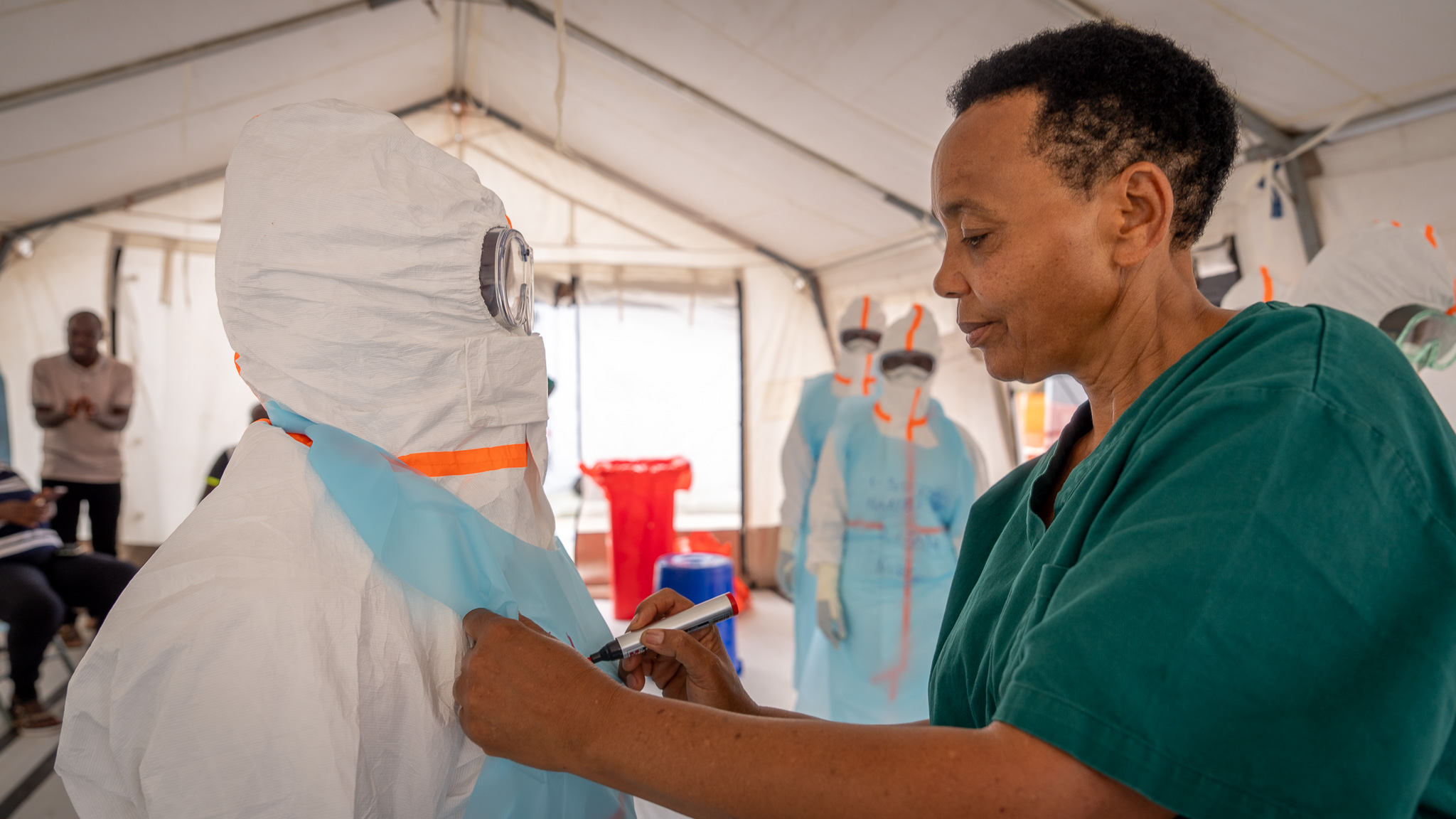
Cover: WHO Regional Office for Africa, 27 August 2026 Uganda outbreak-end news release (Uganda_PR_0.jpg). Health workers donning PPE in an Ebola treatment tent. Not a news-agency photograph.