On 4 September 2026 the U.S. Food and Drug Administration granted accelerated approval to camizestrant — sold as Etcamah by AstraZeneca — in combination with a CDK4/6 inhibitor (abemaciclib, palbociclib, or ribociclib) for adults with hormone receptor–positive, HER2-negative locally advanced or metastatic breast cancer when an ESR1 mutation is detected during aromatase-inhibitor plus CDK4/6 therapy on an FDA-authorized test. The agency also cleared the Guardant360 CDx assay as the companion diagnostic.
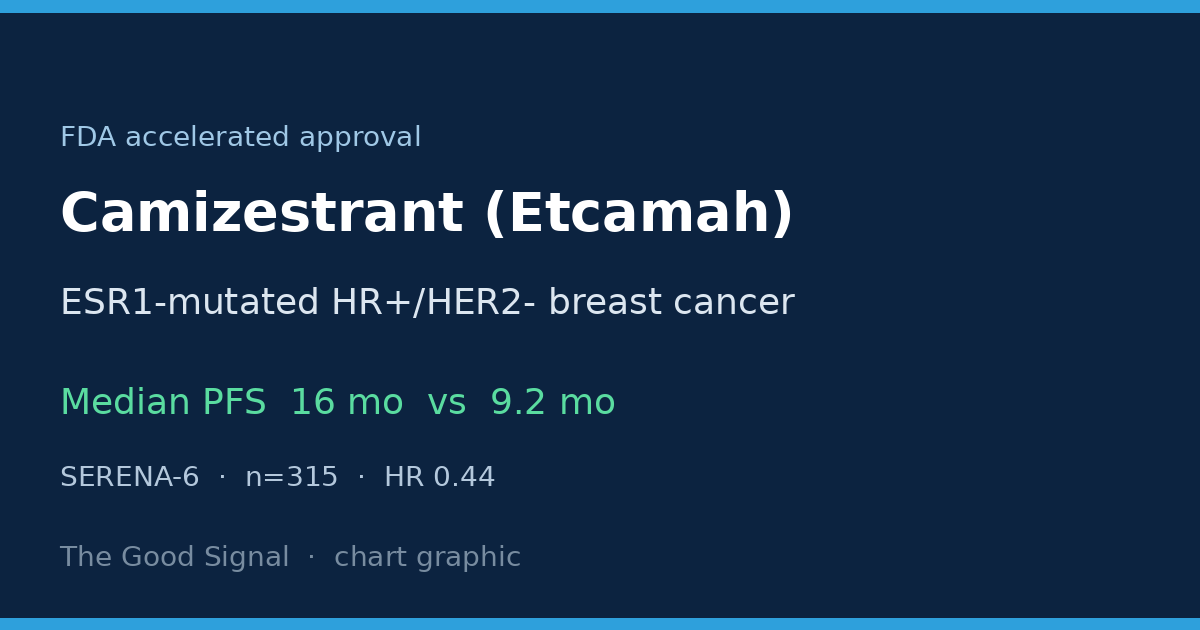
In the pivotal SERENA-6 trial (NCT04964934), 315 patients were randomized 1:1. Median progression-free survival was 16 months (95% CI 12.7–18.2) on camizestrant plus a CDK4/6 inhibitor versus 9.2 months (95% CI 7.2–9.5) for those who stayed on an aromatase inhibitor plus CDK4/6 — a hazard ratio of 0.44 (95% CI 0.31–0.60; p < 0.00001). That is roughly nearly 7 months more median time without radiographic progression after the mutation showed up in blood. Overall survival data were not mature. Accelerated approval is not full approval; confirmatory trials must still verify clinical benefit.
Why it matters
Most people with HR-positive metastatic breast cancer start on an aromatase inhibitor plus a CDK4/6 drug. Over time, many tumors pick up ESR1 mutations that help them escape that endocrine pressure. At diagnosis of HR-positive metastatic disease, fewer than 5% of patients already carry the mutation. After progression on an aromatase inhibitor, nearly 40% do, according to the FDA’s 4 September press announcement.
Etcamah is an oral estrogen-receptor antagonist aimed at that acquired resistance. What is new is when the label lets clinicians act: upon ctDNA detection of ESR1 during first-line AI + CDK4/6 therapy — before scans necessarily show the disease getting worse. Acting FDA Commissioner Kyle Diamantas framed the decision as giving patients “a targeted therapy designed specifically to overcome resistance, giving them more time before their disease progresses.” Oncology Center of Excellence director Angelo de Claro called it the first FDA approval of a cancer therapy guided by a resistance mutation in circulating tumor DNA before imaging shows progression — and added that more evidence is still needed to confirm clinical benefit.
That last clause is not fine print. On 30 April 2026, the Oncologic Drugs Advisory Committee voted 6–3 that the SERENA-6 strategy had not shown a clinically meaningful benefit relative to waiting for radiographic progression. The FDA still granted accelerated approval months later, while requiring confirmatory work. Progress here is real PFS numbers for a defined mutation — and an unresolved debate about whether switching at a blood signal beats the older sequence of waiting for scans.
Key numbers
| Metric | Value |
|---|---|
| FDA accelerated approval | 4 September 2026 |
| Drug (brand) | camizestrant (Etcamah, AstraZeneca) |
| Combination | + CDK4/6 inhibitor (abemaciclib, palbociclib, or ribociclib) |
| Indication gate | ESR1 mutation on FDA-authorized test during AI + CDK4/6 therapy |
| Companion diagnostic | Guardant360 CDx |
| Trial | SERENA-6 (NCT04964934), randomized 1:1, double-blind |
| Sample size | n = 315 |
| Eligibility on prior therapy | ≥6 months on AI + CDK4/6 with no progression |
| Median PFS — camizestrant arm | 16 months (95% CI 12.7–18.2) |
| Median PFS — AI arm | 9.2 months (95% CI 7.2–9.5) |
| Hazard ratio | 0.44 (95% CI 0.31–0.60); p < 0.00001 |
| Approximate median PFS gap | ~6.8 months (~nearly 7 months) |
| Overall survival | immature at PFS analysis |
| Dose | 75 mg oral once daily (with or without food) |
| ESR1 at metastatic diagnosis | <5% |
| ESR1 after AI progression | nearly 40% |
| ODAC (30 Apr 2026) | 6–3 against clinically meaningful benefit of the switch strategy |
How it worked
SERENA-6 enrolled adults with ER-positive, HER2-negative locally advanced or metastatic breast cancer who were already on an aromatase inhibitor plus a CDK4/6 inhibitor as initial endocrine-based treatment. Investigators used blood ctDNA testing with Guardant360 CDx to find ESR1 mutations while patients were still progression-free. Everyone had to have been on AI + CDK4/6 for at least six months with no progression by investigator assessment.
Patients were then randomized to switch the endocrine partner to camizestrant once daily while continuing the same CDK4/6 inhibitor, or to continue the aromatase inhibitor (anastrozole or letrozole) plus CDK4/6. The primary endpoint was investigator-assessed progression-free survival per RECIST v1.1. Overall survival was a secondary endpoint and remains immature.
The labeled dose is 75 mg orally once daily until progression or unacceptable toxicity, always with a CDK4/6 inhibitor kept at the dose used when the ESR1 mutation was found. Prescribing information carries a boxed warning for arrhythmia risk from QTc prolongation when Etcamah is taken with other QTc-prolonging drugs, plus warnings for bradycardia and embryo-fetal toxicity.
The review ran under Project Orbis with partners in Australia, Brazil, Canada, Singapore, and Switzerland; camizestrant had breakthrough therapy designation. Accelerated approval rests on PFS measured from ESR1 detection, not from the usual radiographic-progression start line — the design choice that drove much of the ODAC debate.
What this is not
- Not full approval. It is accelerated approval on a PFS endpoint; continued approval depends on confirmatory trials that verify clinical benefit.
- Not a proven overall-survival win. OS data were immature at the PFS analysis. Survival benefit is not established.
- Not proof that ctDNA switching beats waiting for scans. The FDA’s own press note says it is not yet confirmed whether intervening at mutation detection, rather than at confirmed radiographic progression, translates into clinically meaningful benefit — which is why confirmatory studies are required. ODAC’s 6–3 vote against the strategy is the advisory context for that caution.
- Not first-line therapy for all breast cancer. The label is for HR+/HER2− locally advanced or metastatic disease after ESR1 appears during AI + CDK4/6 therapy, on an authorized test.
- Not a cure. Median PFS improved; disease can still progress. Safety risks (QTc/arrhythmia with interacting drugs, bradycardia, embryo-fetal toxicity) are labeled.
- Not “doubling” progression-free time. Sixteen months versus 9.2 months is about 1.7×, or nearly 7 months of extra median PFS — not a clean 2× claim.
What to watch
- Confirmatory trials and Project Confirm. Accelerated approval stands or falls on whether later studies show durable clinical benefit, including clearer survival and sequencing answers.
- Overall survival maturity. Reporting timelines matter; immature OS was a central ODAC concern.
- Real-world Guardant360 CDx use. How often clinics test ctDNA during stable first-line therapy, and how payers cover mutation-triggered switches, will decide how many patients actually see the label pathway.
- Safety in combination. QTc interactions, bradycardia, and embryo-fetal toxicity need pharmacovigilance as use expands beyond trial centers.
- International Orbis partners. Parallel reviews in TGA, ANVISA, Health Canada, HSA, and Swissmedic may broaden access on staggered calendars.
For patients who already live with metastatic HR-positive disease and whose tumors pick up ESR1 while AI + CDK4/6 still looks stable on scans, 4 September 2026 adds a labeled option: an oral pill that, in SERENA-6, held progression for a median 16 months after the mutation appeared, versus 9.2 months without the switch. The honest hedge travels with that number — accelerated, OS unknown, ODAC split, confirmatory trials required.
Sources
- FDA, “FDA grants accelerated approval to camizestrant with a CDK4/6 inhibitor for ESR1-Mutated HR-positive, HER2-negative locally advanced or metastatic breast cancer,” 4 September 2026 — https://www.fda.gov/drugs/resources-information-approved-drugs/fda-grants-accelerated-approval-camizestrant-cdk46-inhibitor-esr1-mutated-hr-positive-her2-negative
- FDA, “FDA Grants Accelerated Approval to a New Breast Cancer Treatment” (press announcement), 4 September 2026 — https://www.fda.gov/news-events/press-announcements/fda-grants-accelerated-approval-new-breast-cancer-treatment
- ClinicalTrials.gov: NCT04964934 (SERENA-6)
- ODAC context (30 April 2026 vote 6–3): Fierce Biotech — https://www.fiercebiotech.com/biotech/astrazeneca-camizestrant-ambitions-stumble-fda-panel-rejects-novel-oral-serd-proposal ; Endpoints News — https://endpoints.news/fdas-oncology-advisors-vote-against-new-paradigm-in-astrazeneca-trial/
- Cover: TGS chart graphic (16 vs 9.2 months PFS) — not an FDA product photo