On 27 August 2026 a Charité – Universitätsmedizin Berlin team reported in Nature Medicine the first prospective clinical trial of a CD19 CAR T-cell therapy in rheumatoid arthritis. Six adults with severe, treatment-refractory, ACPA-positive disease received a single infusion of mivocabtagene autoleucel (miv-cel) after stopping every disease-modifying antirheumatic drug and after standard lymphodepletion. Disease activity improved in all six. Three reached DAS28-CRP remission and an American College of Rheumatology 70 percent response. Charité’s press note says three patients were on no rheumatoid-arthritis medication at the end of follow-up.
This is a six-person Phase 1. It is not a cure, and it is not an approved treatment for rheumatoid arthritis. Follow-up ran 36 to 52 weeks. The paper records that one patient relapsed after an initial drug-free stretch.
Rheumatoid arthritis is a chronic autoimmune attack on the joints. Standard care can suppress inflammation. It rarely resets the disease. People stay on immunosuppressants for life. The six volunteers, three women and three men aged 31 to 69, had already been through as many as eight targeted or biologic therapies over about a decade. None had been enough.
Why it matters
About the people who live with this: when the newer biologics fail, the remaining options are more of the same class, or living with pain and joint damage. B cells that survive in lymph nodes, bone marrow and joint tissue keep making autoantibodies that restart the fire. Rituximab, an anti-CD20 antibody, depletes circulating B cells and still leaves a tissue reservoir. CAR T cells were built to hunt a surface tag, CD19, that those cells wear.
If a single infusion can take a subset of the hardest cases off all rheumatoid-arthritis drugs for a year, that is a different kind of result from adding a ninth biologic. The honest scale is six people, at a university hospital, with chemotherapy beforehand. Phase 2 of the same COMPARE trial will put the cell therapy against rituximab in ten more patients. That comparison is the one regulators can actually use.
The print
Numbers below are from the Nature Medicine abstract and Charité’s 27 August release, which cites the same paper.
| Trial | COMPARE Phase 1, NCT06475495 |
| n | 6 (3 women, 3 men, ages 31–69) |
| Product | mivocabtagene autoleucel, autologous fully human CD19 CAR T |
| Follow-up | 36–52 weeks |
| DAS28-CRP | median 34% reduction at latest follow-up |
| DAS28-CRP remission + ACR70 | 3 of 6 |
| ACPA against mutated citrullinated vimentin, seroconversion | 4 of 6 |
| Rheumatoid factor IgM, seroconversion | 5 of 6 |
| CRS | all six, grade 1 or 2 only |
| ICANS | none |
| Serious adverse events | none |
| Dose-limiting toxicity | one (grade 3 transaminase rise, resolved) |
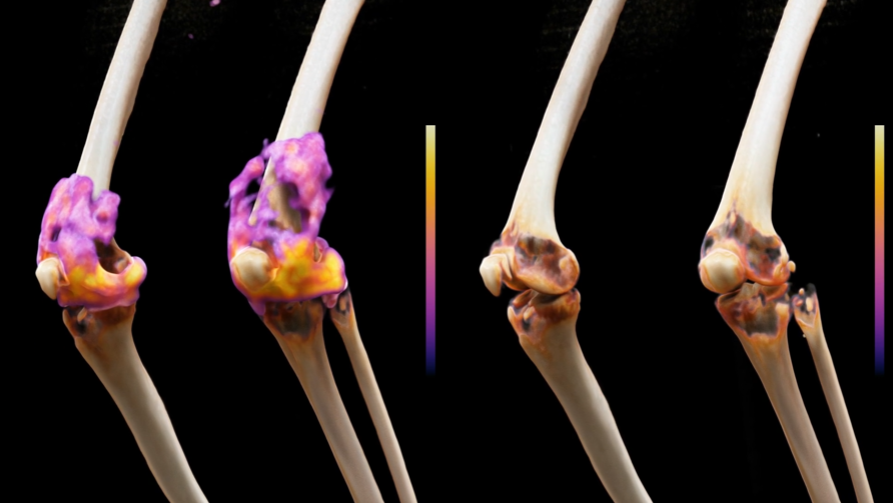
Charité’s release adds the clinical color the abstract compresses: inflammatory foci around a participant’s knees on PET-MRI were gone months later, with less swelling and better movement. Autoantibody levels fell. When B cells came back, they were mostly naïve cells that had not yet been shaped by the disease. Protective antibodies from earlier vaccines, including tetanus and varicella, stayed detectable.
How they did it
T cells were collected from each patient’s blood, given a chimeric receptor that binds CD19, and returned as a single infusion after a short fludarabine–cyclophosphamide lymphodepletion course. That chemo is not optional in this protocol: it clears space so the engineered cells can expand. Once back in the body they hunt CD19-positive B cells in blood and, the team reports, in tissue.
Fredrik N. Albach, Marie C. Rehm, Marie Luise Hütter-Krönke, Thanh Hang Le and Julia M. Giezen share first authorship. David Simon and Gerhard Krönke jointly supervised. Krönke leads the joint Clinical Rheumatology group at Charité and the German Rheumatology Research Center. Simon designed the trial with Krönke. Hütter-Krönke, medical director of the hematology early-trial unit, is the source for the safety line: mild-to-moderate cytokine release syndrome in everyone, no severe neurological events, infections rare.
COMPARE is an investigator-initiated Phase 1/2 study. Kyverna Therapeutics funded the trial and supplied miv-cel. The paper and the Charité release both say the company had no role in design, data, or the write-up. Georg Schett at Erlangen, who has published the broader CAR-T-in-autoimmunity series, is a co-author.
The protocol’s primary endpoints were safety in the first four weeks: cytokine release syndrome, ICANS, and other adverse events. The primary safety bar was met, which is what lets the trial advance. Secondary work looked at clinical scores, CAR T expansion, how long B cells stayed down, and autoantibody titres. Lymph-node histology in one patient at week 16 showed CD19-positive B cells gone from the tissue while some CD138-positive plasma cells remained — a reminder that this product is a CD19 hunter, not a wipe of every antibody-secreting cell.
DAS28-CRP is a 28-joint disease-activity score that folds in C-reactive protein. ACR70 means a 70 percent improvement on the American College of Rheumatology composite. Those are the bars rheumatology trials actually use. A median 34 percent DAS28-CRP drop is the all-patient number; the three people who also hit ACR70 are the ones the headline is about. Do not read “all six got better” as “all six are drug-free.”
What this is not
It is not a license. It is not a randomized comparison with rituximab — that is Phase 2, ten more people. Responses were not uniform. The paper is explicit that disease activity improved in all six and that three hit the combined remission/ACR70 bar; the press note is explicit that one person flared again after a drug-free interval. Lymphodepletion has its own risks. Long-term effects on the immune system are unmeasured. People with garden-variety rheumatoid arthritis who are doing well on methotrexate are not the population here.
Anecdotes of CD19 CAR T cells in rheumatoid arthritis already existed as case reports. This is the first prospective, protocol-defined safety trial in that disease. That is the news, and it is still a first-in-disease Phase 1.
What to watch
Phase 2 of COMPARE, against rituximab. Durability past one year. Whether hypogammaglobulinemia becomes a problem as B cells recover. Whether the seroconversions hold. And whether a hospital-grade cell product can ever be a practical option outside a handful of academic centers.
Sources
- Albach F.N. et al. CD19 CAR T cell therapy for treatment-refractory seropositive rheumatoid arthritis: a phase 1 trial. Nature Medicine, published 27 August 2026. https://doi.org/10.1038/s41591-026-04603-3
- Charité – Universitätsmedizin Berlin. Cell therapy successful in treating severe rheumatoid arthritis. 27 August 2026. https://www.charite.de/en/service/press_reports/artikel/detail/cell_therapy_successful_in_treating_severe_rheumatoid_arthritis/
- ClinicalTrials.gov NCT06475495