Computational pathology has been very good at encoding tiles and less good at the thing a pathologist actually signs: the whole slide, the specimen, the report. On 31 July 2026, Nature Medicine published PRISM2, a slide-level foundation model from Paige.AI with Microsoft Research, Memorial Sloan Kettering Cancer Center and Yale, trained on deidentified MSK slides licensed to Paige. The claim that survives the authors’ own caveats is narrow and large at once: with prompt-based inference and no additional training, PRISM2 matches or exceeds three clinical-grade Paige products on the test sets those products were built for.
What happened
Vorontsov, Shaikovski, Casson et al., “End-to-end multimodal pathology foundation model with clinical dialogue,” Nature Medicine (2026). Received 16 October 2025; accepted 12 June 2026; published / version of record 31 July 2026. Open access, CC BY 4.0. DOI 10.1038/s41591-026-04521-4.
Training data, quoted from the paper:
| Object | Count |
|---|---|
| Whole-slide images | 2,350,518 |
| Specimens / reports | 685,507 |
| Patients | 200,692 |
| Question–answer pairs | 14 million |
| Model size | 4.6 billion parameters (Phi-3 Mini 3.8B + slide encoder) |
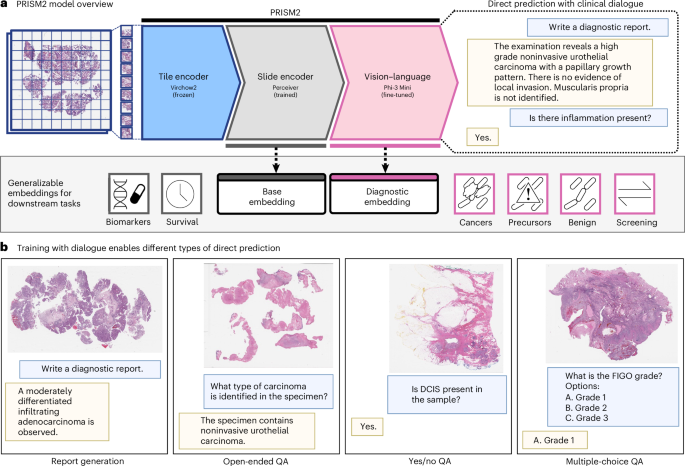
All WSIs are formalin-fixed, paraffin-embedded, H&E, scanned at ×20 / 0.5 microns-per-pixel on Leica scanners. Specimens are MSK-internal and consults submitted from elsewhere; all were scanned and reported at MSK. Tile embeddings come from Virchow2. A perceiver-based slide encoder (541 million parameters plus a 79-million-parameter pooler) builds a base embedding. A LLaVA-style adapter feeds 256 latents into Phi-3 Mini; the hidden state of the assistant token is the diagnostic embedding.
The evaluation that earns the headline is prompt-based yes/no question answering against three clinical-grade products: Paige Prostate (FDA De Novo), Paige Breast (CE-IVD / UKCA), and Paige BLN (FDA Breakthrough; CE-IVD / UKCA). PRISM2 matches Prostate and Breast and outperforms BLN, P < 0.05, on those products’ own testing datasets, without further training. PRISM and TITAN, the contrastive slide-level predecessors, do not match the clinical products in that setting.
Linear probing on the diagnostic embedding, pan-cancer detection: PRISM2 0.967 AUC, versus PRISM2 base 0.956, PRISM 0.947, TITAN 0.931. The drop on rare cancers is modest (0.967 → 0.957). CAMELYON17 lymph-node staging, quadratic weighted κ: PRISM2 diagnostic 0.881, base 0.888, versus PRISM 0.852, TITAN 0.641 (P < 0.05). Survival fine-tune on 225,597 cases / nearly 100,000 patients (69,114 death events). MSK colorectal recurrence-free survival C-index: PRISM2 survival embeddings 0.809 versus a from-scratch survival specialist 0.773.
A pathologist review of 50 held-out specimens puts model error at 7–11% on question answering, higher on free-text diagnostic summaries (hallucinations and omissions). Complementary yes/no training data had an 18% ground-truth error rate, because the pipeline assumes unmentioned findings are absent.
The authors say the goal is not to deploy a conversational agent. Single-turn dialogue is a supervisory signal for slide-level representations. Prompt-based inference is not zero-shot: the indications were seen in training. Weights are CC-BY-NC-ND; not for clinical use.
Why it matters
Matching an FDA De Novo prostate detector without a second training run is a scaling result, not a care-pathway result. The advance is language-supervised whole-slide representation at this corpus size (2.3 million slides), and a dual embedding that lets diagnostic tasks ride the language model while biomarker and survival tasks keep the base vector.
What it is not: a prospective reader trial; a randomised outcome study; a model proven on scanners other than MSK’s Leicas; a chatbot for sign-out. The paper is explicit on each of those. Complementary-question noise at 18 percent is a data limit, not a rounding error. All training slides were scanned at one centre even when the tissue came from elsewhere. Robustness to other scanners is unproven.
For a Good Signal reader the progress is that a foundation model finally sat on the same test sets as products that already have regulatory marks, and did not lose. The honest next sentence is that those test sets are still Paige’s, and the training distribution still runs through MSK.
What to watch next
- A prospective reader study on a non-MSK scanner. Until then, do not write that PRISM2 is in clinical use.
- Biomarker and survival pretraining. The authors flag those as the frontier once diagnostic AUCs saturate. The 0.809 C-index is a fine-tune, not a report-trained skill.
- License and deployment. CC-BY-NC-ND weights plus Paige’s commercial line. Keep those two doors labelled.
Sources
- Vorontsov, E. et al. End-to-end multimodal pathology foundation model with clinical dialogue. Nat Med (2026). https://doi.org/10.1038/s41591-026-04521-4