A City of Hope–led international team reports in Nature Medicine on 16 September 2026 a blood test that flagged early-stage pancreatic ductal adenocarcinoma (PDAC) with 83.8% sensitivity in its testing cohort — and 86.8% sensitivity for stage I–II disease when the microRNA signature is combined with the familiar tumor marker CA19-9.
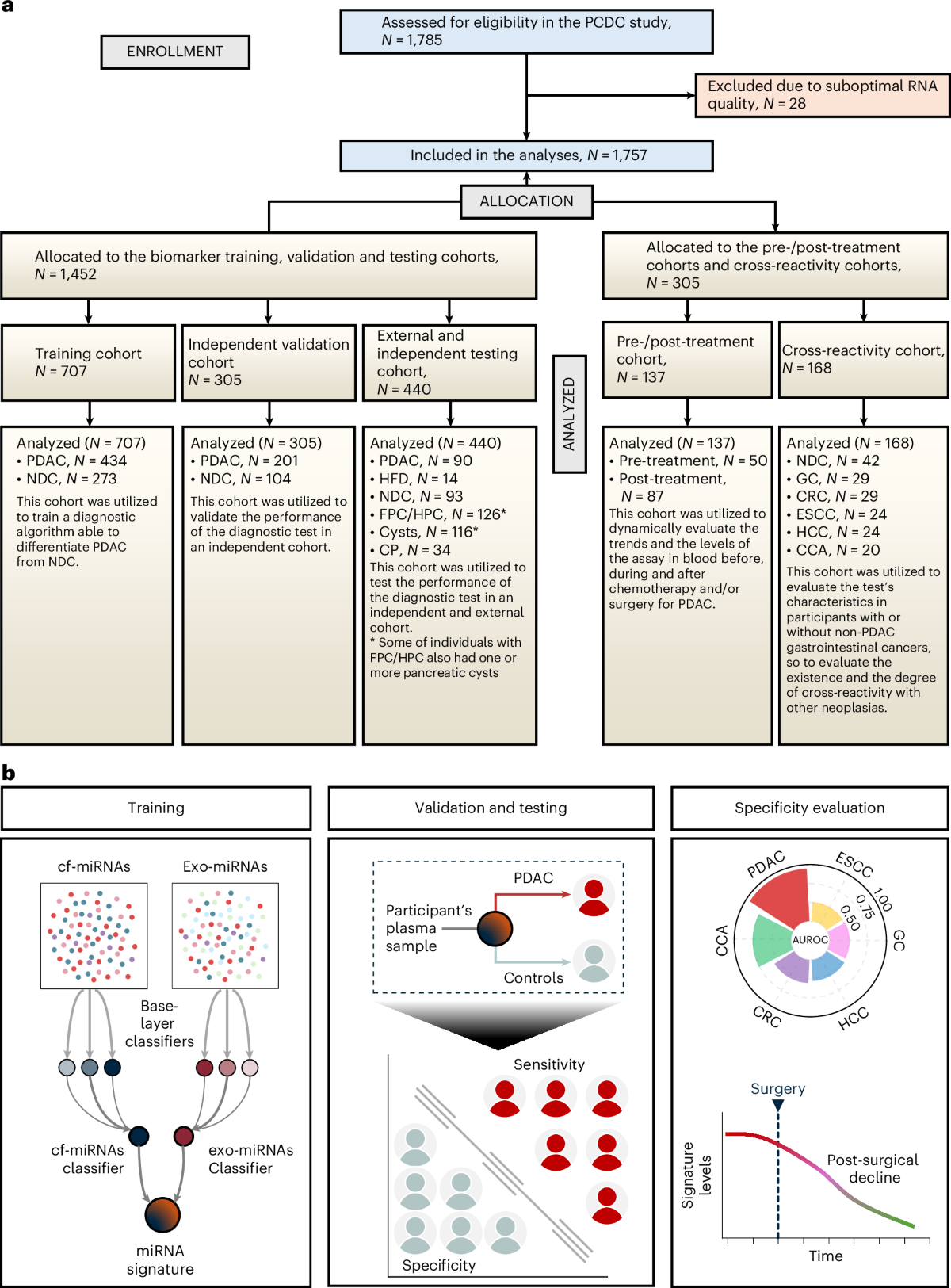
The composite score is called PANXEON (PANcreatic cancer eXosome Early detectiON). The prospective, multicenter study enrolled 1,852 people with and without PDAC across four countries. The microRNA panel alone reached an area under the ROC curve (AUC) of 88.6% in testing, with low cross-reactivity to other gastrointestinal cancers.
This is a carefully designed biomarker study, not an FDA-cleared population screening test. The authors say it may complement existing strategies and needs larger prospective trials. Pancreatic cancer’s brutal reputation is exactly why an early blood signal matters if those next studies hold.
Why it matters
PDAC is often found late. There is still no widely used, clinically relevant blood assay dedicated to catching it early. CA19-9 helps in some patients but fails many Lewis-antigen–negative people and is not specific enough alone for early detection.
A test that works in stage I–II changes the practical question from “can surgery even be offered?” to “can we find the tumor while surgery still helps?” Even a partial win — high sensitivity in early disease with controlled false positives in low-risk controls — is why oncology groups watch liquid biopsies so closely.
The study’s size and geography matter. 1,852 participants across multiple countries is larger than a single-center pilot. That does not equal regulatory clearance, but it is the right shape of evidence for a biomarker that wants to graduate.
Key numbers
| Quantity | Value (Nature Medicine, 16 Sep 2026) |
|---|---|
| Peg | 16 September 2026 Nature Medicine |
| Name | PANXEON (miRNA signature + CA19-9) |
| Design | International, multicenter, observational, prospective biomarker study |
| Cohort | 1,852 individuals, four countries |
| miRNA panel | 10 circulating microRNAs (including miR-142-3p, miR-30c-5p, miR-335-5p, miR-340-5p, miR-200b-3p, miR-1260b, miR-145-3p/5p, miR-429, miR-200a-3p) |
| miRNA AUC (testing) | 88.6% |
| miRNA sensitivity, early-stage PDAC | 83.8% |
| PANXEON + CA19-9 sensitivity, stage I–II | 86.8% |
| False-positive rate, low-risk controls (testing) | 3.2% |
| False-positive rate, high-risk controls (testing) | 15.6% |
| Longitudinal signal (n=19) | miRNA levels fell during neoadjuvant chemo / after surgery; rose before recurrence |
| High-risk cysts / high-grade dysplasia | detection potential cited at 64.3% |
| Trial registration | NCT06388967 |
| Lead site (first affiliation) | Beckman Research Institute of City of Hope |
How the assay works
PANXEON starts from exosome-associated microRNAs in blood — small RNA fragments packaged in extracellular vesicles — then folds in CA19-9. The paper lists a fixed 10-miRNA signature rather than an unbounded AI feature dump. That matters for reproducibility: other labs can try the same panel.
Performance is reported on a held-out testing cohort after development and validation steps (standard for biomarker pipelines). The miRNA score alone already separates PDAC from controls at AUC 88.6%. Adding CA19-9 lifts stage I–II sensitivity to 86.8% while false positives stay low in low-risk controls (3.2%) and higher, as expected, in high-risk controls (15.6%).
A small longitudinal set (19 people) shows the biology moving with treatment: signature levels drop during neoadjuvant chemotherapy and after surgery, then climb again before clinically recognized recurrence. That is not a surveillance approval — n is tiny — but it is the pattern you want if a marker tracks tumor burden.
The authors also flag potential use in people with high-risk pancreatic cysts, where distinguishing high-grade dysplasia from indolent lesions is a daily clinical headache. They cite 64.3% detection potential for high-grade dysplasia in that setting — promising, still exploratory.
What this is not
- Not FDA-cleared screening. No claim that average-risk adults should get this test tomorrow.
- Not a cure or a drug. Detection only.
- Not perfect specificity in high-risk controls. 15.6% false positives there means imaging and clinical context still decide next steps.
- Not a replacement for biopsy or CT/MRI. A blood score triage tool, if confirmed.
- Not limited to one ethnicity in principle — the paper examines performance across groups; readers should check the full figures before generalizing.
What to watch
- Larger prospective screening cohorts in high-risk clinics (family history, cysts, new-onset diabetes pathways).
- Regulatory path — whether PANXEON or a successor panel enters FDA review with locked cutoffs.
- Head-to-head with CA19-9 alone and with imaging in the same early-stage series.
- Independent replication outside the City of Hope–anchored network.
- Cyst pathway trials that test the 64.3% high-grade dysplasia signal with surgical gold standards.
The progress signal is a 1,852-person, four-country blood assay that hits roughly 84% sensitivity on early PDAC and about 87% on stage I–II when paired with CA19-9. The hedge stays honest: biomarker evidence, not a screening program — and still one of the clearest liquid-biopsy leads pancreatic cancer has had in years.
The clinical gap PANXEON is aiming at
Pancreatic ductal adenocarcinoma still kills most patients who receive the diagnosis, largely because symptoms arrive late and imaging is not a practical population filter. Endoscopic ultrasound and MRI help high-risk clinics, but they are expensive, operator-dependent, and hard to scale. A blood draw that reliably enriches for early disease — especially stage I–II — would let those imaging slots go to people who need them.
CA19-9 already sits in the clinic for monitoring, yet it is a blunt instrument for early detection. PANXEON’s design choice is additive: keep CA19-9, add a locked 10-miRNA exosome panel, and score them together. The testing-cohort false-positive rates — 3.2% in low-risk controls versus 15.6% in high-risk controls — are exactly the pattern clinicians expect. Low-risk screening would demand extreme specificity; high-risk surveillance can tolerate more false alarms if sensitivity stays high.
City of Hope’s molecular diagnostics group (Beckman Research Institute) anchors the author list alongside collaborators in Italy, Japan, Korea, and U.S. cancer centers. That geographic spread is how you stress-test a blood assay against different pre-analytical habits and population mixes — still not a substitute for an independent locked-protocol validation study, but better than a single-hospital curiosity.
Sources
- Xu, C., Mannucci, A., Han, H., et al., “Liquid biopsy for early detection of pancreatic ductal adenocarcinoma,” Nature Medicine, published 16 September 2026. https://www.nature.com/articles/s41591-026-04625-x (DOI 10.1038/s41591-026-04625-x)
- ClinicalTrials.gov NCT06388967.