
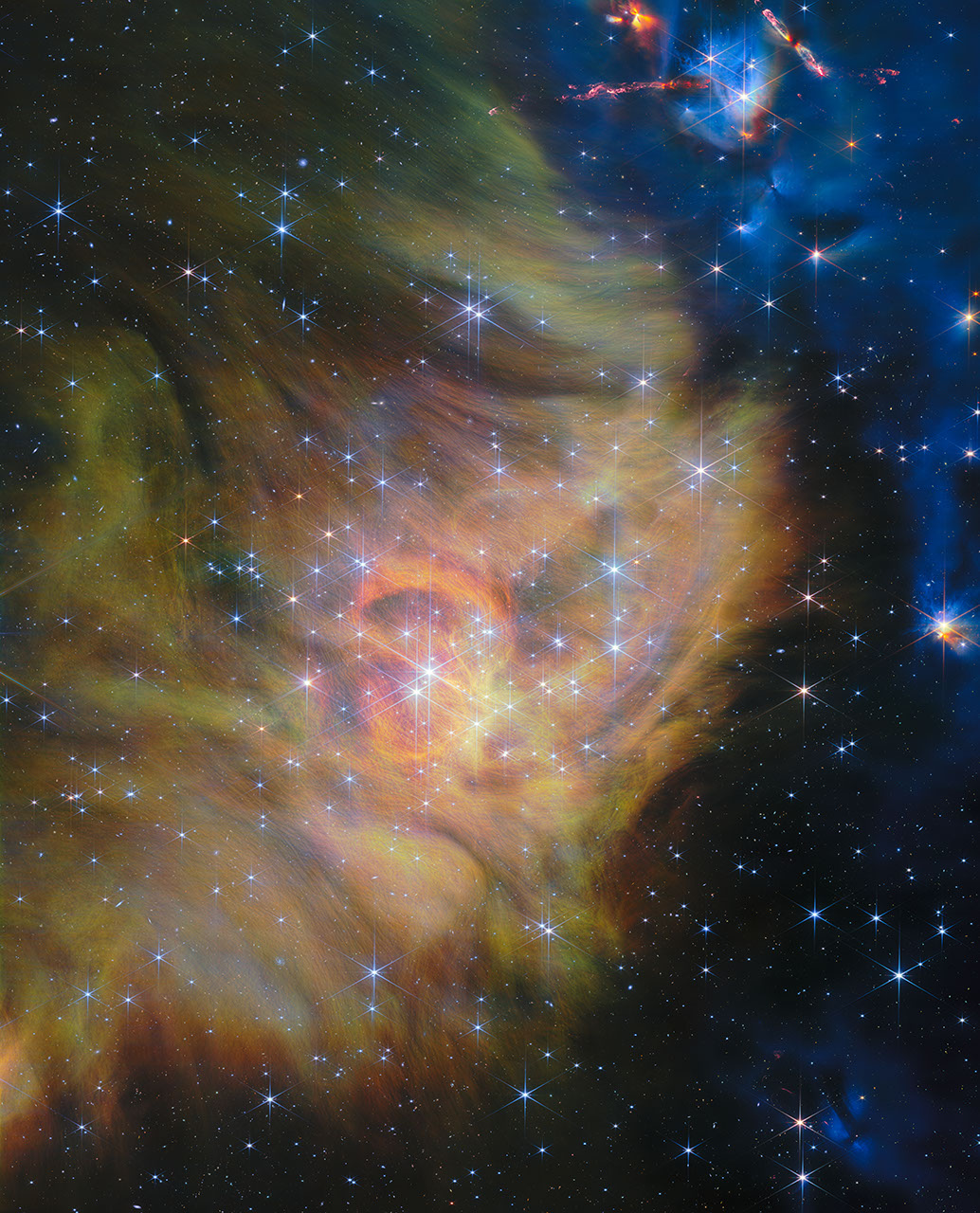
NASA reported on 15 September 2026 that the James Webb Space Telescope has pushed the bottom of the brown-dwarf mass ladder to about twice Jupiter’s mass — roughly 0.19% of the Sun’s mass — in the nearby star-forming region IC 348, about 1,000 light-years away in Perseus.
The same research team had already used Webb in 2022 to find brown dwarfs as light as three to four Jupiter masses in IC 348’s center. The new, deeper survey goes lower. One of the lightest new objects also shows signs of a circumstellar disk, which means planet-building raw material can sit around an object that is itself only about the mass of a giant planet.
This is a star-formation result, not a census of free-floating “rogue planets” as a separate population. Brown dwarfs form like stars — from collapsing molecular clouds — but never get hot enough in their cores to fuse ordinary hydrogen into helium. The news is how small that process can go.
Why it matters
Star-formation theory has long struggled with a simple question: how small is the smallest object a molecular cloud can make? If the answer keeps dropping, models that assumed a firm floor near a few Jupiter masses need to explain cooler, lighter collapse products — and whether those objects can still host disks and, someday, planets.
For everyone outside astrophysics the stake is concrete. Brown dwarfs sit between stars and planets. Finding them at ~2 Jupiter masses, with at least one disk, blurs the practical line between “failed star” and “giant planet that never found a star.” Webb’s sensitivity is what made the bottom of that ladder visible.
The image itself is also news. NASA and ESA describe the IC 348 mosaic as one of the largest Webb images released to the public so far — a panoramic near-infrared view that also catches protostellar jets and classic Herbig-Haro shocks such as HH 797 and HH 211.
Key numbers
| Quantity | Value (NASA Science / ESA Webb, 15 Sep 2026; Luhman et al. ApJL) |
|---|---|
| Peg | 15 September 2026 NASA / ESA image + science release |
| Region | IC 348, Perseus, ~1,000 light-years |
| New mass floor | |
| Prior Webb floor in IC 348 (2022) | 3–4 Jupiter masses |
| Stellar hydrogen-burning limit (context) | ~8% of the Sun’s mass |
| NIRCam candidates (paper) | 39 brown-dwarf candidates |
| NIRSpec follow-up (paper) | spectra for 15; 9 new substellar cluster members |
| Disk surprise | at least one of the lightest objects shows a disk |
| Hydrocarbon feature | seen strongly in the coolest objects; team proposes spectral class “H” |
| Webb program | GO 4866 (PIs: K. Luhman, C. Alves de Oliveira) |
How Webb got there
The team used Webb’s NIRCam in 2024 to pick candidates by color and brightness across a wider field than the earlier central survey. They then used NIRSpec in 2025 to take spectra and estimate masses. That two-step path — deep imaging, then spectroscopy — is how “candidate” becomes “member.”
NASA’s release stresses the comparison to 2022: the earlier IC 348 work already set a record-low spectroscopically confirmed brown dwarf at 3–4 Jupiter masses. Going to ~2 is not a cosmetic update. It is a new constraint on the initial mass function at the planetary-mass end.
The paper behind the release (Luhman, Alves de Oliveira and colleagues in the Astrophysical Journal Letters) also reports that eight of nine new brown dwarfs, plus one previously known member reobserved with NIRSpec, show the same unidentified aliphatic hydrocarbon absorption near 3.4 μm. The feature gets stronger at fainter magnitudes. The authors propose a new spectral class “H” defined by that band — a classification move, not a new element in the atmosphere.
Two new members (about 2 and 10 Jupiter masses in the paper’s estimates) show large excess emission from disks. That is the raw material argument: even objects near the planetary-mass floor can retain disks long enough that planet formation is at least chemically and dynamically plausible.
What this is not
- Not a claim that every ~2 Jupiter-mass object is a brown dwarf. Mass estimates depend on age, distance, and models; IC 348’s youth and known membership help, but the numbers are still model-tied.
- Not proof of planets around a brown dwarf. A disk is raw material, not a detected planet.
- Not EUV-style overclaim territory for star formation. The release challenges how low the IMF goes; it does not rewrite the definition of a star.
- Not the same as free-floating planet microlensing censuses. Those surveys count dark lenses; this is spectroscopy in a star-forming cluster.
What to watch
- Deeper surveys of NGC 1333 and other Perseus clusters — whether equally light members appear once the same depth is applied.
- Whether the “H” class sticks — independent spectra confirming the 3.4 μm hydrocarbon as a natural cool-atmosphere feature.
- Disk follow-up — ALMA or mid-infrared programs that measure dust mass around the lightest IC 348 members.
- Theory response — whether turbulent fragmentation and ejection models can produce a robust ~2 Jupiter-mass floor without special pleading.
The progress signal is simple: Webb has now spectroscopically anchored brown dwarfs at about twice Jupiter’s mass in a well-studied nursery 1,000 light-years away, and at least one of those lightweights still wears a disk. The hedge belongs in the lede, not the headline: this is a mass-floor result for star formation, not a catalog of named exoplanets.
The panorama is part of the science
Beyond the mass floor, the public mosaic is a working map of a nursery. The upper-right corner of the NIRCam view is crowded with embedded protostars and shock fronts. HH 797 resolves into two nearly parallel outflows; HH 211 shows the classic propeller of jets plus wider winds. Those details are not decoration: they show that IC 348 is still actively making stars while, elsewhere in the same cloud, the collapse process is terminating at planetary masses.
That coexistence is the intellectual punch. The same molecular cloud can produce long-lived low-mass stars, classic brown dwarfs, and objects so light that older textbooks would have filed them with planets — yet their spectra and membership argue they formed with the cluster, not as ejected worlds from some other system. Webb’s job was to make the faint end bright enough to classify.
Sources
- NASA Webb Mission Team, “NASA’s Webb Reveals Dynamic Panorama of Star Formation,” NASA Science, 15 September 2026. https://science.nasa.gov/missions/webb/nasas-webb-reveals-dynamic-panorama-of-star-formation/
- ESA/Webb, “Webb reveals stunning panorama of star formation,” 15 September 2026. https://www.esa.int/Science_Exploration/Space_Science/Webb/Webb_reveals_stunning_panorama_of_star_formation
- Luhman, K. L., Alves de Oliveira, C., et al., “A New Spectral Class of Brown Dwarfs at the Bottom of the IMF in IC 348,” ApJL (DOI 10.3847/2041-8213/addc55).
- Webb GO program 4866.