Missed liver lesions on contrast-enhanced CT are a high-volume failure mode in ordinary radiology, not a rare-disease story. On 19 August 2026, Nature Medicine published a multicenter development study plus a single-arm trial of LiON (Liver DiagnOsis Network), a contrast-enhanced CT system built to sit in that workflow as an extra reader. The prospective number that matters is an AUC of 0.952 in 10,333 consecutive patients, with a confidence-interval floor the protocol had required to clear 0.900. That is a diagnostic safety-net result. It is not a survival endpoint, and the authors say so.
What happened
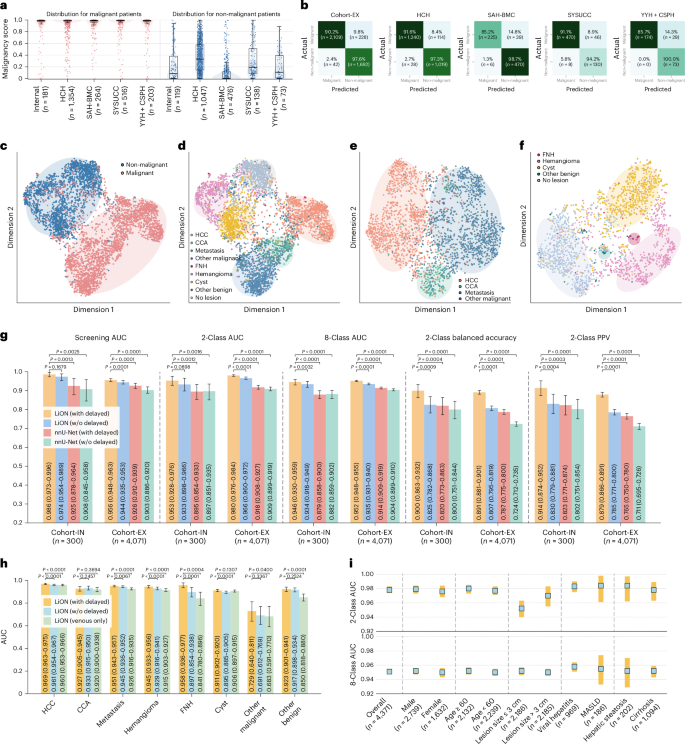
Zhang, Li, Han, Yin and colleagues — jointly supervised from Shengjing Hospital of China Medical University, Zhejiang University, Alibaba DAMO Academy, and partners including King’s College London and EURECOM — trained LiON on 6,443 patients. Retrospective validation covered 22,251 patients across multicenter and real-world cohorts. In that retrospective work the AUC for malignancy diagnosis was 0.975 (95% CI 0.971–0.979). Performance held in hepatic steatosis (AUC 0.971, 95% CI 0.952–0.985) and cirrhosis (AUC 0.924, 95% CI 0.901–0.946). Those two subgroups are the ones that usually break liver-CT models.
The prospective piece is a single-arm trial in routine practice. LiON ran as an additional AI reader on 10,333 patients (Cohort-RWP, Shengjing Hospital). The primary endpoint was an AUC whose 95% CI lower bound exceeded 0.900. It met that bar: AUC 0.952 (95% CI 0.942–0.961). Secondary outcomes, from the abstract:
| Prospective finding | Number | Note |
|---|---|---|
| Patients in routine workflow | 10,333 | single-arm, extra reader |
| Previously overlooked lesions found by AI–human collaboration | 51 | including 15 malignancies |
| Radiology reports amended | 37 | |
| Multidisciplinary-team escalations | 22 | |
| Clinical-management changes | “a subset of patients” | not a count in the abstract |
ClinicalTrials.gov: NCT07153783. Received 23 November 2025; accepted 15 July 2026; published 19 August 2026. DOI 10.1038/s41591-026-04589-y.
LiON takes non-contrast, arterial and venous phases, with an optional delayed phase, and can fold in clinical data. It predicts a patient-level malignancy score and segments eight types of liver lesion. Code for the full product is not released: the authors cite proprietary phase classification, registration and rendering, and a pending patent (CN116993663A). Key detection logic is pointed at an open-source Pixel-Lesion-Patient Network repository at Alibaba DAMO Academy. Wei Liu, Yuan Gao, Ke Yan and Ling Zhang are Alibaba employees and own stock as part of employment. That belongs in the story, not the headline.
The authors are explicit about the limit: this is not a randomised comparison of outcomes across health systems. “Further evidence from prospective comparative studies across diverse healthcare systems is warranted to assess effects on clinical outcomes.”
Why it matters
An AUC on a retrospective set is easy to oversell. A 10,000-patient workflow trial that changes 37 reports is harder to dismiss, and still not a claim that anyone lived longer. The useful framing is a diagnostic safety net, not an autonomous radiologist.
Overlooked lesions in the prospective cohort, in the extended data, were predominantly low-enhancement, small, and spread across clinical settings and liver segments. That is the miss pattern radiologists already know. LiON’s job in this protocol was to surface them for a human, who then amended the report or took the case to an MDT. Fifteen malignancies in that pile is the number to keep. Fifty-one lesions is the denominator.
The cirrhosis AUC of 0.924 is the caution inside the success. It is still high. It is not 0.975. Steatosis held; cirrhosis dropped. Any deployment copy that skips that row is a miss.
Alibaba employment and a related patent are disclosed. So is the fact that full source is closed. A Good Signal piece that treats LiON as a public-good algorithm without those two sentences is incomplete.
What to watch next
- A comparative trial that measures time-to-treatment and missed-cancer rates against usual care, outside a single-country hospital network. Until then the verified claim is AUC 0.952 in 10,333 consecutive patients and 15 malignancies that had been overlooked.
- External scanners and health systems. The prospective arm is Shengjing. The retrospective multicenter map is China-heavy. That is a feature of the dataset, not a world rollout.
- Open methods versus closed product. The GitHub detection core is the reproducibility handle. The patent is the commercial handle. Keep them distinct.
Sources
- Zhang, X. et al. Large-scale AI-guided liver malignancy diagnosis: multicenter study and a single-arm trial. Nat Med (2026). https://doi.org/10.1038/s41591-026-04589-y — https://www.nature.com/articles/s41591-026-04589-y
- ClinicalTrials.gov NCT07153783 — https://clinicaltrials.gov/study/NCT07153783
- Pixel-Lesion-Patient Network (open detection core) — https://github.com/alibaba-damo-academy/pixel-lesion-patient-network