
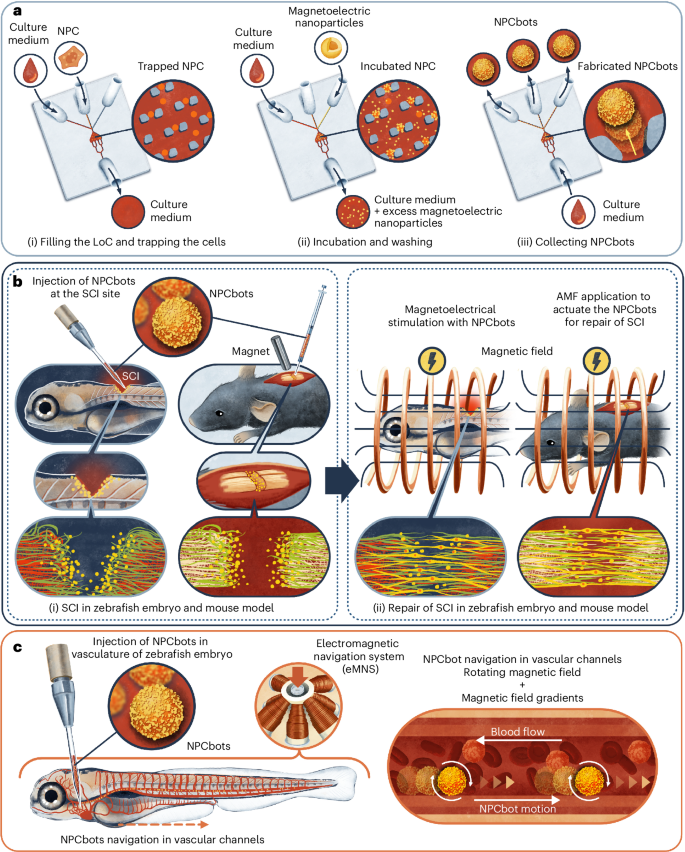
On 2 June 2026, ETH Zurich and the University of Zurich published a peer-reviewed Nature Materials study on micro-robot-assisted stem-cell repair after a complete spinal-cord cut in mice — with recovered locomotion that is striking in the lab and still far from a human therapy.
The robots have a name, a recipe, a fabrication line, two animal models, and a 28-day mouse readout. The paper exists. The press release exists. The job is to report them.
What happened
A team at ETH Zurich’s Multi-Scale Robotics Lab, with colleagues at the University of Zurich’s Department of Molecular Life Sciences, built biohybrid microrobots they call NPCbots. Each bot is about six micrometres across. It combines:
- Neural progenitor cells (NPCs) derived from human induced pluripotent stem cells, and
- Magnetoelectric nanoparticles — a magnetic core with an outer layer that turns a magnetic field into a local electrical signal. ETH says the coating is barium titanate; the inner layer responds to magnetic fields.
The pairing does two jobs that implanted-electrode stem-cell therapies struggle with. An external magnetic field can steer the bots to a lesion. An alternating magnetic field then stimulates the progenitors to differentiate, without cables in the cord. First author Hao Ye, a senior scientist at ETH, and Professor Salvador Pané i Vidal describe a lab-on-a-chip process: cells are trapped in a one-square-centimetre reservoir, nanoparticles are injected, and the two bind in about thirty minutes. Parallel chips are used to make the hundreds of thousands to millions of bots that cell and animal work require.
They tested the system in two species.
Zebrafish larvae, which can regenerate spinal tissue, recovered nearly normal swimming and exploratory behaviour in three days under magnetoelectric stimulation, with rapid in-vivo neuronal and astrocytic differentiation at the lesion. University of Zurich biologists Stephan Neuhauss and Jingjing Zang ran that model. ETH’s stills show uninjured cord, injured cord, and nerve-cell growth with the bots. Extended data document navigation in the dorsal aorta of kdrl:mCherry larvae using a 50 mT rotating field and a 700 mT/m compensatory gradient, with and against blood flow. In PBS, rolling bots were driven at 10 mT, 1 Hz.
Mice with a complete spinal cord transection — a non-regenerating model — were the harder test. After 28 days, nerve cells had reconnected at the injury site. Treated animals showed clear gains in gait, stride length, coordination and exploratory behaviour. ETH’s phrasing is “increasingly normal movement patterns,” not a return to an uninjured baseline. The Nature abstract says NPCbots “were well tolerated for at least 28 days,” “localized effectively to the injury site,” “promoted neural differentiation,” and “resulted in substantial improvements in motor function within 4 weeks.” The treatment produced no reported adverse immune reaction in the study window. Supplementary Video 1 shows walking-gait recordings at 7, 21 and 34 days after various treatments.
The paper does not, in the public abstract, print a sample size n for the mouse cohort. Do not invent one. Do not write “a mouse.” Do not write “cured” or “moved normally.”
The paper is Ye, Zang, Zhu et al., “Magnetoelectric microrobots for spinal cord injury regeneration,” Nature Materials 25, 1458–1469 (2026), published 2 June 2026 (received 3 September 2024; accepted 7 May 2026). DOI: 10.1038/s41563-026-02625-3. Funding includes the Swiss National Science Foundation (206033 and 198643) and a Sino-Swiss project with the National Natural Science Foundation of China.
The live slug is truncated (…treatm). Keep it until a 301 exists. A cleaner path, microrobots-stem-cells-spinal-cord-eth-zurich-2026, is optional after publish.
Why it matters
Complete transection in a mammal is a high bar. Most experimental spinal therapies are scored on contusion or hemisection models; a cord that has been fully cut does not rewire on its own in a mouse. Showing that a magnetically navigated, electrically stimulating graft can produce measurable motor recovery in that setting is a real preclinical signal.
It also attacks two practical failure modes of NPC transplants: the cells do not always reach the lesion, and they do not always differentiate or integrate once they do. Wireless magnetoelectric stimulation is meant to replace implanted electrodes on a tissue that does not forgive extra hardware. “Microrobotic guidance makes the treatment more precise and minimally invasive,” Ye says in the ETH release.
None of that is a therapy. It is a platform result — a fabrication method plus two animal models — and should be filed that way. Spinal cord injury in people is usually contusion and scar, not a clean cut. Field strengths that work in a larva or a mouse are not a human dose. The bots are designed to dissolve into tissue; ETH says further work is needed on long-term degradation and excretion of the particles. That is a safety clock, not a footnote.
Pané i Vidal has mentioned cardiology, oncology and wound healing as possible adaptations of the chip-based fabrication line. Those are ideas. They are not data. They do not belong in the lede.
What to watch next
- Independent replication and a published n, in the same complete-transection mouse model, with quantified scores (BBB or equivalent) rather than qualitative gait language. The source data files exist behind the Nature paywall; a follow-up desk pass should pull them.
- Fate of the nanoparticles. Barium titanate over a magnetic core. ETH says further work is needed on long-term degradation and excretion.
- Human translation questions Ye already flags: which field strengths and stimulation durations are even plausible in a person, and how the method behaves in a cord that is contused and scarred rather than cleanly cut.
- Scope discipline. Do not promote cardiology and oncology into the headline.Until those items move, the accurate public sentence is: in zebrafish and in mice, magnetoelectric stem-cell microrobots improved motor function after spinal injury, in a peer-reviewed 2026 study from ETH and UZH. It is not: a mouse was cured, and the paper has not been published.
Sources
- ETH Zurich, “Microrobots repair spinal cord,” 2 June 2026 — https://ethz.ch/en/news-and-events/eth-news/news/2026/06/microrobots-repair-spinal-cord.html
- Hao Ye et al., “Magnetoelectric microrobots for spinal cord injury regeneration,” Nature Materials 25, 1458–1469 (2026). DOI: 10.1038/s41563-026-02625-3 — https://www.nature.com/articles/s41563-026-02625-3
