What happened
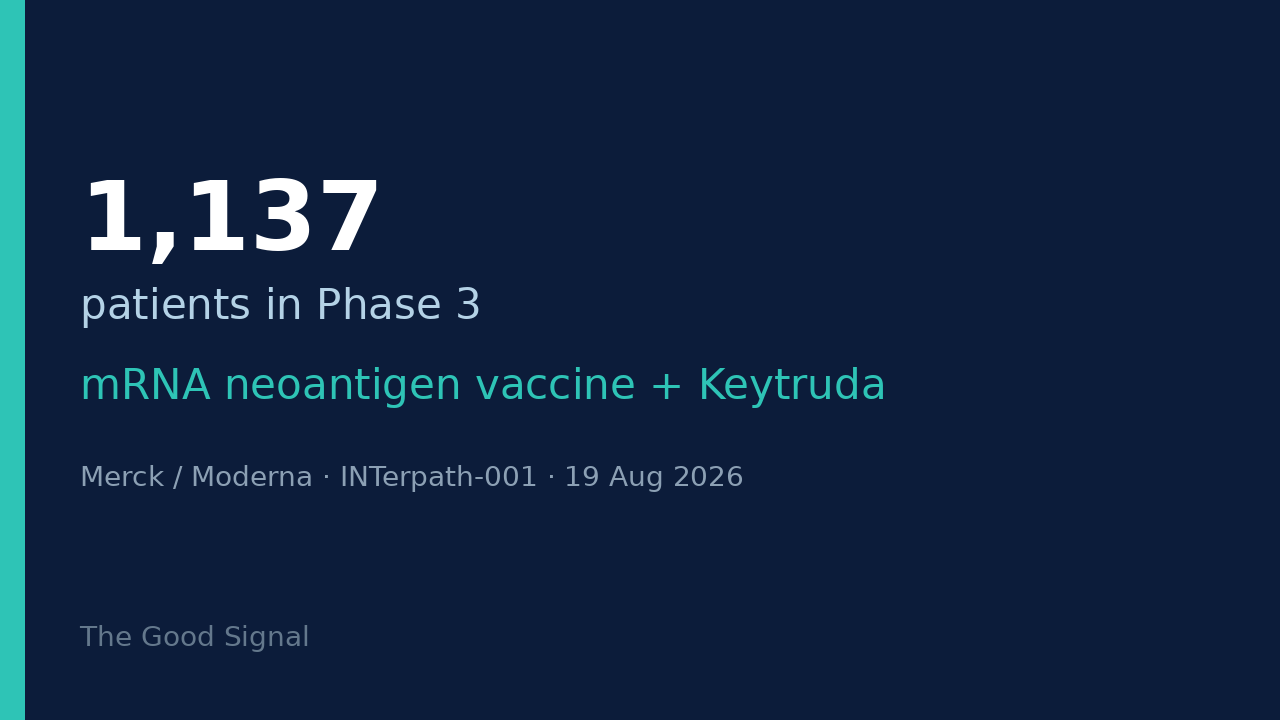
On 19 August 2026, Merck and Moderna reported topline results from Phase 3 INTerpath-001 (NCT05933577): adjuvant intismeran autogene (also called V940 or mRNA-4157) plus KEYTRUDA (pembrolizumab) beat KEYTRUDA alone on recurrence-free survival (RFS) and distant metastasis-free survival (DMFS) in people with completely resected stage IIB, IIC, III or IV cutaneous melanoma who had not received prior systemic therapy.
The trial enrolled 1,137 patients, randomized 2:1 to the combination versus KEYTRUDA alone. Intismeran was given at 1 mg every three weeks for up to nine doses; KEYTRUDA at 400 mg every six weeks for up to nine cycles (about one year). At a pre-specified interim analysis, both the primary endpoint (RFS) and a key secondary endpoint (DMFS) cleared statistical and clinical bars. Overall survival continues under the protocol. The sponsors said the safety profile matched prior combination studies, with no new signals.
This is the first positive Phase 3 readout for an individualized neoantigen therapy and for an mRNA-based cancer therapy, and the first Phase 3 to show a clinically meaningful gain over KEYTRUDA alone in adjuvant resected melanoma — per the companies’ 19 August release. It is not an FDA approval. Numeric Phase 3 hazard ratios were withheld for a medical meeting; regulators have not cleared a label.
The number that already exists
Phase 3 HRs are still under wraps. The same program’s Phase 2b KEYNOTE-942 / mRNA-4157-P201 five-year follow-up, presented at ASCO 2026 and cited in the Phase 3 release, is the public evidence of effect size so far:
| Endpoint (Phase 2b, ASCO 2026) | Result vs KEYTRUDA alone |
|---|---|
| Recurrence or death | 49% risk reduction (HR 0.51; 95% CI 0.294–0.887) |
| Distant metastasis or death | 59% risk reduction (HR 0.411; 95% CI 0.200–0.843) |
Treat those as the prior signal, not a substitute for the Phase 3 numbers that will land at the upcoming meeting.
How the vaccine is built
Intismeran is an investigational messenger-RNA individualized neoantigen therapy. A patient’s tumor sample is sequenced to identify a mutational “fingerprint.” The drug product is a synthetic mRNA coding for up to 34 neoantigens tailored to that tumor. After injection, the encoded peptides are presented to the immune system to drive tumor-specific T-cell responses. KEYTRUDA blocks PD-1 so those T cells are less likely to be shut down.
Why it matters
Adjuvant melanoma care already uses KEYTRUDA after complete resection of stage IIB–III disease. Recurrence still happens, often as metastatic disease within the first two years. Merck cites more than 330,000 new melanoma cases worldwide in 2022 and an estimated ~112,000 new U.S. cases and over 8,500 U.S. deaths in 2026. A personalized mRNA add-on that clears Phase 3 RFS and DMFS against that standard is the first hard test of whether individualized neoantigen vaccines can move the needle in a large randomized setting.
Principal investigator Georgina Long (Melanoma Institute Australia / University of Sydney) called it a landmark for adjuvant melanoma. Moderna CEO Stéphane Bancel framed it as turning an aspirational idea — an mRNA treatment designed for one patient’s cancer — into a Phase 3 reality. Both statements sit on topline statistics, not a filed label.
What this is not
- Not an approval. Merck and Moderna plan a medical-meeting presentation and regulatory engagement.
- Not a published Phase 3 hazard ratio. Do not invent one.
- Not proof for lung, bladder, kidney, or pancreatic disease. The INTerpath program has nine Phase 2/3 trials across tumor types; only melanoma Phase 3 has read out positive so far.
- Not a substitute for surgery or for watching overall survival.
What to watch next
- Full INTerpath-001 efficacy and safety tables at the announced international meeting.
- Regulatory filing timing (Breakthrough Therapy designation is already in place in the U.S., per secondary reporting; no submission date in the primary release).
- Overall survival maturity.
- Parallel INTerpath readouts in resected NSCLC and other tumors.
Sources
- Merck / Moderna press release, 19 Aug 2026: https://www.merck.com/news/merck-and-moderna-announce-phase-3-interpath-001-trial-of-intismeran-autogene-plus-keytruda-met-endpoints-of-recurrence-free-survival-rfs-and-distant-metastasis-free-survival-dmfs-in-patient/
- ClinicalTrials.gov NCT05933577 (INTerpath-001)