On 11 February 2026, QuTech physicists published a Nature result that finally reads out the parity of a minimal two-site Kitaev chain — the platform theorists call poor-man’s Majoranas. That is a real, named, dated result. It is not a fault-tolerant topological qubit product, and the paper does not claim a readout fidelity above 99%.
What happened
van Loo, Zatelli, Steffensen, Roovers and colleagues at QuTech and the Kavli Institute of Nanoscience, Delft University of Technology, with theory from Gorm O. Steffensen and Ramón Aguado at ICMM-CSIC in Madrid and nanowires from Eindhoven, reported the first single-shot, real-time readout of the fermionic parity stored in a pair of Majorana modes. The paper is van Loo et al., “Single-shot parity readout of a minimal Kitaev chain,” Nature 650, 334–339 (2026), published 11 February 2026 (accepted 17 November 2025). DOI 10.1038/s41586-025-09927-7. QuTech’s news post followed on 12 February 2026; ICMM-CSIC the same week.
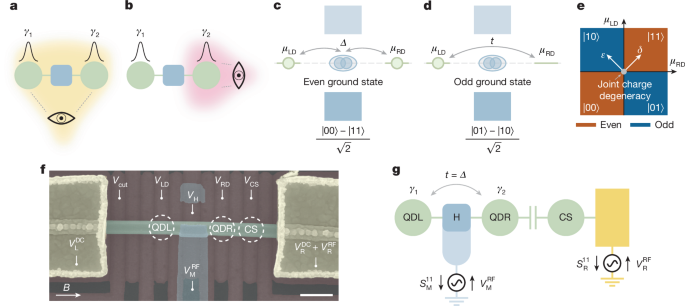
The device is a minimal Kitaev chain: two semiconductor quantum dots coupled through a superconducting segment. Even that two-site chain hosts a pair of Majorana modes, spatially separated but with limited protection compared with longer chains. The authors say so in the opening paragraph. Physics World later quoted first author Nick van Loo making the same point: the two-site chain is not topologically protected; protection is expected to improve as sites are added.
The measurement problem is structural. A single pair of Majorana zero modes encodes a parity bit — even or odd occupation of a shared fermionic state. A pair of those parity bits would make a qubit, so four modes. A probe that couples to only one end of the device cannot, in principle, reveal that parity. Standard charge sensors, the workhorse of spin qubits, go blind because the two parity states are effectively charge-neutral.
The Delft team’s answer is quantum capacitance. An RF resonator connected to the superconductor senses how charge can flow into and out of the superconducting condensate. In an even-parity state, electrons can pair and enter as a Cooper pair; in an odd-parity state a lone electron cannot. That difference shows up as a change in quantum capacitance. A nearby charge sensor, run at the same time, confirms the limitation: near the operating point it shows little or no response, while the capacitance channel discriminates parity in single shots.
The numbers that are in the QuTech post and the Nature abstract:
| Quantity | Value | Where it is written |
|---|---|---|
| Parity lifetime | exceeding one millisecond (abstract: “lifetimes exceeding a millisecond”) | Nature abstract; QuTech 12 Feb 2026 |
| Average switching time τ_avg (main analysis) | 1.85 ± 0.03 ms | Extended Data Fig. 4 |
| Single-shot readout timescale | microseconds (integration 150 μs in the reported traces) | QuTech post; Extended Data Fig. 4 |
| Readout error formula | estimated from SNR and τ_bin; no “>99% fidelity” | Extended Data Fig. 4 |
| Tunnel-spectroscopy gap at the sweet spot | about 30 μeV | Extended Data Fig. 6 |
| Readout fidelity above 99% | not reported | — |
The time traces show random telegraph switching between even and odd. Dwell times fit a Poisson process. A parallel two-chain device, not fine-tuned to the sweet spot, resolved three levels consistent with a computational basis |ee⟩, |oo⟩ plus leakage into the globally odd manifold. No direct |ee⟩ ↔ |oo⟩ transitions were observed, which the authors take as evidence against inter-chain tunnelling.
Ramón Aguado’s actual line, from the ICMM-CSIC note, is that this is “a crucial advance” because the team can access the stored information with quantum capacitance, “a global probe sensitive to the overall state of the system.” Francesco Zatelli’s actual closer is: “This is the measurement primitive protected qubits have been missing.”
Microsoft appears in the acknowledgements as Microsoft Corporation Station Q, a funder, alongside NWO, a Spanish ministry grant, and the European Innovation Council Pathfinder grant 101115315 (QuKiT). Microsoft is not a co-author. IBM is not in the paper.
Why it matters
Majorana platforms have spent a decade arguing with their own spectroscopy. Signatures in nanowires were real enough to publish and contested enough to stall. The Kitaev-chain approach — dots assembled bottom-up, like Lego, as Aguado puts it — is meant to make the modes tunable and the readout local to a device geometry that already looks like a qubit. Dvir et al. (Nature 2023) and ten Haaf et al. (Nature 2024) built the two-site chain. This paper adds the clock: you can watch parity jump in real time.
That is the missing primitive for time-domain control. It is not yet coherence of a logical qubit, not fusion, not braiding, and not error-corrected gates. QuTech says the next milestone is a demonstration of coherence, then fusion and braiding. van Loo told Physics World the same remaining hurdle: non-Abelian exchange statistics.
The comparison that belongs in the piece is the Microsoft Quantum Hardware interferometric parity measurement on a different Majorana platform (Nature 638, 651–655, 2025), which the Delft authors cite. Two architectures, two readouts. Neither is a topological processor on a rack.
For a Good Signal reader the progress is narrower and better: a named Dutch–Spanish collaboration solved a measurement problem that the field had written down, on a device whose limits they also wrote down. Poor-man’s Majoranas with millisecond parity lifetimes and microsecond shots. That sentence does not need an invented fidelity number on top.
What to watch next
- Coherence, then fusion and braiding. QuTech’s own order. Until those exist, do not write “decoded Majorana qubits” as if a logical operation ran.
- Longer chains. Protection is limited on two sites. Three-site devices already appear in the citation list. Distance between modes is the scaling the team flags in parallel.
- Do not recycle the fidelity. If a later paper reports a readout fidelity, quote that paper. The 11 February 2026 Nature article is not it.
Sources
- van Loo, N., Zatelli, F., Steffensen, G.O. et al. Single-shot parity readout of a minimal Kitaev chain. Nature 650, 334–339 (2026). https://doi.org/10.1038/s41586-025-09927-7
- QuTech, “QuTech demonstrates real-time readout for Majoranas,” 12 February 2026 — https://qutech.nl/2026/02/12/qutech-demonstrates-real-time-readout-for-majorana-based-qubits/
- ICMM-CSIC, “New ‘crucial’ advance for quantum computers…” — https://www.icmm.csic.es/en/noticias/new-crucial-advance-quantum-computers-researchers-manage-read-information-stored-majorana
- CSIC (ES), 11 February 2026 — https://www.csic.es/es/actualidad-del-csic/logran-por-primera-vez-leer-la-informacion-almacenada-en-uno-de-los-cubits-cuanticos-mas-esquivos
- 4TU.ResearchData, data and code — https://doi.org/10.4121/227fd419-fded-4a96-ab62-421a0cd57fa5