
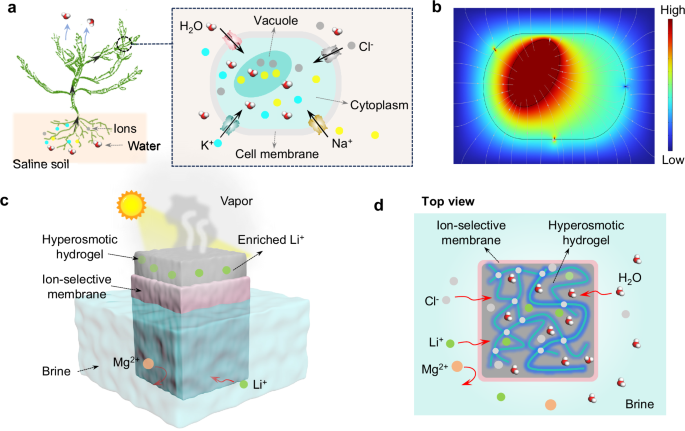
Lithium from salt lakes is still mostly a waiting game: brine sits in ponds until the sun evaporates the water and you precipitate the rest. A Soochow University team has now shown a different object — a sunlight-driven ion-selective hydrogel pump (ISHP) that pulls Li⁺ through an ultrathin polyamide skin into a crosslinked polyvinyl alcohol block. The headline laboratory flux is 1.20 g m−2 h−1. The osmotic driving force they measure is 47.86 bar. Both numbers are in the paper. Neither is a salt-lake plant.
The paper is Aqiang Chu, Xinke Zhang, Yuzhang Zhu and colleagues, “An ion-selective hydrogel pump for high-throughput solar-powered lithium extraction,” Nature Communications, published 21 August 2026 (received 12 February, accepted 11 August). DOI 10.1038/s41467-026-76958-7. Corresponding authors: Shenxiang Zhang and Jian Jin at Soochow’s State Key Laboratory of Bioinspired Interfacial Materials Science. Co-authors include Youjing Zhao at the Qinghai Institute of Salt Lakes, Chinese Academy of Sciences; Teng Zhou at Hainan University; and Lei Jiang at the Suzhou Institute for Advanced Research, University of Science and Technology of China. Open access, CC BY-NC-ND 4.0. No competing interests declared.
What happened
The design copies a halophyte, Salicornia. Root cells raise cytoplasmic osmotic pressure to drink saline water; vacuoles store the salt. ISHP splits those jobs: the PVA hydrogel is the hyperosmotic interior; an ultrathin polyamide (PA) membrane grown in situ on the outer surface is the selective skin. Polypyrrole in the gel makes it photothermal. Under 1 kW m−2 the surface stabilizes at 38 °C; light absorption is 98.17%. Water evaporation from the PVA/PPy hydrogel reaches 1.58 kg m−2 h−1, six times pure water in their comparison. Evaporation efficiencies: 83.60% (PVA/PPy) and 80.29% (ISHP).
The PA skin is 43 nm thick, molecular-weight cut-off 151 Da, pores 3.2–8.3 Å. Hydrated Mg²⁺ is 8.6 Å; the Stokes diameter of Li⁺ is 4.8 Å. Separation is size-based (surface charge at pH 7.48: −1.99 mV). Optimized recipe: PIP 5.0 mg mL−1, TMC 0.5 mg mL−1, PA crosslinking 60 °C, PVA 10 wt%.
The 47.86 bar figure is measured, not guessed. They coupled ISHP to MgCl₂ from 5 to 100 g L−1 and found zero water flux at 81 g L−1. From Jw = A (Ptrans − Π), that is a transpiration pressure of 47.86 bar (Fig. 2j).
How the pump works
Sunlight evaporates intermediate water at the hydrogel–air interface. The gel stays hydrated; that sink pulls water — and Li⁺ — across the PA skin. Molecular-dynamics snapshots in Fig. 3 put PVA on the permeate side of a model PA membrane: Li⁺ flux 0.2 g m−2 h−1 with PVA versus 0.048 g m−2 h−1 without. Stacking photothermal, ion-selective and water-transport layers instead of growing PA on the gel yields only 0.028 g m−2 h−1 under the same conditions (Supplementary Fig. 15). The integrated skin is the device.
Indoor tests: 25.0 ± 0.5 °C, 40 ± 5% RH, xenon lamp. Flux is defined on the vertical projected area of the cylinder, not the wetted skin. Negative Li⁺ rejection in their plots means Li⁺ is enriched inside the gel relative to the water that evaporates.
On binary LiCl–MgCl₂ at 10 g L−1, as the Mg²⁺/Li⁺ mass ratio (MLR) rises from 10 to 60, selectivity S rises from 18.39 to 22.74, then stays above 20; Mg²⁺ rejection is about 90%. LiCl purity in the gel goes from 13.5% to 74.2% at MLR 10, and from 1.5% to 24.7% at MLR 100. At fixed MLR 10, raising salinity from 5 to 60 g L−1 lifts Li⁺ flux from 0.36 to 2.42 g m−2 h−1; Mg²⁺ rejection at 60 g L−1 is still 84.0%.
The 1.20 g m−2 h−1 number is geometry. Same 10 g L−1, MLR 10 feed: deeper immersion means more PA–brine contact under the same projected area. At 2.5 cm, flux is 1.20 g m−2 h−1 and S is 18.68 (Fig. 4h). In the dark they still get 0.20 g m−2 h−1. From 0.5 to 2.0 kW m−2, flux moves from 0.43 to 0.75 g m−2 h−1 at the shallower geometry of Fig. 4g — not a contradiction of 1.20; different immersion.
Two stages on a 10 g L−1, MLR 80 mixture take LiCl purity from 1.91% to 86.18% and MLR from 80 to 0.25 (S 320 versus 21.25 in one stage).
Flux against the literature they cite
Supplementary Table 1 is the comparison they publish — solar-evaporation membrane processes for salt-lake lithium, not every extraction method. Prior Li⁺ fluxes (g m−2 h−1): AAO/PA 0.018 (Science 385, 1444, 2024); LIG/HKUST-1 0.059; MS&PVA/PA 0.041; Gel/ZIF-8&PSS 0.056; CNT/PA 0.037. This work, PVA/PA, 10 g L−1, Li⁺ 0.22 g L−1, MLR 10, S 18.68: 1.2. The abstract’s “over one order of magnitude higher than the current report” is 1.2 versus a prior high of 0.059. Feeds are not identical. Do not read 1.20 as a number that already exists on a Qinghai pond.
Outdoor device, as reported
The multi-unit outdoor run is a campus experiment, not a lake. ISHP cylinders sit in parallel above the brine. Porous fibre tubes run through the gel in series and circulate water to leach Li⁺. A transparent chamber collects vapour; a peristaltic pump closes the water/Li⁺ loop (Fig. 5d).
They ran it on the Soochow University campus, 8:30 a.m. to 4:30 p.m., on MgCl₂–LiCl at 10 g L−1, MLR = 10 — the same synthetic binary, not East Taijinar brine. Average evaporation: 1.74 kg m−2 h−1. Duty cycle: 8 hours extraction, 16 hours elution with recycled condensate. Over five daily cycles the average Li⁺ production rate is 3 g m−2 day−1 (Fig. 5f). That is the outdoor number. It is not 1.20 g m−2 h−1 under a desert sky.
East Taijinar brine, then the model
For a real brine they used East Taijinar, Qinghai: salinity exceeding 300 g L−1, MLR 35, Li⁺ 0.16 g L−1, Mg²⁺ 5.6 (Supplementary Table 2). First-stage ISHP: Li⁺ flux 0.58 g m−2 h−1, S 11.39, Mg²⁺ rejection about 76.5%. After the second stage, MLR 0.23, S 153.13. After photothermal concentration, NaOH/Na₂C₂O₄, then Na₂CO₃, the solid matches Li₂CO₃ (PDF#22-1141) at 98.5% purity. Laboratory process on real brine. Not continuous outdoor battery-grade carbonate.
The 90% shorter production cycle and eightfold annual economic benefit live in Supplementary Note 5 and Fig. 6e–f. They are an estimation model (“based on the reported data and estimation models”). Assumed pond area 2,000 m², irradiance 1 kW m−2, 8 hours sun. ISHP evaporates ~10.76 kg m−2 day−1; the conventional case uses ~1.6 kg m−2 day−1. Time to 1 tonne of Li₂CO₃: 45 days versus 404 days. Precipitant excluding Na₂CO₃: ~0.3 tonne versus ~4.36 tonnes. Model cost per tonne: conventional US$1,799; ISHP about US$3,050 on Fig. 6f — higher per tonne, not cheaper. Annual profit in the same figure: US$7,710 versus US$59,098 (priced “as of August 2025”), which is the eightfold the abstract cites. The ISHP material bill assumes the gel operates stably for three months. Float-on-pond integration is a Discussion proposal, not a demonstration.
What to watch next
- 1.20 versus 0.58. Peak flux is a 2.5 cm dip in 10 g L−1 synthetic brine. East Taijinar printed 0.58 g m−2 h−1 in the first stage. Independent groups should name the feed.
- Outdoor on real brine. Campus sunlight on MgCl₂–LiCl is not Qinghai wind, dust, or winter. The five-day, 3 g m−2 day−1 cycle is the outdoor object to replicate.
- Three months. The economic case writes quarterly replacement. Microstructure retention in the lab is not a season on a pond.
- Cost per tonne. The same model that says “90% shorter” and “eightfold” prices ISHP carbonate above evaporation per tonne. Annual profit is a utilisation argument. It dies if the gel does not last.
- Fouling in mixed brine. Size selectivity at 43 nm is the claim. Concentration polarisation at >300 g L−1 already cut Mg²⁺ rejection to ~76.5%.
Until those are measured, the sourced claim is specific: a PVA hydrogel with an in-situ PA skin, 47.86 bar transpiration pressure, 1.20 g m−2 h−1 Li⁺ in the geometry they name, a five-day outdoor module at 3 g m−2 day−1 on synthetic brine, and a 45-versus-404-day Li₂CO₃ model. Not a replacement for a salt lake.